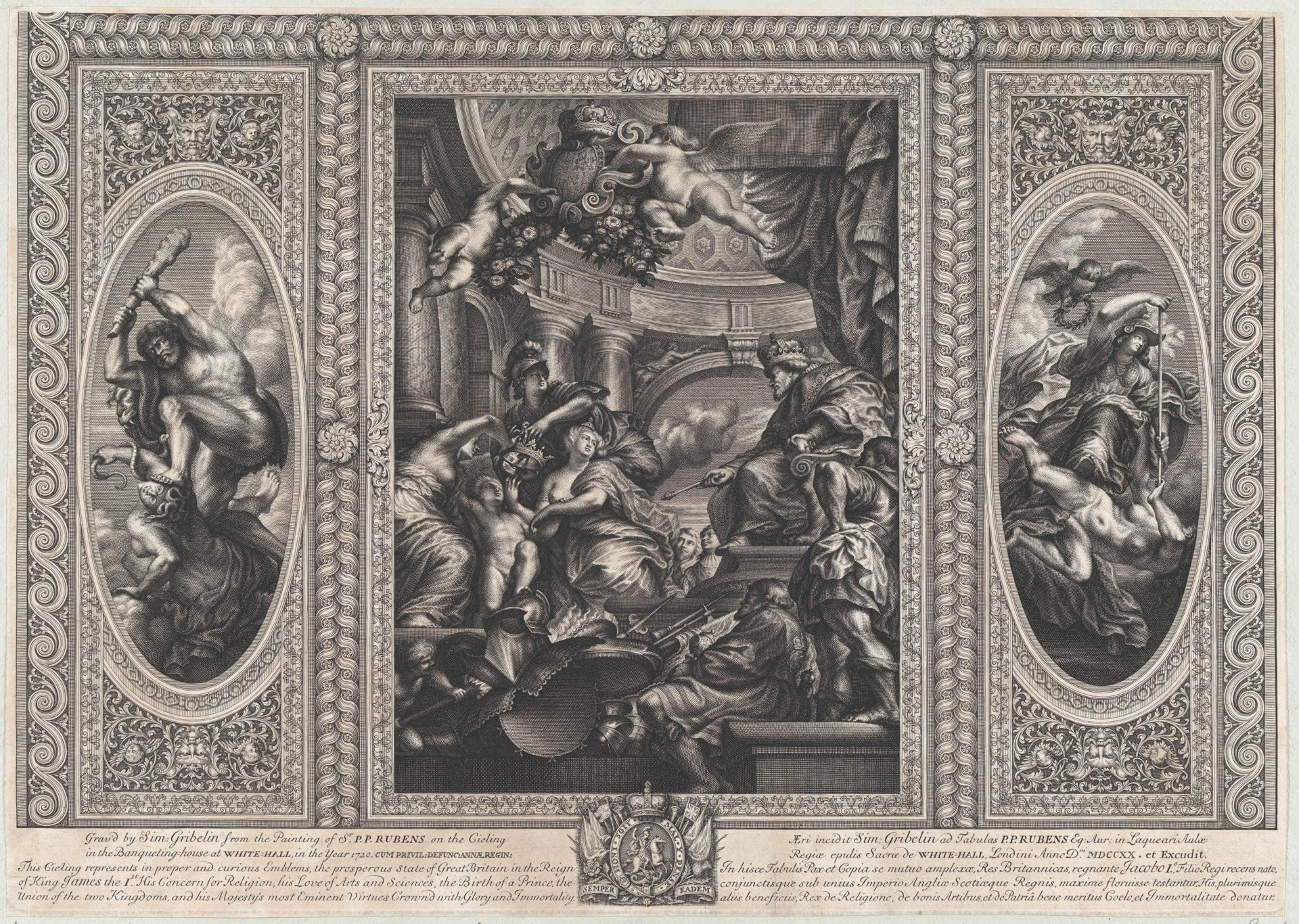
An Allegorical Scene Showing the Benefits of James' Reign at Center, Wise Government Trampling Rebellion at Right, and Liberty Trampling Avarice at Left
Original title: An allegorical scene showing the benefits of James' reign at center, Wise Government trampling Rebellion at right, and Liberty trampling Avarice at left
kurzbeschreibung
In 1720, Simon Gribelin II produced this engraving of King James I seated on a throne, surrounded by embodiments of his reign. The allegorical sheet belongs to the collection of the Metropolitan Museum of Art.
Description
The king occupies the throne at the picture's center, flanked by allegorical figures that stand for different aspects of his rule. On his left, one figure subdues Rebellion, while Liberty presses Avarice to the ground. The setting feels opulent: columns frame the space, and the ceiling bears a painting of angels and floral garlands. Draped in traditional robes, the figures suggest movement through their flowing fabrics. The arrangement is symmetrically focused on the monarch and enclosed by a floral border.
Context
The print dates to 1720, roughly a century after the death of James I, who reigned from 1603 to 1625. It belongs to a series of engravings Gribelin made after paintings by Peter Paul Rubens in the Banqueting House in London. The originals date to the 1630s and glorify James I's rule. Gribelin made these paintings accessible to a wider public that could not enter the royal rooms.
Impact
The symmetrical layout and the king's central position create an impression of order and authority. The precise lines and monochrome execution draw the eye to the narrative details and the allegorical figures.
Technique
The engraving is recognizable by its sharp contours and fine lines. This technique allows for an exact rendering of details and is particularly suited to reproducing complex paintings. The sheet was trimmed to 33.1 × 46.5 cm, reducing its original format.
AI-generated description text
Source: Metropolitan Museum of Art · Public Domain (CC0 1.0)