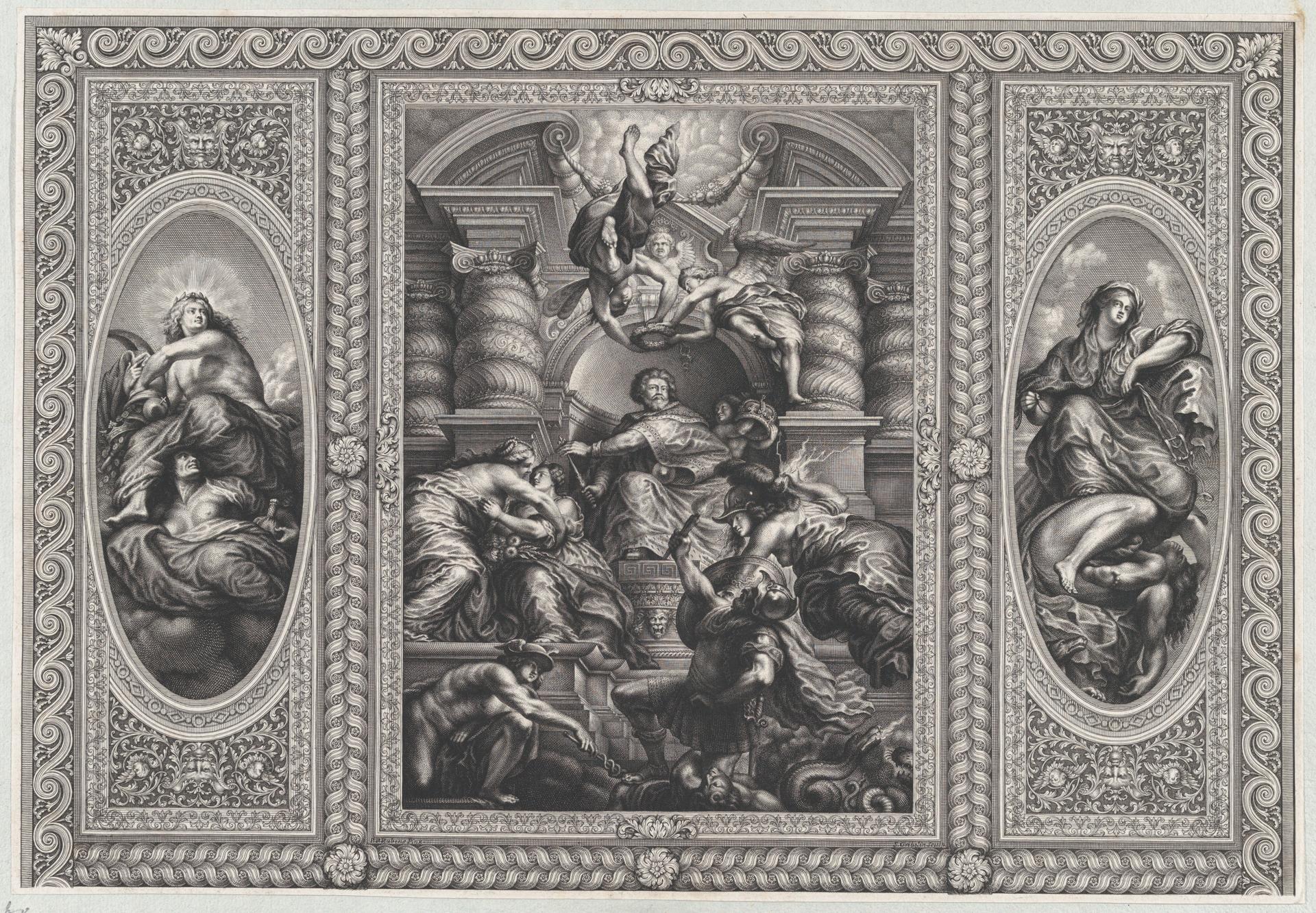
James I appointing Charles as King of Scotland at center, Minerva spearing Ignorance at right, and Hercules beating Envy at left
Original title: James I appointing Charles as King of Scotland at center, Minerva spearing Ignorance at right, and Hercules beating Envy at left
kurzbeschreibung
King James I of England and Scotland appoints his son Charles as King of Scotland, as shown in this 1720 engraving by Simon Gribelin II. The black-and-white print combines history painting with mythological elements.
Description
Men in a palace engage in a fierce, almost chaotic confrontation. In the upper left, Minerva thrusts her spear into personified Ignorance, while in the upper right, Hercules strikes Envy with a hammer. Two oval panels flank the central block of action, creating a symmetrical layout. The figures assume dramatic poses, suggesting intense drama. Color is entirely absent, and the light is evenly distributed.
Context
Simon Gribelin II came from France and worked as an engraver in London, where he became known mainly for reproductive prints. This sheet was made in 1720, when allegorical representations glorifying the monarchy were widespread. It refers to the Scottish succession: James I (1566–1625) appointed his son Charles—the future Charles I—as King of Scotland. Such prints often served political propaganda or documented historical events.
Impact
The symmetrical division and the mythological flanking figures create an atmosphere that is both celebratory and charged with tension. The detailed engraving and strong contrasts draw the eye to the central event, while the allegorical figures open a moral interpretive layer. Overall, the sheet feels representative and underscores the divine legitimacy of the monarchy.
Technique
For this engraving, lines were incised into a copper plate and then printed. The precisely placed lines allow for high detail in figures and architecture. The use of only black and white, with evenly distributed light, follows the conventions of this printing technique.
AI-generated description text
Source: Metropolitan Museum of Art · Public Domain (CC0 1.0)