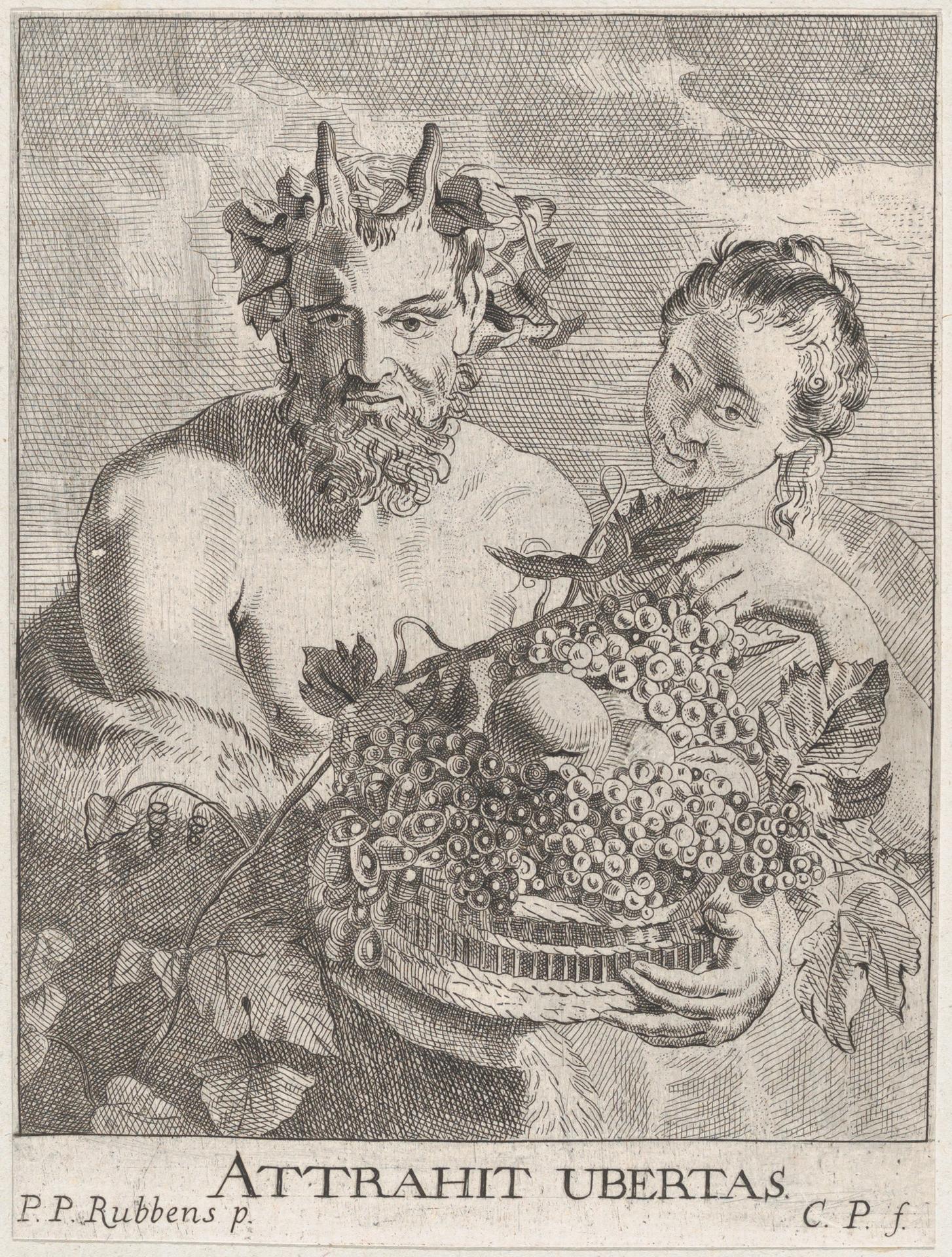
Satyr and Bacchante (ca. 1650–67)
Original title: Satyr and Bacchante
kurzbeschreibung
Cornelis van Poelenburch made this etching between about 1650 and 1667. Unlike many contemporary prints on the same theme, it presents a mythological couple within a landscape, using etching as its medium.
Description
On the left stands a satyr wearing a wreath of leaves, with a beard and hair tied in a braid, barefoot. Beside him on the right is a bacchante in a dress; she holds a basket with grapes and leaves, her hair gathered in a knot. Abstract lines and strokes in the background suggest a natural setting. Along the bottom edge are the inscriptions “ATTRAHIT UBERTAS”, “P.P. Rubbens p.” and “C. P. f.”
Context
The Dutchman Cornelis van Poelenburch worked in the seventeenth century as a painter and etcher and was valued for small-scale landscapes with mythological figures. As the inscription “P.P. Rubbens p.” indicates, a design by Peter Paul Rubens served as the basis. This print belongs to the late phase of Poelenburch's career, roughly the years 1650 to 1667.
Impact
The etching sets a calm, idyllic landscape alongside the clearly present group of figures, creating a contemplative mood. Delicate lines and a clear structure give the sheet an elegant, classical feel characteristic of Dutch art of the Golden Age.
Technique
For this etching, lines were bitten into a copper plate and then printed. This process allows fine, precise strokes, used here to render figures and landscape. The trimmed sheet measures 23 × 16.4 cm.
AI-generated description text
Source: Metropolitan Museum of Art · Public Domain (CC0 1.0)