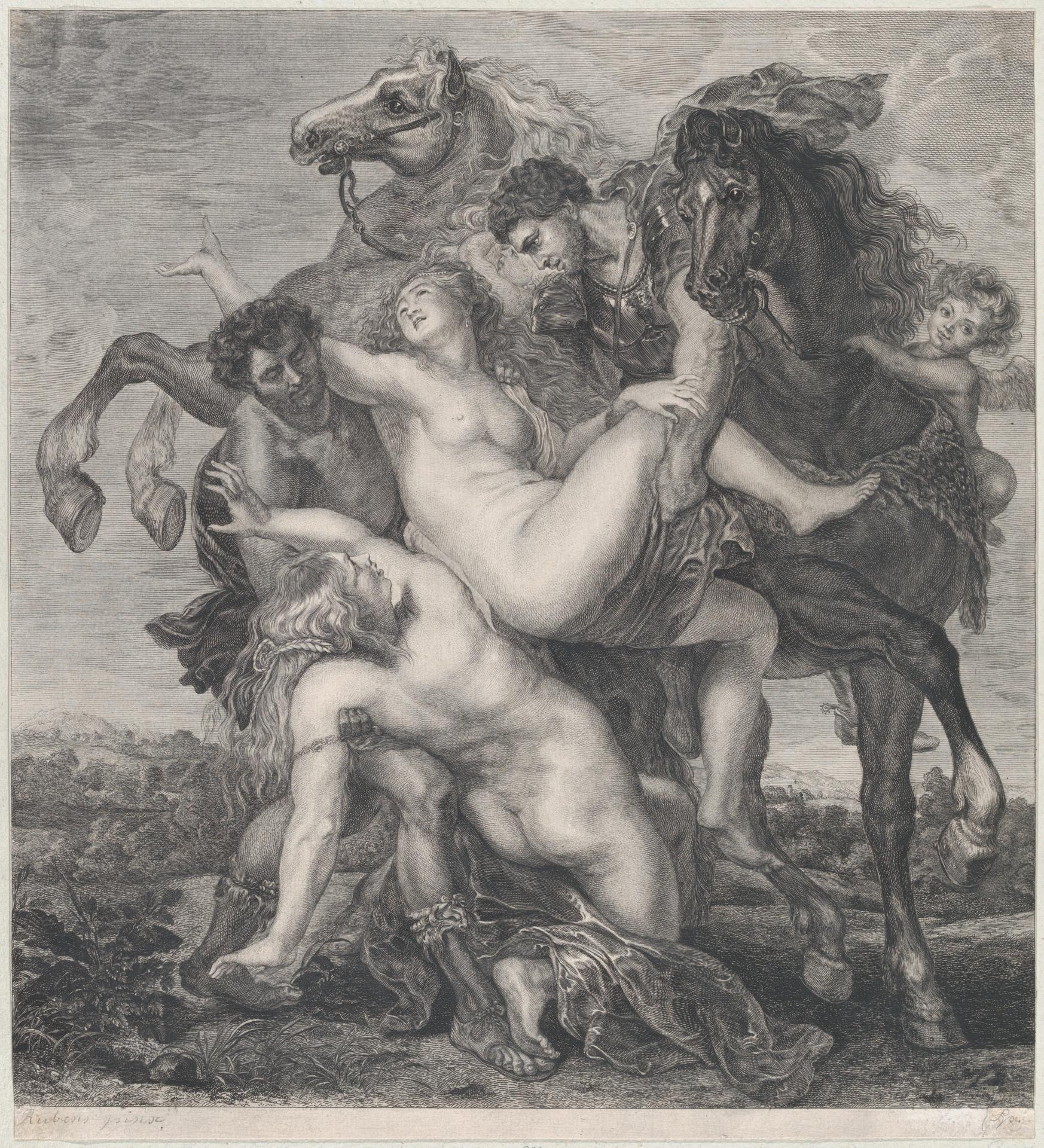
Phoebe and Hilaeria, the daughters of Leucippus, being abducted by Castor and Pollux (ca. 1750–1800)
Original title: Phoebe and Hilaeria, the daughters of Leucippus, being abducted by Castor and Pollux
kurzbeschreibung
This engraving from around 1750–1800, by an unknown artist, depicts the Dioscuri Castor and Pollux abducting the Leucippides Phoebe and Hilaeria. Executed as a black-and-white print in portrait format, the sheet belongs to the tradition of mythological reproductive graphics.
Description
In the foreground, two strong, barely clothed men lean over a woman who tries to fend them off with raised arms. The bodies are dynamic and full of drama, their outlines clearly drawn. Behind the figures, two horses move restlessly, heightening the tense atmosphere. A simple landscape with trees and a cloudy sky completes the scene, less precisely rendered than the figures.
Context
The etching dates from the late 18th century, when mythological subjects were very common in art. It probably derives from a painting by Peter Paul Rubens of the same scene, which became known through reproductive engravings. The anonymous engraver joins the ranks of those artists who multiplied such models for a broad public.
Impact
The intersecting lines of the bodies and the rearing horses create strong tension. Clear lines and bold shadows make the scene appear dramatic, even theatrical.
Technique
The copper engraving brings out the muscles and movements in rich detail through sharp, precise lines and fine hatching. In this process, the lines are incised into a copper plate and then printed. The present example has been trimmed to a sheet of 40.3 × 36.5 cm.
AI-generated description text
Source: Metropolitan Museum of Art · Public Domain (CC0 1.0)