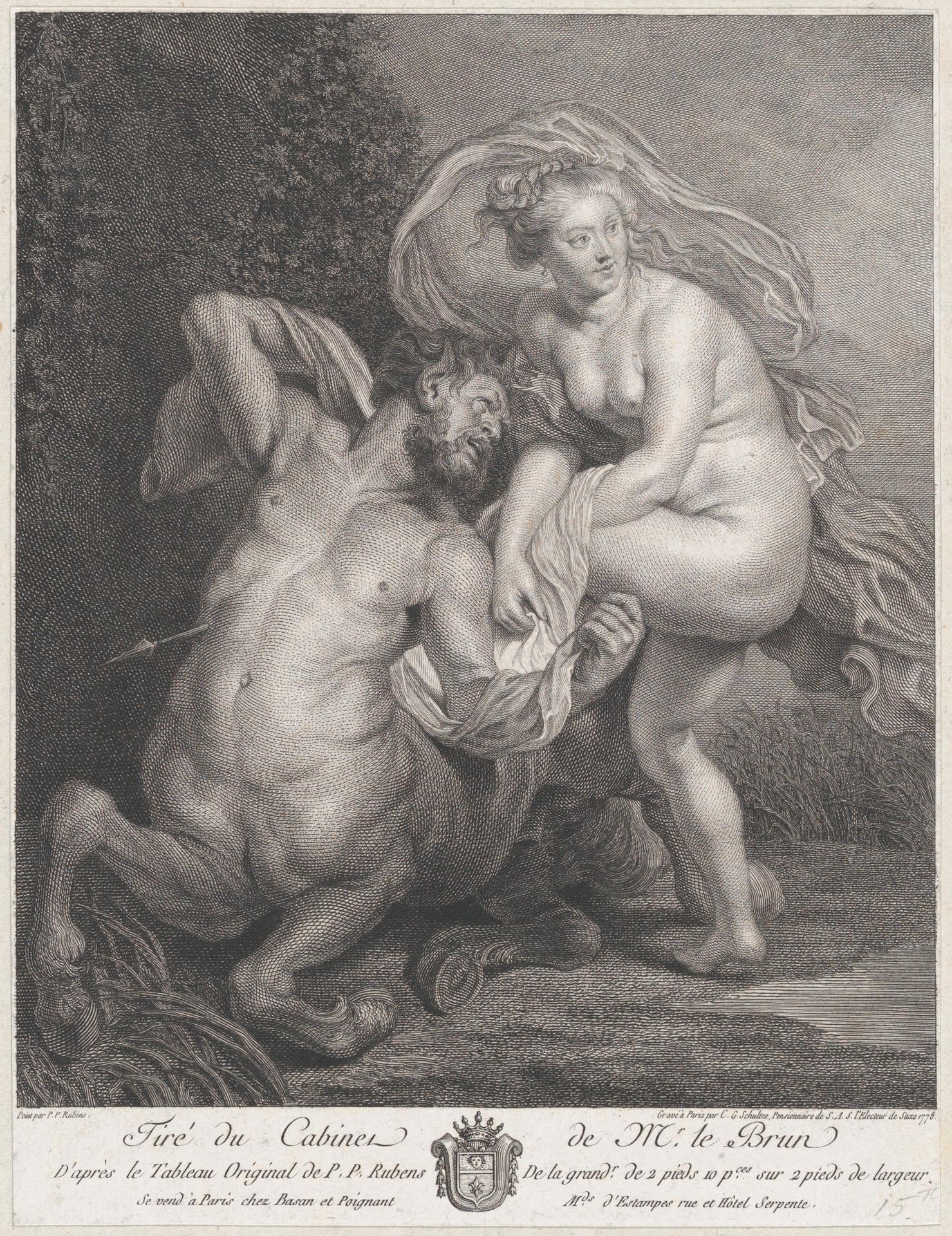
Deianeira receiving the poisoned tunic from Nessus, and the wounded centaur falling to the ground at left (1778)
Original title: Deianeira receiving the poisoned tunic from Nessus, and the wounded centaur falling to the ground at left
kurzbeschreibung
Christian Gottfried Schultze produced this engraving in 1778, capturing the instant Deianeira accepts the poisoned garment from the dying centaur Nessus. The print renders the centaur's final, fatal moment.
Description
Deianeira clutches the robe and turns away from the centaur sprawled on the ground. Nessus, wounded, wears a face twisted with pain and despair. Trees and shrubs enclose the figures in a natural setting. The arrangement suggests movement and draws the eye to the exchange between the two. Monochrome and muted lighting deepen the somber mood.
Context
The engraving appeared in 1778, when Greek mythology enjoyed great popularity in art. Christian Gottfried Schultze was a German artist who made his name primarily through printmaking. The sheet takes up a tale from Ovid's Metamorphoses: Nessus hands Deianeira a garment soaked in the centaur's blood, which later kills Heracles.
Impact
The sharp contrast of light and shadow summons an ominous, tragic atmosphere. The centaur's expressive features and Deianeira's averted stance create an emotional tension that holds the viewer. The detailed execution makes the dramatic sequence of events vividly clear.
Technique
For this engraving, the drawing was incised into a metal plate and etched with acid. The subsequent printing yields fine lines and shadings that precisely render the surfaces of figures and background. The monochrome tonality is typical of the process and emphasizes the graphic impact of the sheet.
AI-generated description text
Source: Metropolitan Museum of Art · Public Domain (CC0 1.0)