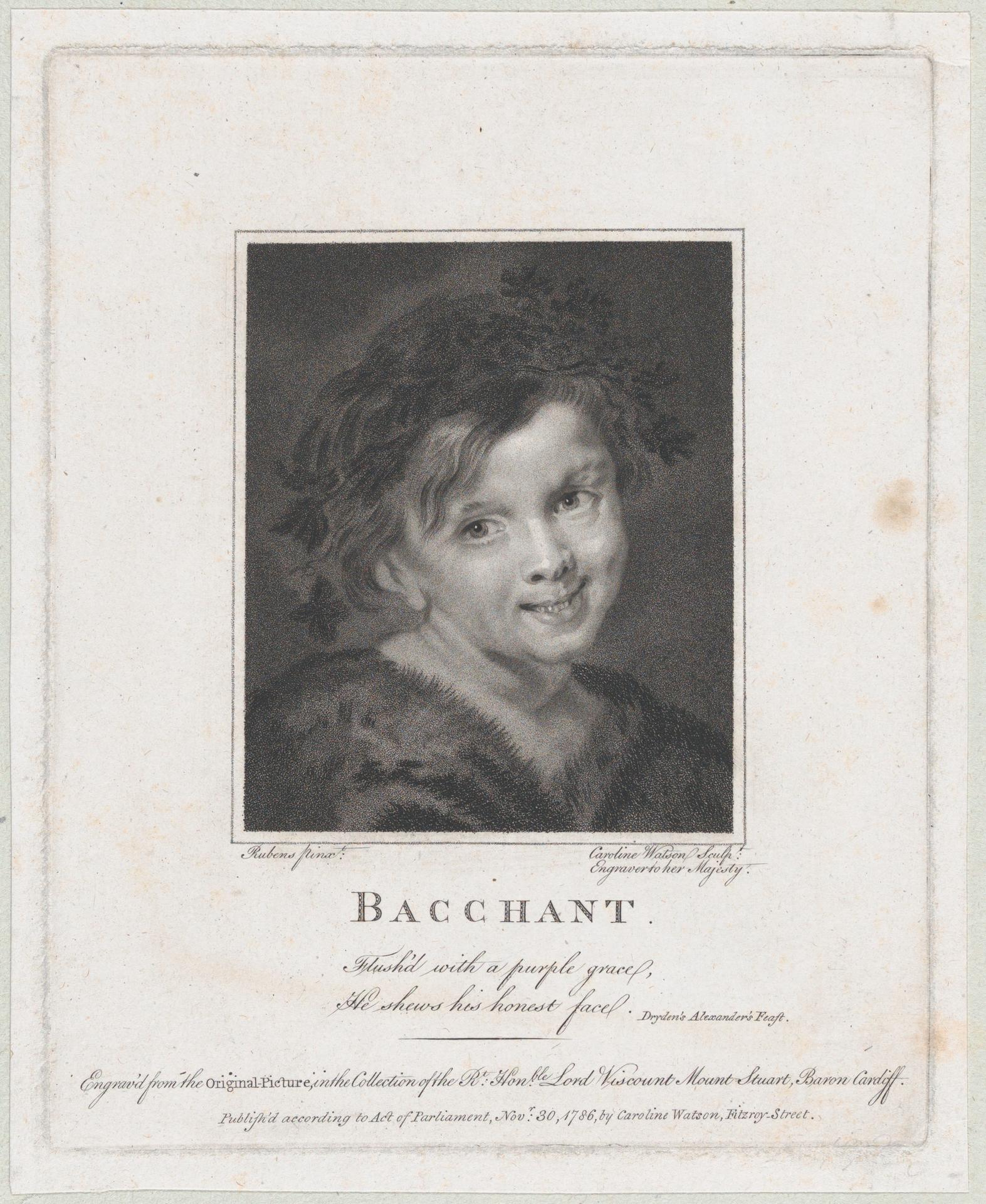
Young Bacchus
Original title: Young Bacchus
kurzbeschreibung
Caroline Watson's 1786 stipple engraving 'Junger Bacchus' presents a child in the guise of a Bacchant. Executed as a dotted engraving on paper, it offers a frontal bust adorned with a wreath of leaves and fur-like clothing.
Description
A child's face meets the viewer's gaze, crowned with leaves and wrapped in a garment that suggests animal skin. The features are finely worked and lively, the smile restrained. A dark ground makes the figure stand out. The arrangement is centrally aligned, the view frontal. Soft light models contours and surfaces.
Context
The Englishwoman Caroline Watson worked as a copperplate engraver in the late 18th century, producing portraits and mythological scenes after others' designs. Her 'Junger Bacchus' dates from 1786, when stipple technique was spreading widely in England. Child Bacchus figures were a common motif in the 18th century, often used allegorically or decoratively.
Impact
From the first glance, the gentle gradation of dots captivates, lending the face a fragile quality. The bright flesh tones stand out clearly against the dark ground, creating a closeness that seems almost vulnerable. The precisely placed stipples remain perceptible throughout.
Technique
As a stipple engraving, the image is built from tiny dots and short strokes. This produces soft transitions and a nuanced rendering of skin and fabric. Printing was done on paper; the plate measures approximately 20.3 × 16.2 cm.
AI-generated description text
Source: Metropolitan Museum of Art · Public Domain (CC0 1.0)