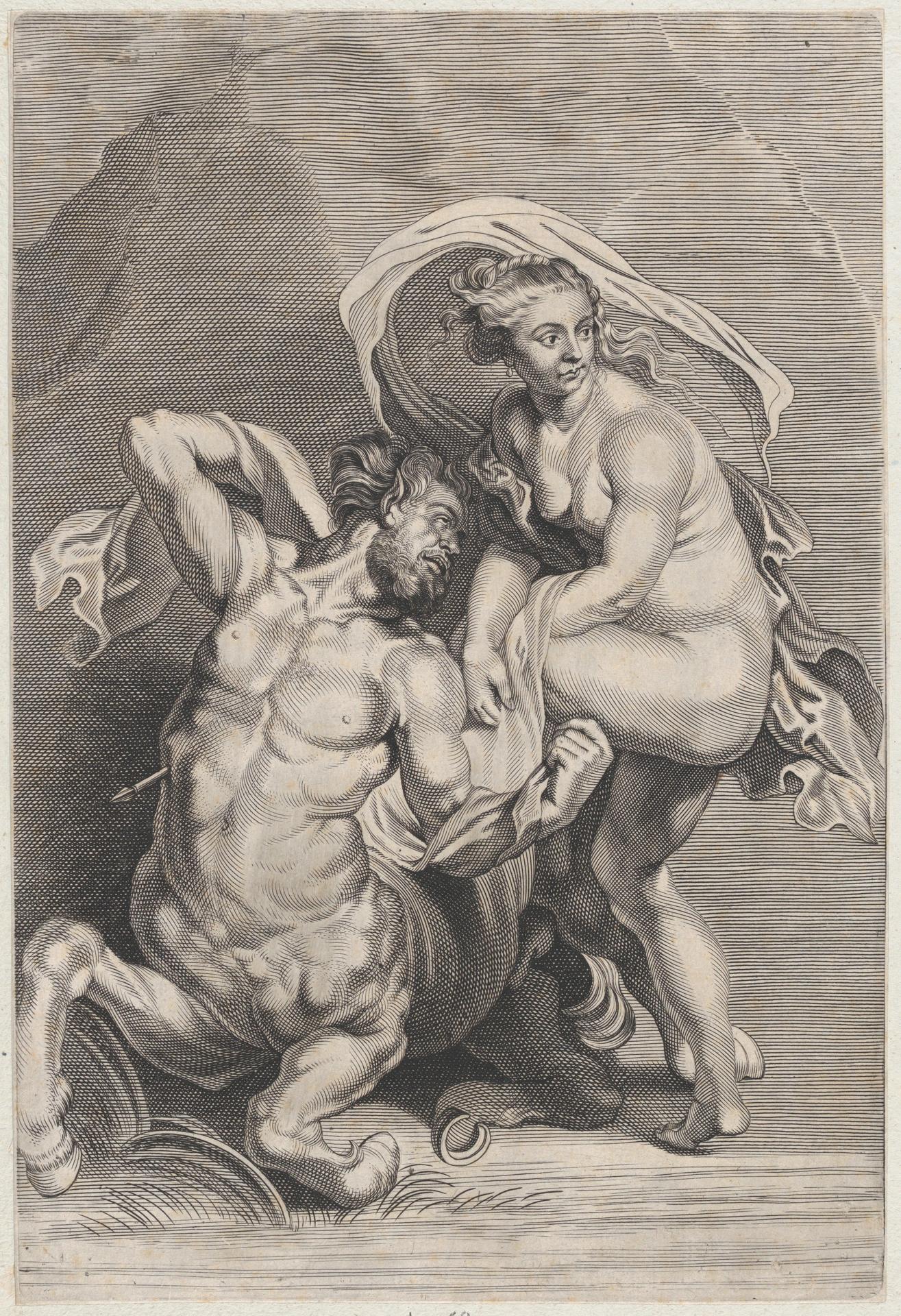
Deianeira receiving the poisoned tunic from Nessus, and the wounded centaur falling to the ground at left (ca. 1650–1700)
Original title: Deianeira receiving the poisoned tunic from Nessus, and the wounded centaur falling to the ground at left
kurzbeschreibung
Made between roughly 1650 and 1700, this anonymous engraving captures the instant Deianeira accepts the poisoned garment from the dying centaur Nessus. While the handover takes place on the right side of the image, the wounded Nessus collapses to the ground on the left.
Description
In the right foreground Deianeira stands holding the cloth; on the left the stricken centaur Nessus falls. The figures are arranged in a tense grouping that heightens the drama of the moment. The setting remains bare and recedes behind the action. The greys and hatching of the monochrome print model light and shadow with pronounced contrast.
Context
The engraving draws on a tale from Greek myth: the centaur Nessus assaults Deianeira, wife of Heracles, and is killed by him. Dying, Nessus advises Deianeira to use his blood as a love charm, which later brings about Heracles' death. Such mythological subjects were widespread in the printmaking of the period, whether as part of a series or as single sheets. Nothing is recorded about the anonymous engraver, a common situation for prints of this era.
Impact
The strong contrast of light and dark gives the sheet a dramatic, emotionally charged intensity. The figures' animated poses create immediate tension and draw the viewer into the decisive moment.
Technique
For the engraving, lines were cut into a metal plate and then printed. The monochrome rendering with nuanced shading corresponds to the usual etching technique, in which fine tonal gradations are produced by etching or engraving.
AI-generated description text
Source: Metropolitan Museum of Art · Public Domain (CC0 1.0)