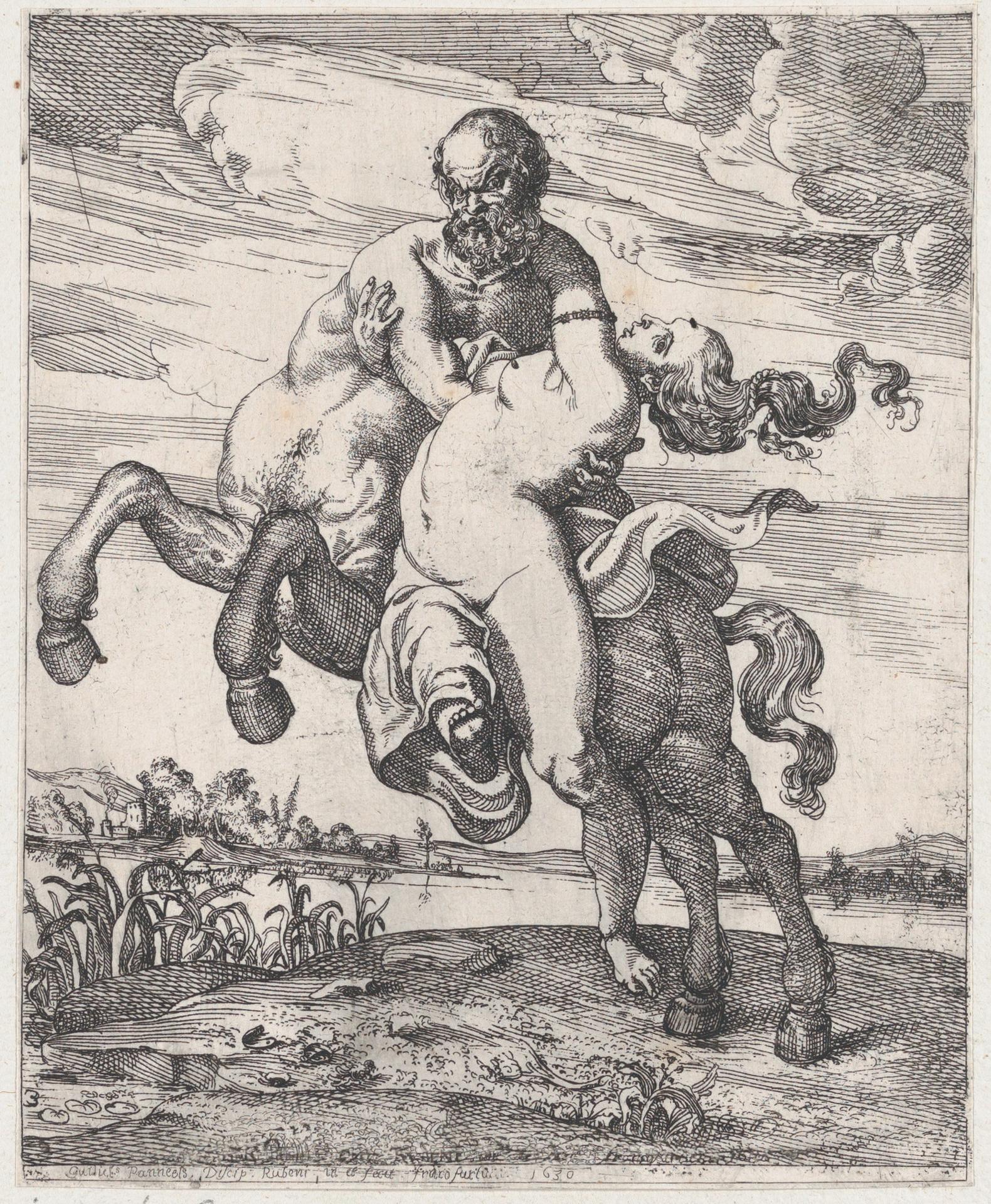
Nessos abducting Deianira
Original title: Nessos abducting Deianira
kurzbeschreibung
Willem Panneels's 1630 etching Nessos Abducting Deianira treats the ancient myth of the centaur Nessos carrying off Deianira. Unlike many contemporary prints that set the moment of flight within a broad landscape, Panneels pushes the figures tightly together and draws the viewer straight into the action. This small-format print is a characteristic example of seventeenth-century etching.
Description
In the foreground, the gigantic Nessos lifts Deianira high, while she looks downward with a gesture of terror. Her hair blows in the wind, heightening the agitation of the moment. Behind them, a landscape with trees opens under a cloudy sky. The arrangement is restless and emphasizes the giant's force; the monochrome etching models light and shadow solely through hatching and cross-hatching.
Context
The Fleming Willem Panneels, active as an engraver and painter, etched this sheet in 1630 and at times worked in the workshop of Peter Paul Rubens. The subject comes from Greek mythology and was frequently used in the Baroque period. The paper, trimmed to 16.8 × 13.5 cm, may later have served as an illustration.
Impact
The exaggerated proportions and dramatic gestures create an intense, almost theatrical tension. Nessos's movement and Deianira's despair elicit immediate emotional involvement from the viewer. The clear line and precise graphic touch give the sheet a matter-of-fact determination.
Technique
For this etching, the drawing was scratched into a copper plate and then bitten with acid. The process allows fine, graduated lines and nuanced shading. It was printed with black ink on paper; afterward, the sheet was trimmed to the dimensions given.
AI-generated description text
Source: Metropolitan Museum of Art · Public Domain (CC0 1.0)