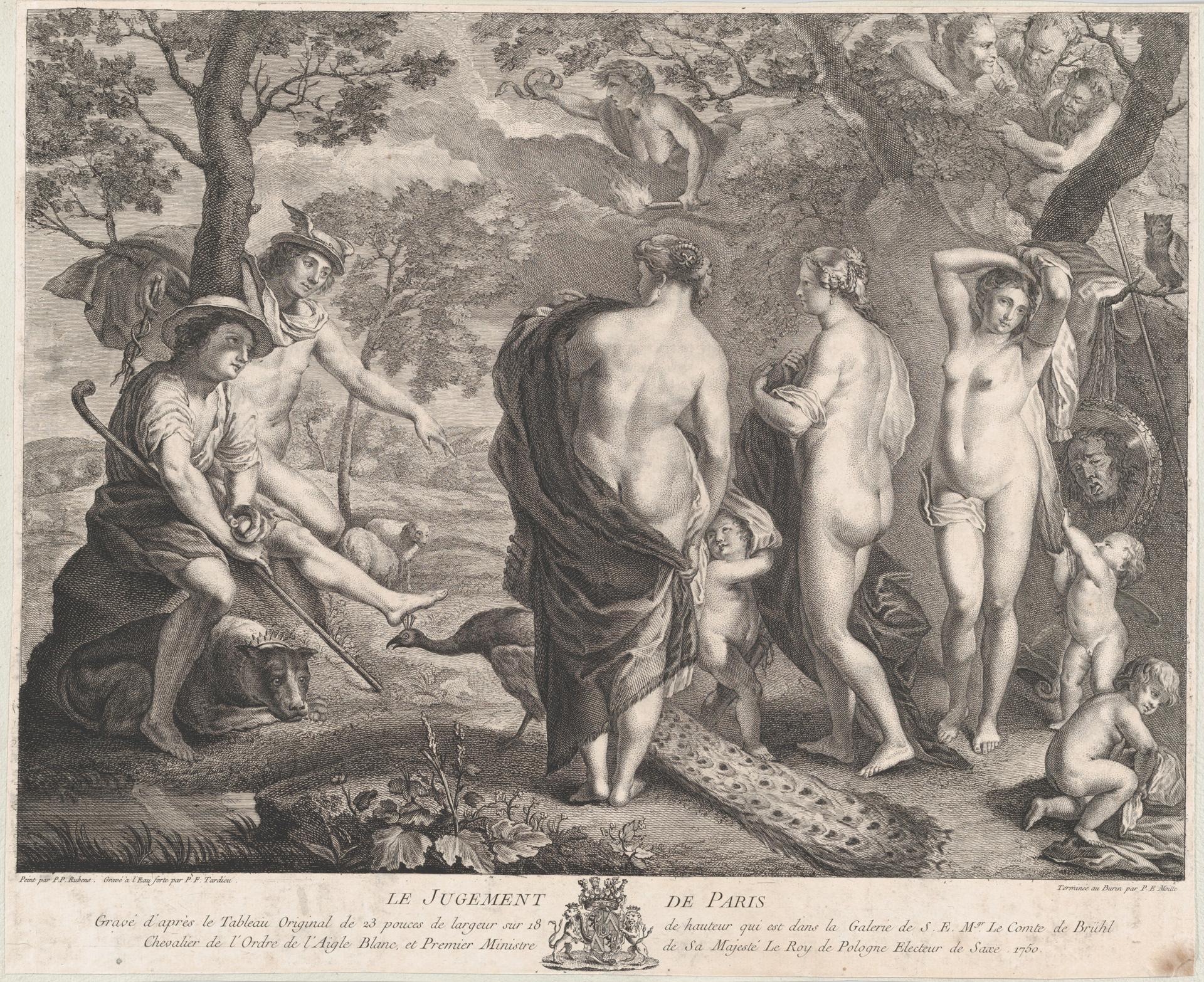
The Judgment of Paris (1750)
Original title: The Judgment of Paris
kurzbeschreibung
Made in 1750, Pierre François Tardieu's engraving 'The Judgment of Paris' brings the ancient myth to life, showing Paris awarding the apple to the fairest goddess. The print was executed as an etching and engraving on paper.
Description
Paris, barefoot and wearing a tunic held by a sash, forms the pivot of the image. His gaze is fixed on the three nude goddesses, partly draped in cloths. Aphrodite holds the apple, while Athena and Hera raise their arms to argue their cases. A satyr with an instrument and several putti populate the background. Trees and a wide landscape frame the rural event.
Context
The Judgment of Paris ranked among the most sought-after mythological subjects of the 18th century. Tardieu, a French engraver, was prized for his exact reproductions. His print of 1750 falls in a period when printmaking in France enjoyed a boom.
Impact
Delicate lines and a calm, symmetrical layout define the sheet. The even distribution of light brings the figures and their interaction to the fore. Varied gray tones give the work a classical elegance.
Technique
Etching and engraving were both used for this work. Both techniques allow high fidelity to detail and nuanced shading. It was printed on paper; the trimmed sheet measures 40.5 × 49.5 cm.
AI-generated description text
Source: Metropolitan Museum of Art · Public Domain (CC0 1.0)