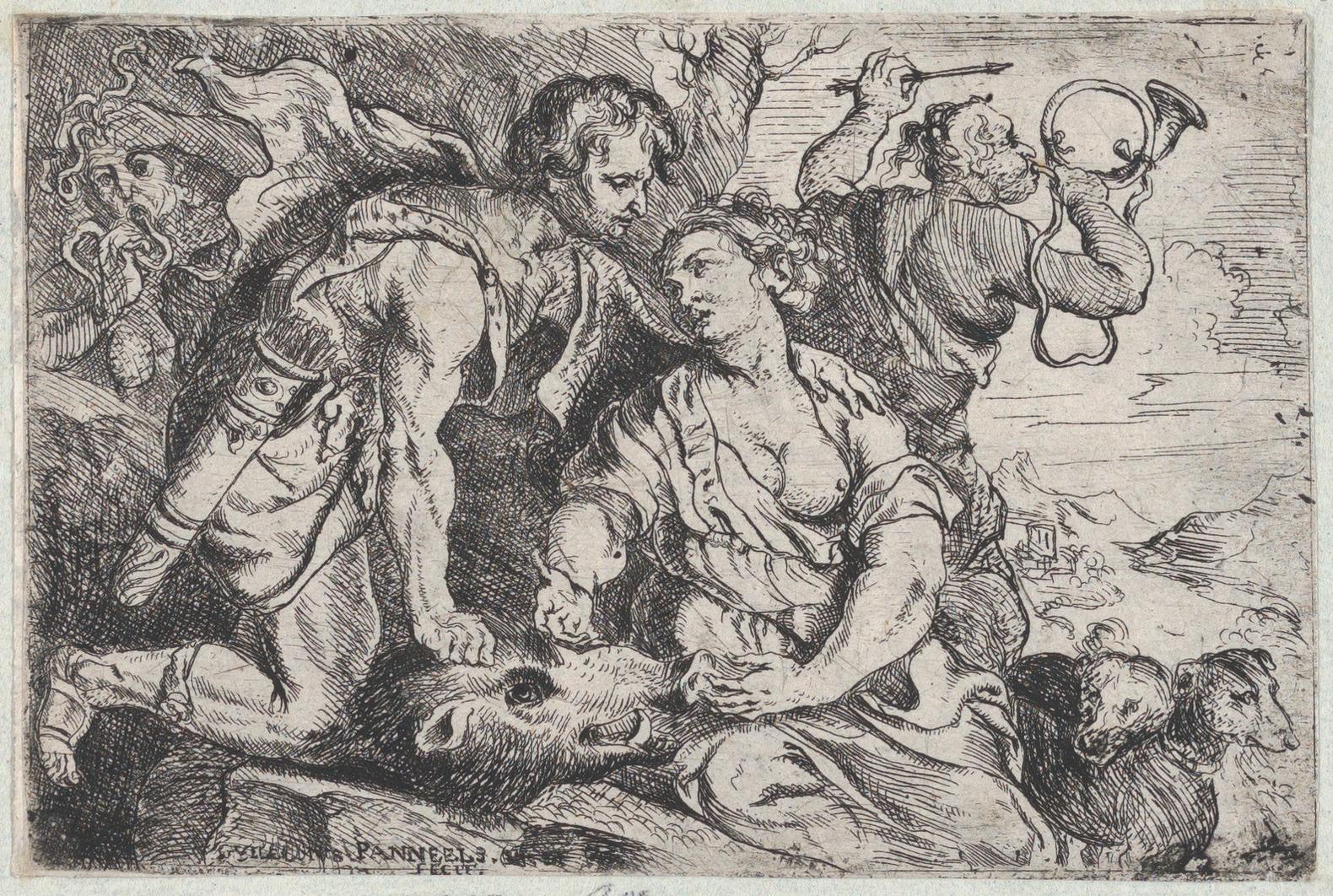
Atalanta and Meleager (ca. 1631)
Original title: Atalanta and Meleager
kurzbeschreibung
Around 1631, Willem Panneels made an etching of the encounter between Atalanta and Meleager, a motif from Greek myth. The print exists in two states; this is the first (Hollstein).
Description
Atalanta kneels forward on the ground, her hair in short curls, a long robe, her arms twisted as if she is suffering pain or despair. Behind her stands Meleager in armor with a shield; one hand holds her, the other gently touches her face. Other figures appear to the sides: on the left, one with long wavy hair who flees or moves; on the right, one with a hunting horn. The arrangement is restless and tense, with harsh contrasts of light and dark.
Context
Panneels, a Flemish artist and pupil of Peter Paul Rubens, worked in Rubens's studio between 1626 and 1630. The etching was made around 1631, probably after a model from Rubens's circle. The subject comes from Ovid's Metamorphoses and was common in the Baroque era. Panneels produced numerous etchings, often as reproductive prints.
Impact
The staging is dramatic, the emotions intensely captured. Strong contrasts and animated lines give the sheet immediate expressive power. Despite its small size, the work achieves considerable depth and tension.
Technique
For the etching, lines were scratched into an etched metal plate and then printed on paper. Shading and contours are precise and detailed, as is typical of the process. The sheet is trimmed and measures 8.7 × 13.1 cm.
AI-generated description text
Source: Metropolitan Museum of Art · Public Domain (CC0 1.0)