The Judgment of Paris (1786–1808)
Original title: The Judgment of Paris
kurzbeschreibung
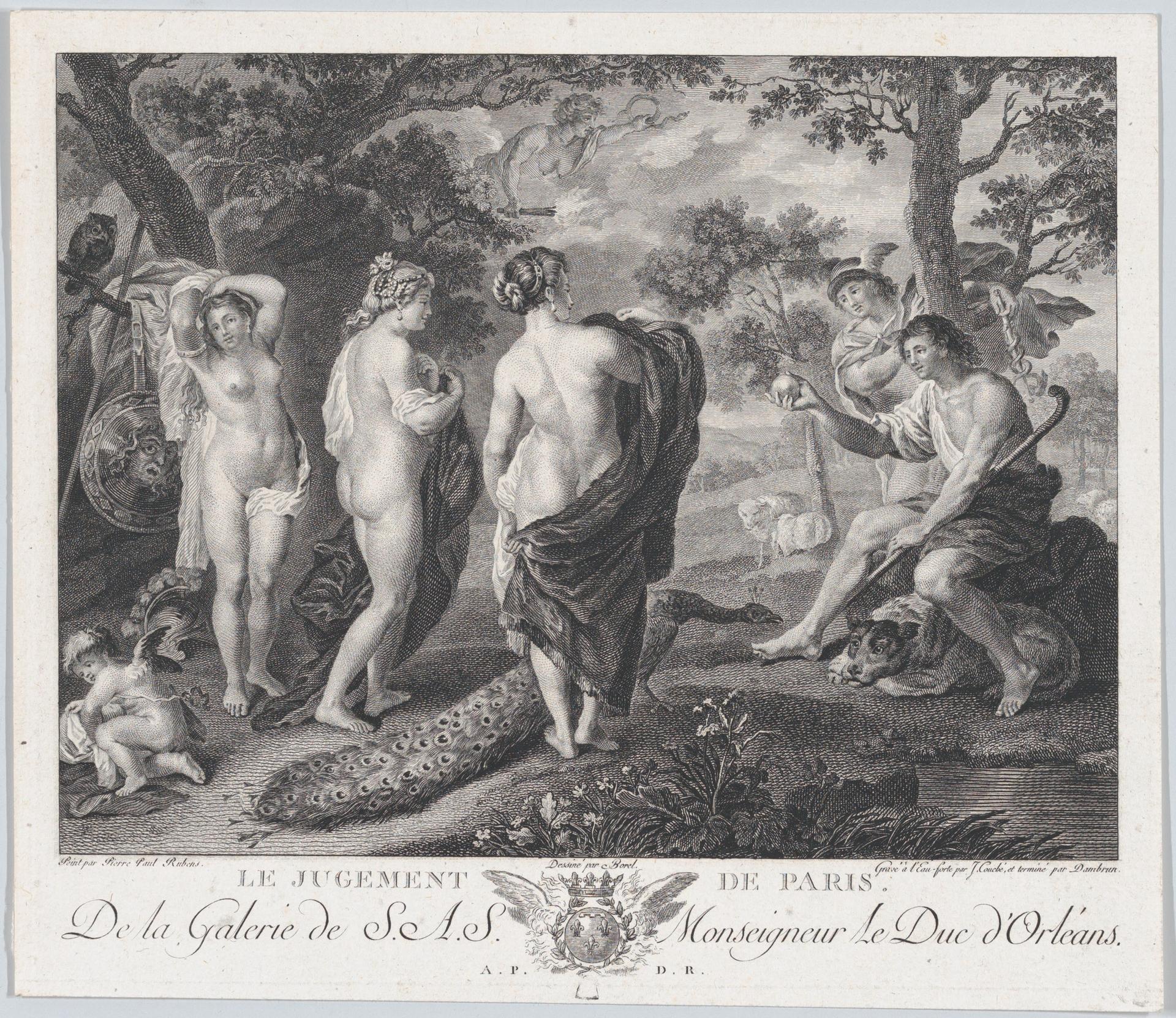
Unlike many contemporary versions of the Judgment of Paris, Jacques Couché's etching and engraving from 1786 to 1808 focuses on the encounter itself: a seated Paris holds a child in his arms while the three goddesses approach him. This monochrome print belongs to mythological reproductive graphics and conveys the scene with clear lines.
Description
Three female figures, some nude and some lightly draped, turn toward Paris. He sits on a rock, wears simple clothing, and cradles a child. Behind them, a landscape with trees and a river unfolds; above Paris, a small angel is visible. Inscriptions and a coat of arms at the bottom point to the collection of the Duc d'Orléans.
Context
The print was made in the late 18th century and is part of printmaking. It was based on a work from the gallery of the Duc d'Orléans, a significant French art collection at the time. Jacques Couché worked as an engraver and often transferred paintings by renowned masters into print to make them accessible to a wider audience.
Impact
The balanced layout and the calm posture of the figures give the sheet a classical, harmonious character. Fine linework and graduated gray tones create a clearly contoured, detailed surface that invites close looking.
Technique
Etching and engraving combined allow for precise lines and nuanced shading. This method was common in the 18th century for reproductive prints, which reproduced paintings as prints.
AI-generated description text
Source: Metropolitan Museum of Art · Public Domain (CC0 1.0)