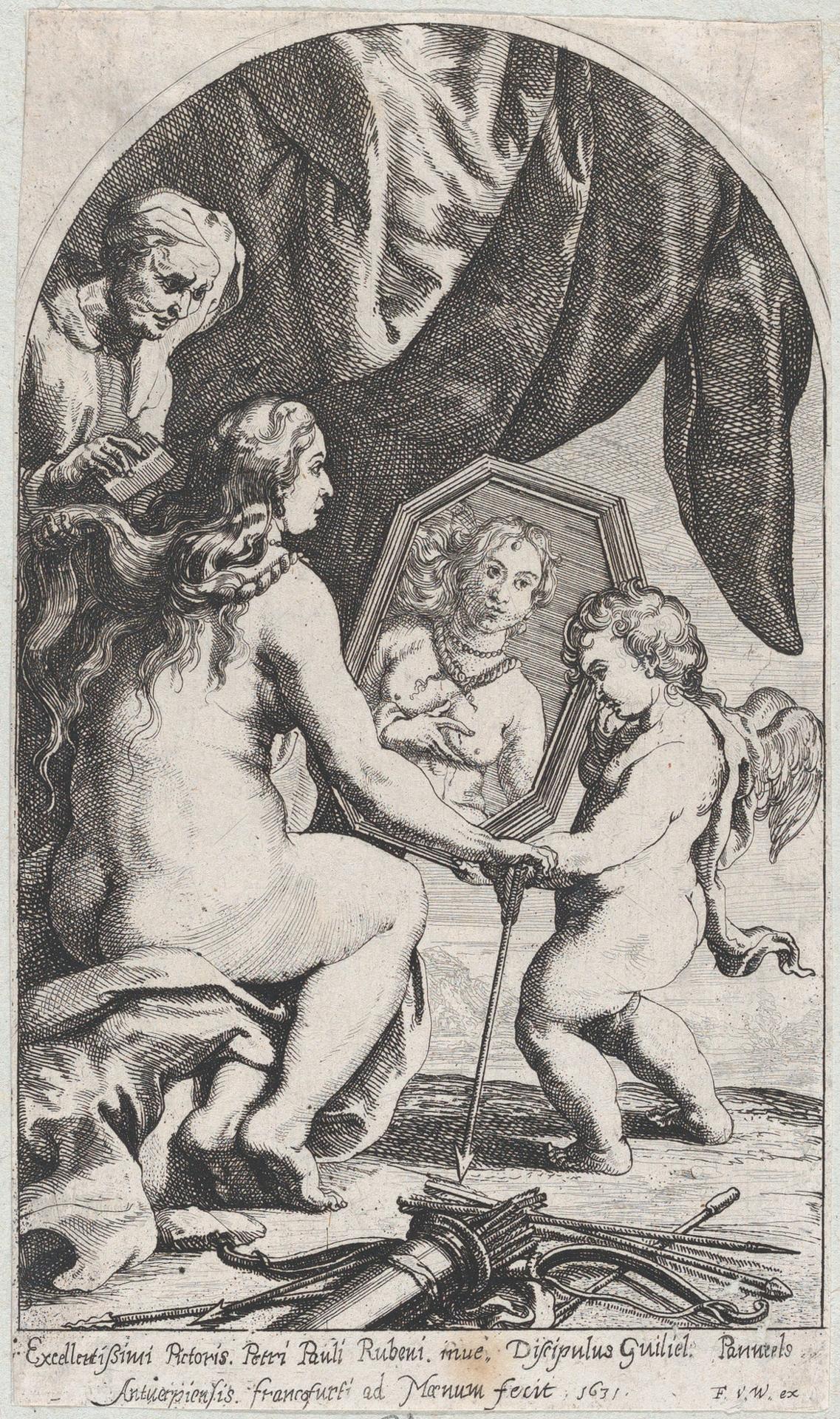
Venus before a mirror held by Cupid while her hair is combed by an old woman
Original title: Venus before a mirror held by Cupid while her hair is combed by an old woman
kurzbeschreibung
This etching by Willem Panneels dates to 1631. It presents a naked Venus seated on a chair, her gaze fixed on a mirror. An old woman combs her hair, while two putti hold the mirror and peer into it. The print is the second of two states (Hollstein).
Description
A symmetrical layout dominates: Venus sits enthroned at the center, flanked left and right by the putti with the mirror. Behind her stands the old woman, combing the long hair. In the foreground on the ground lies a bundle of styluses or brushes. The background remains spare, with a cloth or curtain framing the mirror. The etching is monochrome; delicate lines and hatching build light and shadow.
Context
Willem Panneels, a Flemish artist of the first half of the seventeenth century, made this print in 1631—a time when mythological subjects were in demand for printmaking. He may have been a pupil of Peter Paul Rubens, which could account for his classical style. Venus before the mirror was among the common themes of the Renaissance and Baroque.
Impact
The symmetrical arrangement and fine linework give the print balance and calm. The naked Venus together with the putti creates an intimate yet detached mood. Shading adds depth and emphasizes the figures' physicality.
Technique
In etching, lines are scratched into an acid-resistant ground and then bitten by acid. This produces fine, precise strokes and soft tonal gradations. The print is trimmed to a sheet of 16.5 × 9.7 cm, suggesting a compact, detailed rendering.
AI-generated description text
Source: Metropolitan Museum of Art · Public Domain (CC0 1.0)