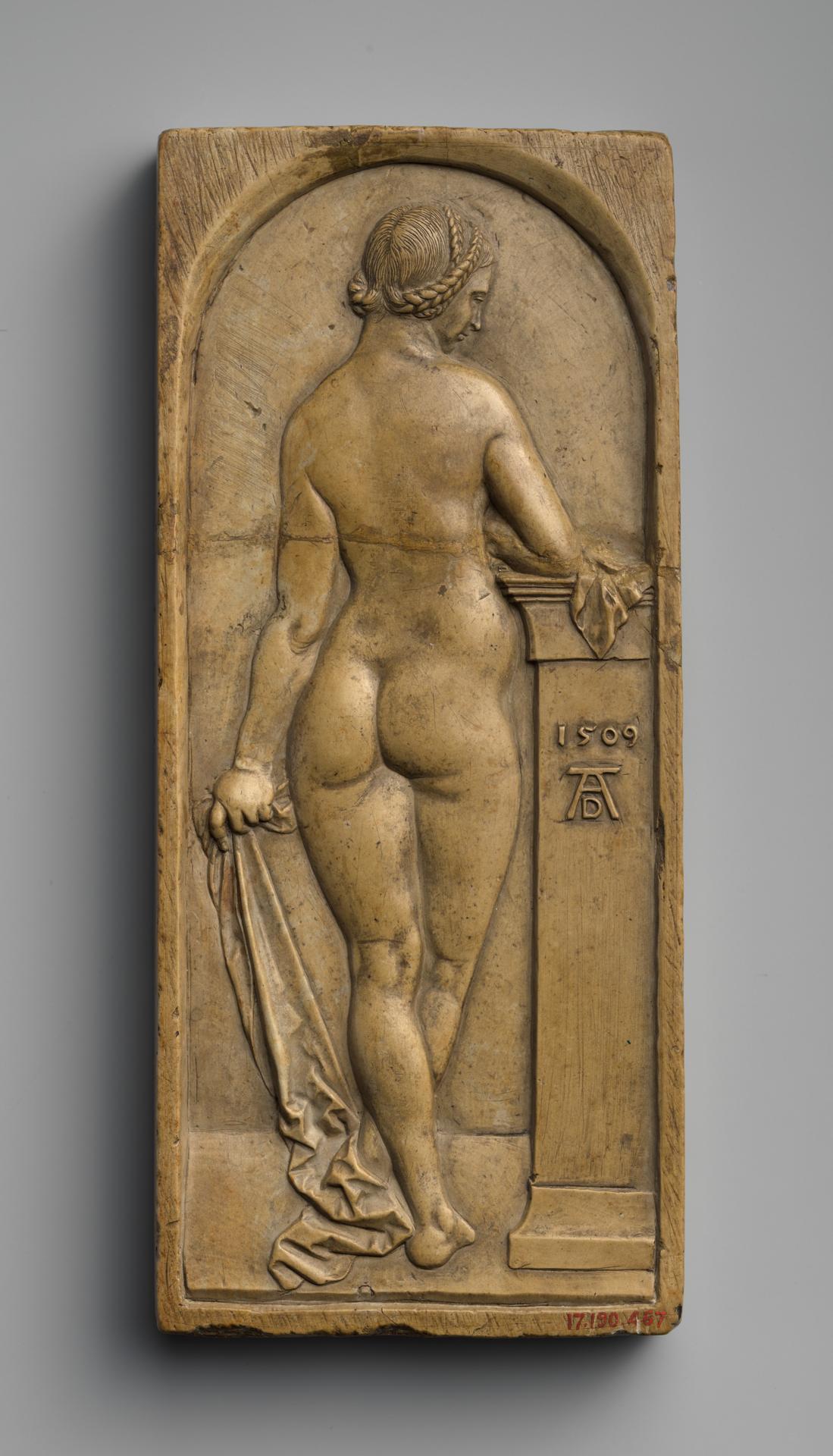
Female Nude Seen from Behind
Original title: Female Nude Seen from Behind
kurzbeschreibung
Female Nude Seen from Behind is a relief carving attributed to Albrecht Dürer, dated to the early 17th century. The work is executed in honestone and depicts a standing nude woman viewed from behind, set within an arched frame.
Description
The relief shows a woman standing upright, her back to the viewer, with her hair tied up and her face turned slightly to the right. Her right hand holds a drapery that falls to the ground, while her left hand rests on a tall rectangular pedestal engraved with the date '1509' and a monogram. The composition is vertical, with the figure occupying the left and center, and the pedestal anchoring the right side. The surface is carved in low relief with warm, earthy tones ranging from light beige to darker brown, and lighting from the upper left casts subtle shadows that emphasize the model's back, shoulders, and buttocks.
Context
Albrecht Dürer, a leading German Renaissance artist, is known for his prints and paintings, but this relief in honestone reflects a lesser-known aspect of his oeuvre. The date '1509' on the pedestal suggests a connection to Dürer's mature period, though the carving itself is dated to the early 17th century, indicating it may be a later reproduction or a work from his workshop. The classical pose and idealized anatomy echo antique sculpture, a source of inspiration for Dürer, who studied Italian art during his travels. The exact provenance and original purpose of the relief remain unclear, but it likely served as a decorative or collector's piece.
Impact
The relief imparts a sense of quiet elegance and sculptural solidity, drawing the eye along the smooth contours of the figure's back. The warm, monochromatic tones and soft lighting create an intimate, contemplative mood, while the pedestal with its date adds a hint of historical depth.
Technique
The work is carved in honestone, a type of hard, fine-grained stone, using a bas-relief technique. The artist achieved smooth, rounded forms with precise modeling of the anatomy, while the outer edge of the frame retains slight tool marks, indicating a handcrafted finish. The low relief creates subtle depth, relying on light and shadow to define the figure.
AI-generated description text
Source: Metropolitan Museum of Art · Public domain (CC0)