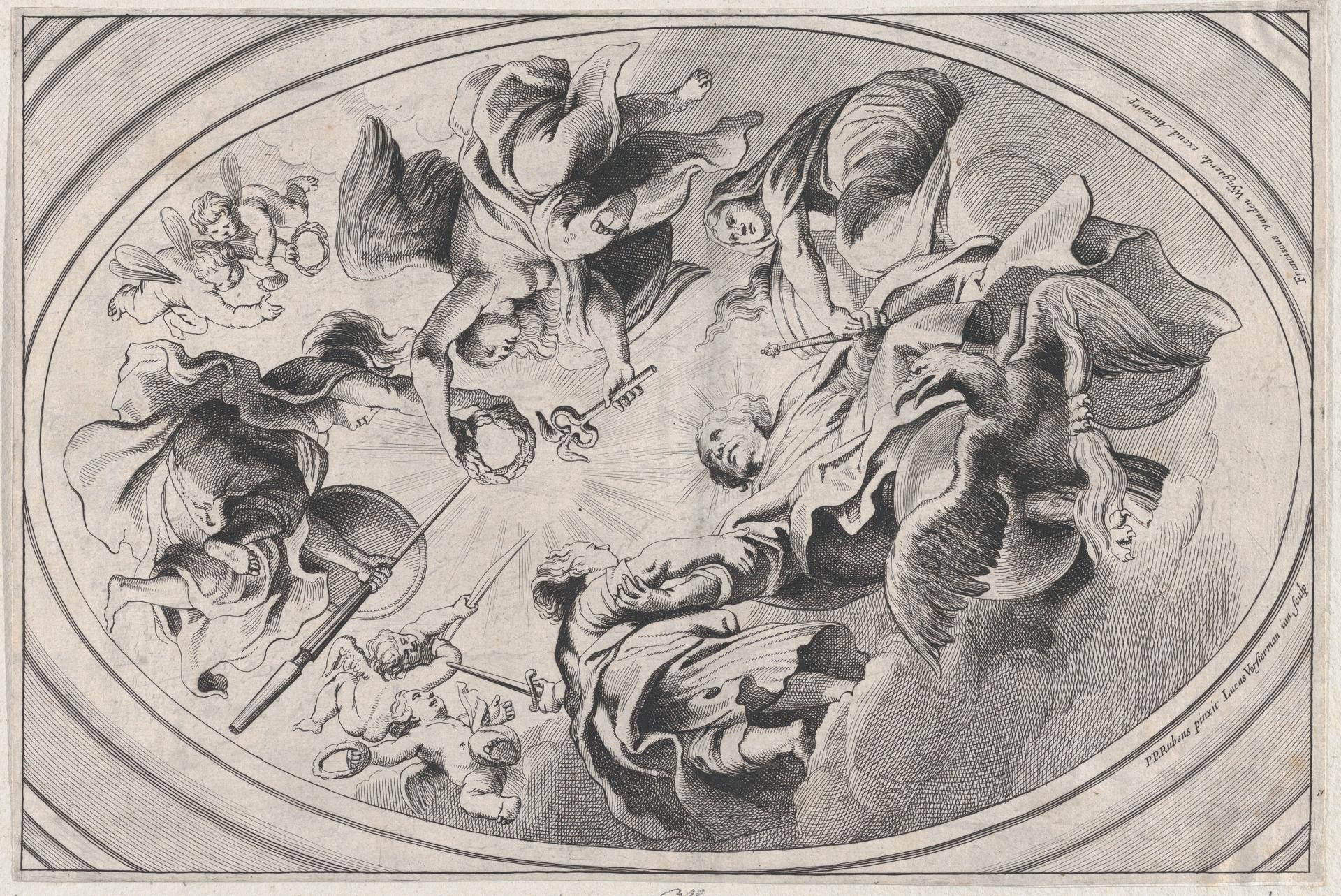
Apotheosis of James I
Original title: Apotheosis of James I, with the king seated at the bottom, an eagle below him, two angels holding a laurel above him, surrounded by putti
kurzbeschreibung
Unlike related allegories of rulers from the period, this etching by Lucas Vorsterman II places King James I of England at the lower edge and lets the sky above become the true stage. Made between 1639 and 1666, the print presents the monarch within an allegorical scene: an eagle hovers beneath him, two angels hold a laurel wreath over his head, and putti fill the space. The work belongs to the Baroque and survives as the second of three states.
Description
An unusual layout: the king sits calmly at the bottom, while above him a dynamic structure unfolds. The eagle glides below the figure, two angels float in carrying the laurel wreath, and between them putti romp in varying poses. Strong hatching creates hard contrasts of light and dark, modeling the bodies in detail; the monochrome linework builds depth and suggests movement without any need for color.
Context
Lucas Vorsterman II worked as a Flemish engraver following in his father's footsteps and specialized in reproductive prints. His sheet dates from the mid-17th century, a phase when allegorical images of rulers were widespread in printmaking. The apotheosis—the elevation of a monarch into heaven—served glorification and appeared frequently as a motif. The etching probably derives from a painting or model showing the king in divine exaltation.
Impact
The arrangement of the figures and the harsh contrasts evoke a solemn, elevated mood. The king stands at the center; the laurel wreath and eagle point to divine legitimacy. The lively putti and hovering angels draw the viewer into a celestial sphere, while the monarch's calm posture maintains distance and dignity.
Technique
As an etching, the print was made by biting lines into an acid-resistant ground on a metal plate. This process allows fine, precise strokes and hatching, with which the figures are rendered in detail. It was printed on paper; the sheet measures 30.6 × 20.1 cm, and the trimming affects the condition of the impression.
AI-generated description text
Source: Metropolitan Museum of Art · Public Domain (CC0 1.0)