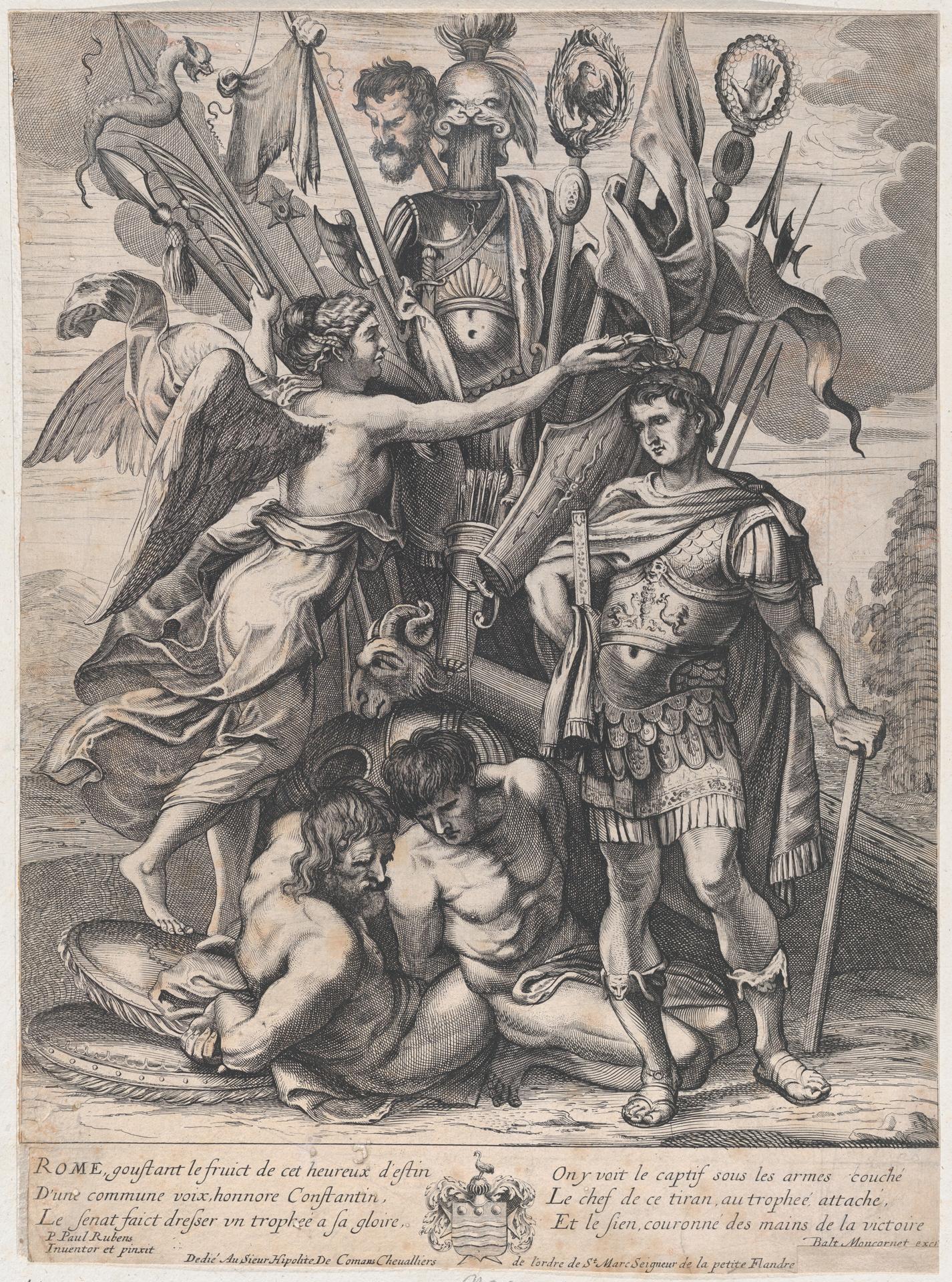
The Trophy of Constantine, with Victory at left crowning the emperor with a laurel, behind them a bounty of arms, armor, prisoners, and Maxentius' head on a stick
Original title: The Trophy of Constantine, with Victory at left crowning the emperor with a laurel, behind them a bounty of arms, armor, prisoners, and Maxentius' head on a stick
kurzbeschreibung
This print celebrates Emperor Constantine's triumph, with a winged goddess of victory placing a laurel wreath on his head. The anonymous sheet was made between about 1650 and 68 as an etching with engraving. Around the main figures, weapons, armor, and captive men are piled high; on a pole is mounted the head of the defeated Maxentius.
Description
Dressed in Roman military garb, the emperor holds a sword while a winged figure offers him the laurel wreath. Behind him stands a second winged figure with sword and lance. On the ground before Constantine, bound men crouch in a humbled posture. The upper and side areas of the image are filled with numerous weapons and suits of armor that testify to victory.
Context
The subject refers to Constantine's victory over Maxentius at the Milvian Bridge in 312 AD. The sheet dates from the 17th century and stylistically follows the art of Peter Paul Rubens. Since no artist is recorded, it is likely a workshop piece or a copy after a lost original.
Impact
The crowning at the center of the image and the abundance of war trophies create a solemn, triumphant impression. The captive men and the severed head emphasize the victor's superiority and give the print a dramatic accent.
Technique
Etching and engraving were combined, resulting in delicate lines and precise hatching. This method allows an exact rendering of armor, weapons, and figures, as was common in 17th-century printmaking.
AI-generated description text
Source: Metropolitan Museum of Art · Public Domain (CC0 1.0)