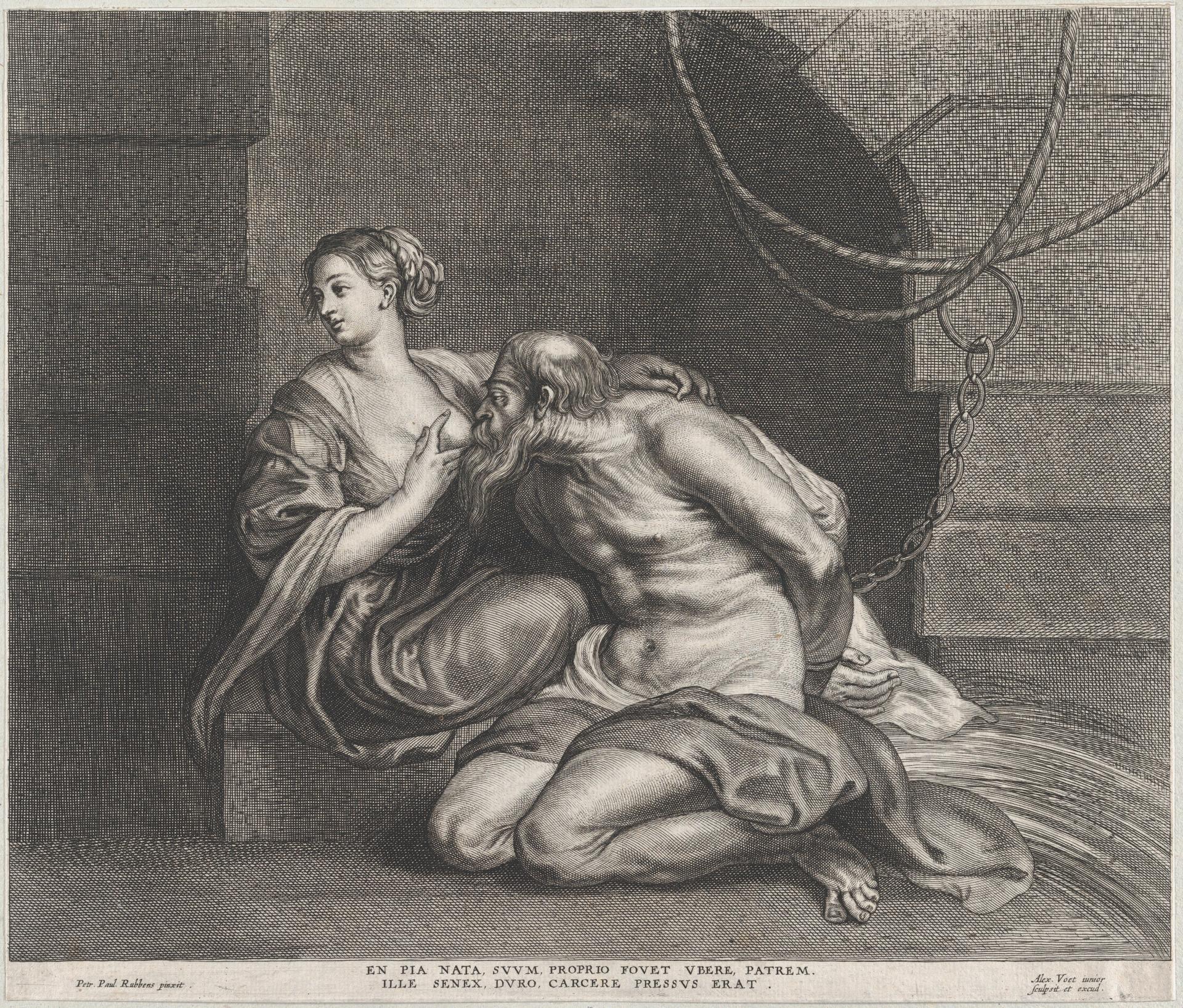
Cimon and Pero (ca. 1650–90)
Original title: Cimon and Pero
kurzbeschreibung
Alexander Voet II produced the engraving Cimon and Pero sometime between 1650 and 1690. The print, which measures 27.1 × 31.7 cm (trimmed), takes up the ancient tale of Caritas Romana and shows a woman breastfeeding a captive man.
Description
A woman in a long robe kneels at the centre, her hand placed on the breast of a seated, bearded man who wears only a cloth. Chains surround him; his skin is pale, and he has a thick grey beard. The woman's hair is dark, and she too is dressed in dark clothing. A heavy structure with a chain and ring appears to the side. The room is gloomy, the light subdued. A carpet-like pattern covers the floor, and engraved Latin text runs along the bottom edge.
Context
During the Baroque period the motif of Caritas Romana enjoyed great popularity, for it illustrated the love between father and child. Alexander Voet II, a Flemish engraver (c. 1635–1695), was active in Antwerp and known for his reproductive prints. The date around 1650–90 falls within his productive years, when he often took works by other masters as models. No specific model is recorded for this print, but the subject was widespread in Dutch and Flemish art.
Impact
The intimate gesture and the muted light evoke a quiet, almost moving atmosphere. The man's bright body contrasts with the dark surroundings, drawing the eye to the action in the middle. Fine lines give the image a detailed yet restrained presence.
Technique
This work is a copper engraving, in which the lines were incised into the plate with a burin. This allows for fine shading and precise textures of fabric and skin. The print was likely made with black ink on paper; as an intaglio process, engraving permits high precision of detail.
AI-generated description text
Source: Metropolitan Museum of Art · Public Domain (CC0 1.0)