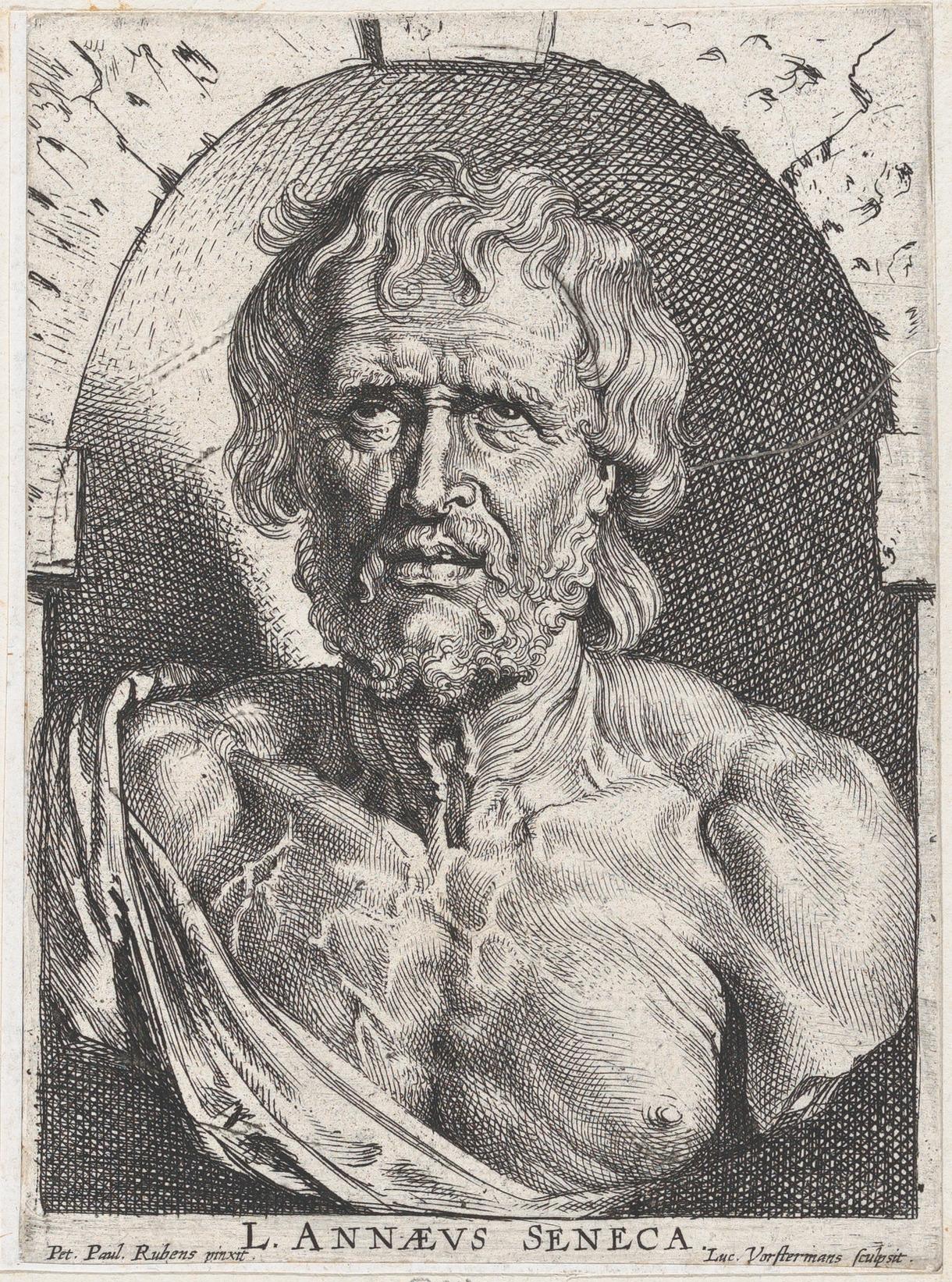
The bust of Seneca, in a niche (ca. 1620, Met-Objekt 1227)
Original title: The bust of Seneca, in a niche
kurzbeschreibung
The bust of the Roman philosopher Seneca appears within a niche. Lucas Vorsterman I made this print around 1620 as an etching and engraving after a work by Peter Paul Rubens.
Description
Seneca's head, with wavy hair and a thick beard, is worked out in detail; his gaze seems collected and turned inward. The niche holding the bust is topped by an arch of fine radial lines. A piece of drapery falling over the shoulder partly covers the bare upper body. At the bottom of the image are the name 'L. Annaeus Seneca' and the signatures of the artists involved.
Context
The print was made in the first half of the 17th century in Antwerp, where Vorsterman worked as an engraver for Rubens. It belongs to a series of portraits of famous figures engraved after the master's designs. For Seneca, the engraving follows the ancient type of the so-called Pseudo-Seneca bust, which at the time was still regarded as a secure portrait of the philosopher.
Impact
The calm arrangement and precise linework give the sheet a clear, serious tone. The pensive expression and careful modeling of the head bring the sitter's intellectual presence to the fore.
Technique
The work is executed as an etching with engraving, in the second state of two. Fine lines and hatching form plastic contours and textures that model the face and upper body. Parallel and radial strokes in the niche create spatial depth.
AI-generated description text
Source: Metropolitan Museum of Art · Public Domain (CC0 1.0)