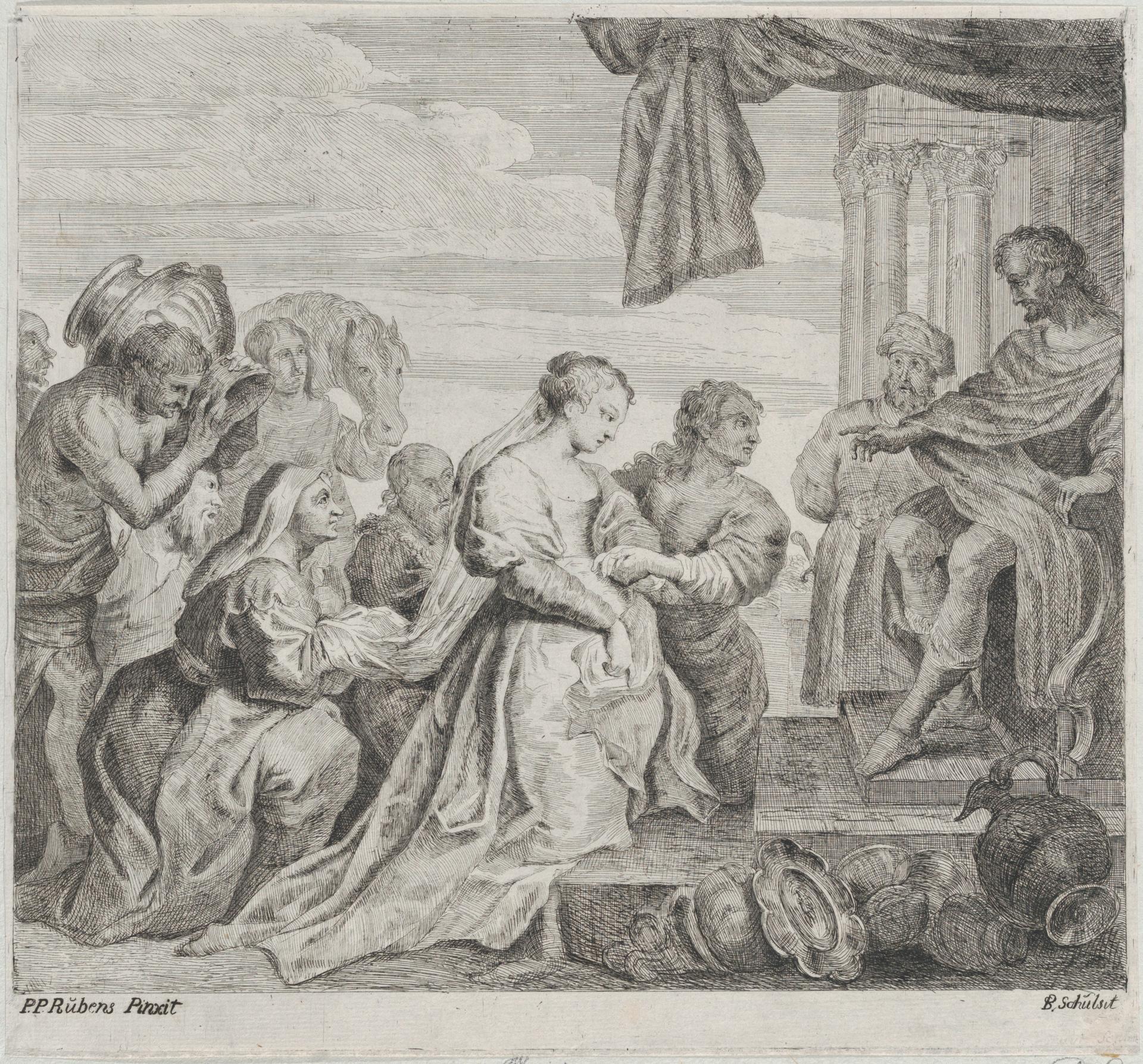
Solomon and the Queen of Sheba (1784)
Original title: Solomon and the Queen of Sheba
kurzbeschreibung
Philip Spruyt produced this engraving in 1784 after a painting by Peter Paul Rubens. It captures the biblical meeting of King Solomon and the Queen of Sheba. As an eighteenth-century reproductive print, it exemplifies the era's practice of disseminating major paintings through printed images.
Description
A woman in flowing robes is seated in the foreground, surrounded by several figures. Another woman kneels, holding a child in her arms. To the right, two men stand, one gesturing with his hand. Further back, more figures appear, including a rider on horseback. Columns and a curtain frame the scene.
Context
Spruyt's engraving is based on a painting by Peter Paul Rubens that depicts the meeting of Solomon and the Queen of Sheba. Rubens's original, created in the seventeenth century, is known for its dramatic composition. Spruyt worked in the late eighteenth century, when reproductive prints of famous paintings were widespread. The print aimed to make the work accessible to a broader audience.
Impact
The viewer's gaze is immediately drawn to the central encounter between the two main figures. Dense groups of people and a clear separation of foreground and background create a balanced arrangement. The calm linework gives the print a dignified mood.
Technique
In engraving, lines are incised into a copper plate. The plate is then inked and printed onto paper. Fine lines and hatching produce sculptural shadows and details. The signature at the bottom margin names Rubens as the painter of the original and identifies the engraver.
AI-generated description text
Source: Metropolitan Museum of Art · Public Domain (CC0 1.0)