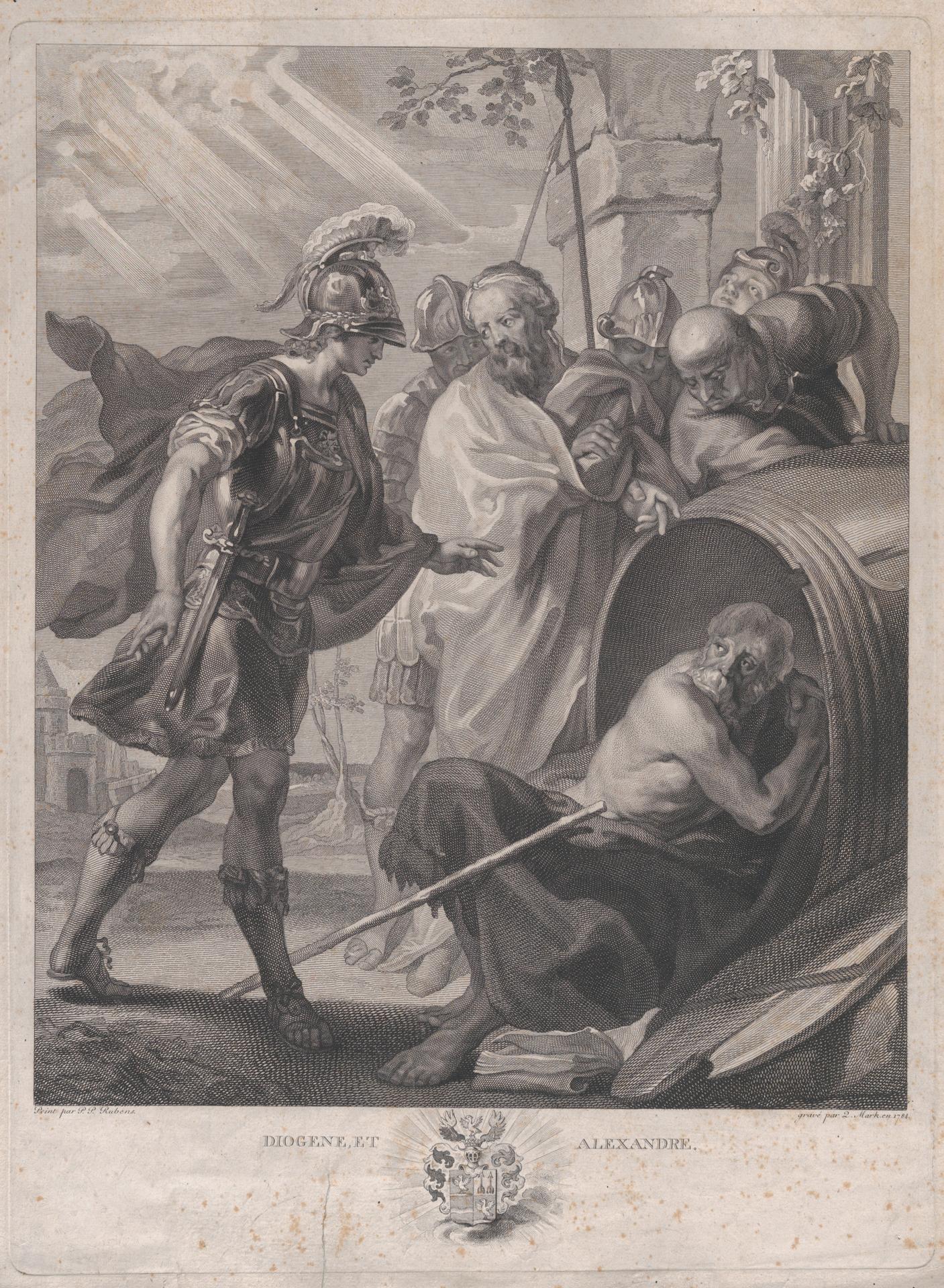
The meeting of Diogenes of Sinope and Alexander the Great (1784, Met-Objekt 1222)
Original title: The meeting of Diogenes of Sinope and Alexander the Great
kurzbeschreibung
Quirin Mark's 1784 engraving brings before our eyes the encounter between the philosopher Diogenes of Sinope and Alexander the Great — a legendary meeting that, in a classicizing manner, teases out the relationship between these two very different men.
Description
In the foreground Diogenes crouches, staff in hand, wrapped in simple clothing; his expression is thoughtful and calm. Facing him stands Alexander, dressed in Roman armor and helmet, extending his hand as if about to address the philosopher. Behind them, other figures in Roman military dress can be seen watching the event. The layout is symmetrical, with the main figures occupying the center. The light remains diffuse and sharpens the outlines; the gray tones match what was customary for etchings of that era.
Context
The meeting of Diogenes and Alexander is one of the familiar subjects of ancient philosophical history and was often treated in eighteenth-century art. Quirin Mark, a German engraver, produced this print in 1784, at a time when classicism was gaining importance in Europe. The engraving probably derives from a painting or drawing that emphasizes the moral and philosophical aspect of the encounter.
Impact
The calm arrangement and clear linework give the print a balanced, reflective mood. The contrast between the simple philosopher and the powerful ruler is felt without dramatic escalation, yet with quiet clarity. The viewer is invited to ponder the clash of wisdom and power.
Technique
As an engraving, the work belongs to the intaglio processes, in which the lines are incised into a metal plate. The precise and detailed execution clearly brings out the texture of garments and faces. The present example is the first of two documented states of the print.
AI-generated description text
Source: Metropolitan Museum of Art · Public Domain (CC0 1.0)