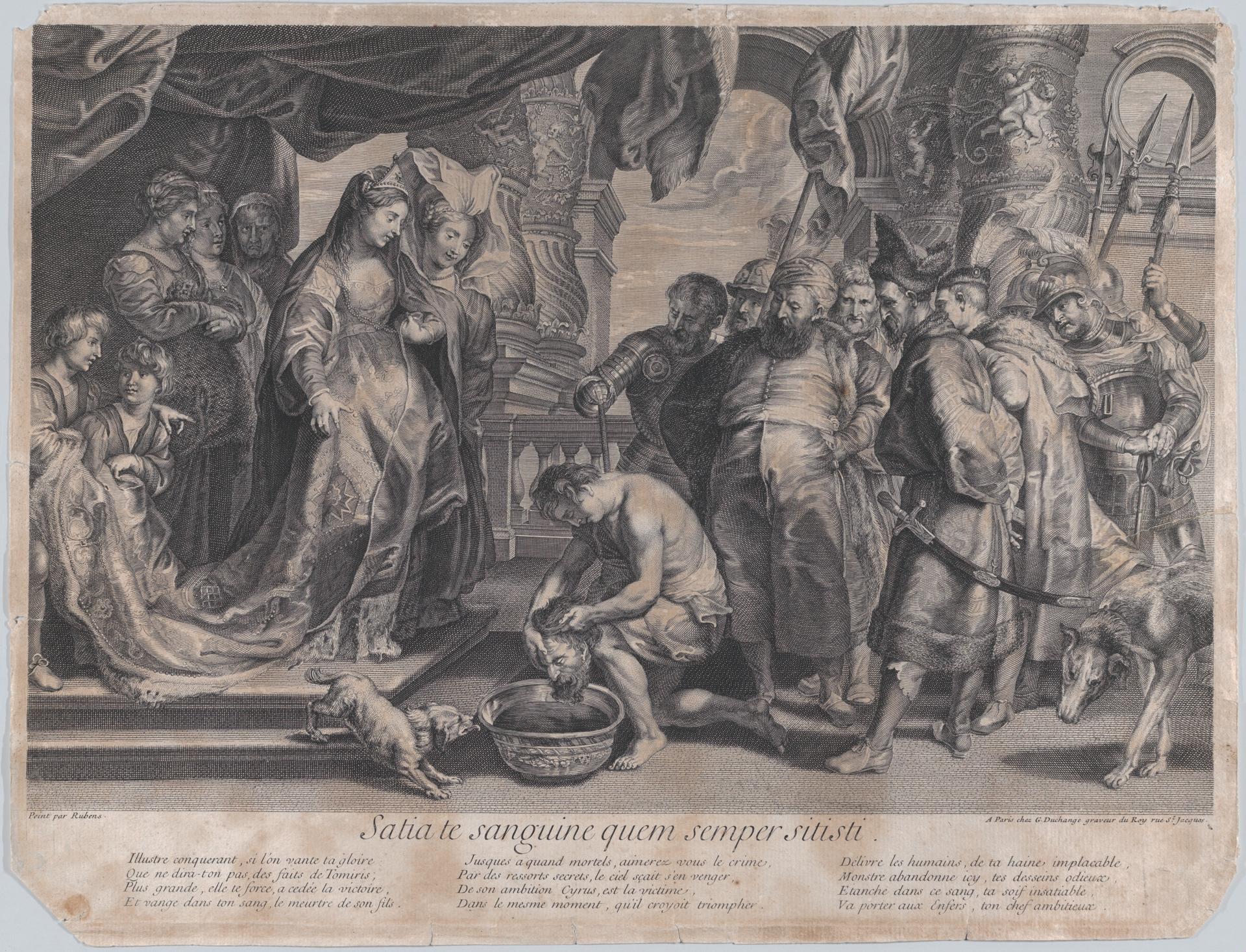
The Head of Cyrus brought to Queen Tomyris (ca. 1713–20, Met-Objekt 1221)
Original title: The Head of Cyrus brought to Queen Tomyris
kurzbeschreibung
Gaspard Duchange made this engraving between 1713 and 1720. It presents Tomyris, queen of the Massagetae, receiving the head of the Persian king Cyrus. The sheet survives in the first of two states and measures 37 × 48.5 cm.
Description
A richly dressed woman sits raised above the others, identifiable as Queen Tomyris. Before her a figure bends forward, presenting a helmet or headpiece that has clearly been taken from someone else. Soldiers and courtiers stagger back into the distance, while columns and hanging drapery frame the room. The arrangement is symmetrical, with the queen at its center. Light falling from above sharpens the outlines of the figures, which are rendered in shades of gray.
Context
The print reproduces a painting by Peter Paul Rubens that recounts the Tomyris episode from Herodotus's Histories. Duchange, a French engraver, worked in Paris and was known there for reproductions after major paintings. The subject follows the Baroque tradition of telling historical or mythological events with drama and abundance of detail.
Impact
The symmetrical layout and the queen's central position give the sheet a solemn, almost theatrical presence. Precise lines and the handling of light draw the eye to the main figures and produce a calm but insistent mood.
Technique
The lines were incised into a metal plate and then printed on paper. This method allows the finest details and an exact rendering of shadow, as the gray tonal values of the print make clear. This is the first state, meaning the plate had not yet been reworked.
AI-generated description text
Source: Metropolitan Museum of Art · Public Domain (CC0 1.0)