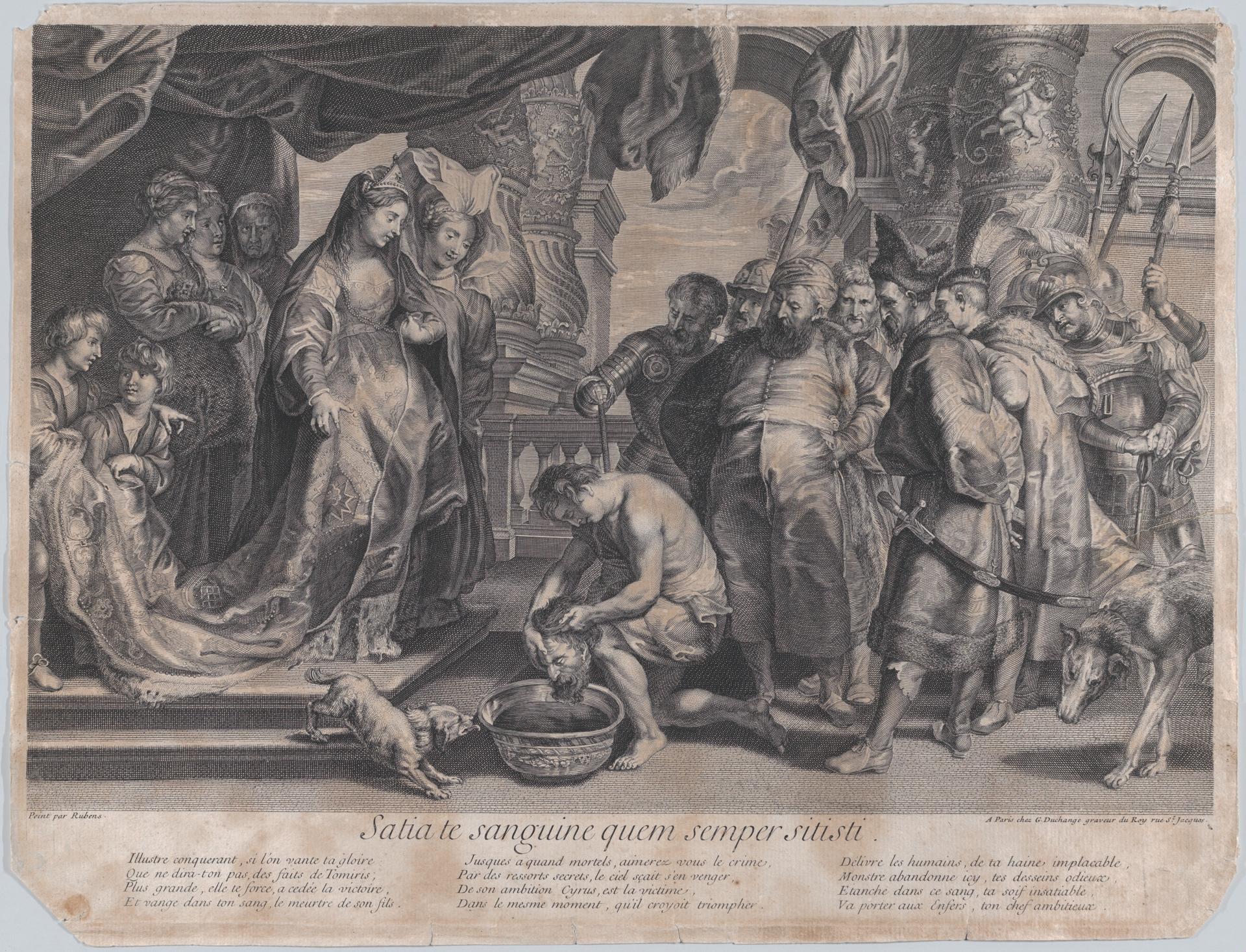
The Head of Cyrus brought to Queen Tomyris (ca. 1713–20, Met-Objekt 1220)
Original title: The Head of Cyrus brought to Queen Tomyris
kurzbeschreibung
Gaspard Duchange produced this engraving between roughly 1713 and 1720. It captures the legendary moment when the Scythian queen Tomyris is presented with the head of the Persian king Cyrus. The impression measures 37 × 48.5 cm and belongs to the first of two states.
Description
A richly dressed woman, clearly the queen, stands on a raised platform and looks down. At her feet, a figure kneels and holds up an object that resembles a head in a bowl. To the queen's side, other figures in traditional attire are grouped, some in military dress, while soldiers with weapons appear at the right edge. Hints of columns and drapery suggest a sumptuous interior. A Latin poem at the bottom explains the narrative.
Context
The image draws on an account by the Greek historian Herodotus: Tomyris, queen of the Massagetae, avenged her son's death by submerging Cyrus's head in blood. Duchange, a French engraver, made this print in the first half of the 18th century, when historical and mythological subjects were in demand for printed graphics. He was best known for reproductive engravings after paintings; for this work, a lost or lesser-known painting may have served as the model.
Impact
The staging is dramatic and clearly structured in its storytelling, so the viewer is immediately drawn into the historical event. The engraving's precise linework gives the image a noble, finely detailed quality that underscores the grandeur of the subject.
Technique
For this engraving, lines were incised into a copper plate and then inked for printing. The sharp contours and intricate linear play are characteristic of the technique, which allows for precise rendering of light and shadow. The present impression is the first state, made before later reworkings of the plate.
AI-generated description text
Source: Metropolitan Museum of Art · Public Domain (CC0 1.0)