Sunset
Original title: Sunset
kurzbeschreibung
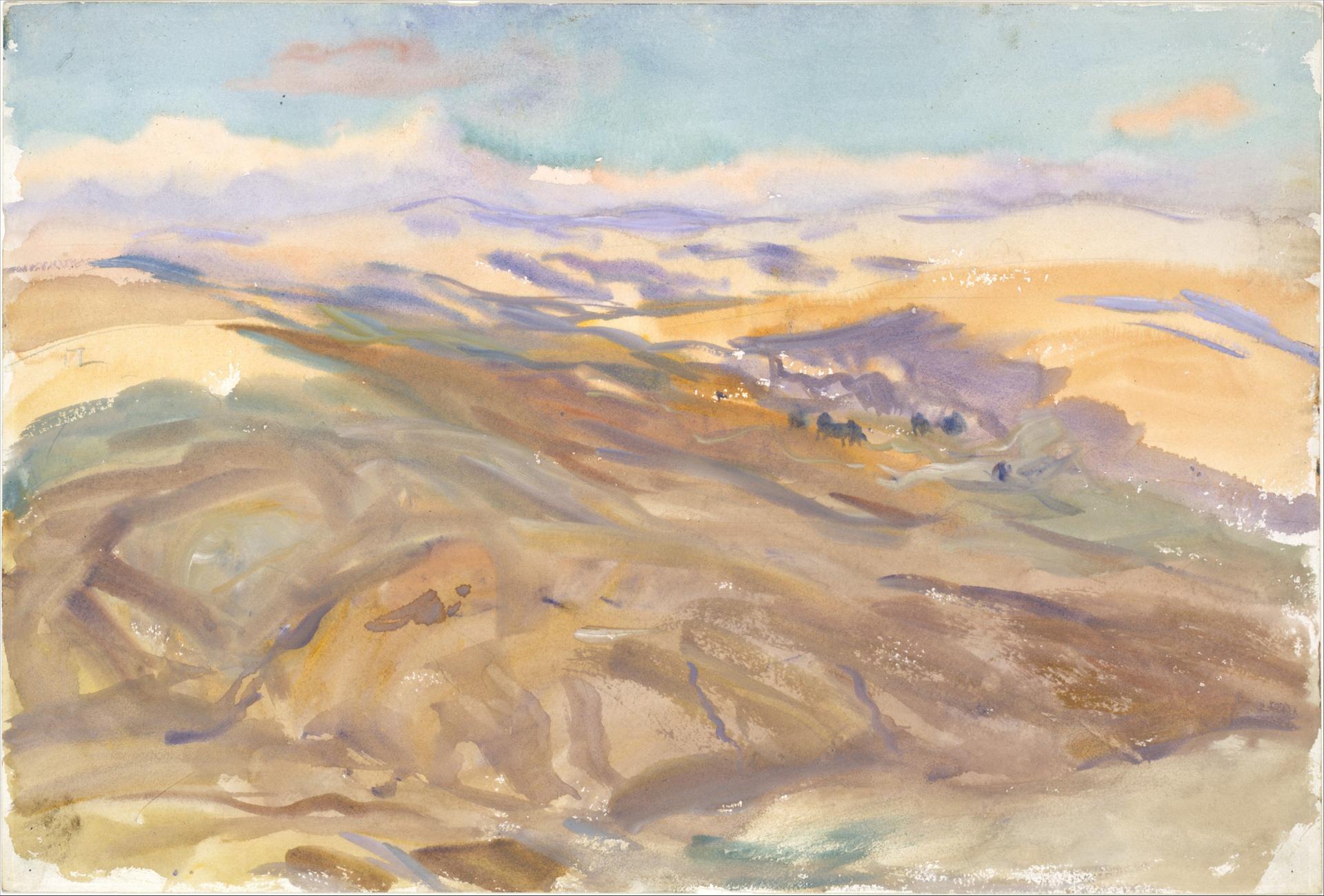
John Singer Sargent's watercolor 'Sonnenuntergang' (Sunset) dates from 1905–06 and presents an expansive landscape of hills and distant mountains beneath a colorful sky. It is executed in watercolor, gouache, and graphite on white wove paper.
Description
Warm earth tones of brown and beige define the flat, undulating hills or dunes in the foreground; their rough texture is suggested by gentle brushstrokes. Behind them rise low, rocky mountains in bluish and purplish hues, pointing to evening or dawn. Light falls from the left, lending the scene a warm, golden tonality. The sky appears in various blues, with a few clouds tinted in sunset colors. No figures or objects are visible, only natural landscape elements.
Context
Around 1905–06, during a phase of intense engagement with landscape painting in watercolor, Sargent created this sheet. He often worked outdoors, capturing impressions of light and atmosphere. It likely originated during a trip, as Sargent frequently traveled in Europe and North Africa. The exact location is not documented, but the depiction of dunes and mountains might suggest a desert or coastal landscape.
Impact
The soft, flowing colors and warm light create a calm, contemplative atmosphere. Because only landscape elements are shown, without figures, the image directs the viewer's gaze to the mood of the moment. The mix of earth tones and cool mountain hues gives the work a harmonious tension.
Technique
The work is executed in watercolor, gouache, and graphite on white wove paper. The transparency of watercolor allows flowing color gradients, while gouache was used for opaque accents. The brushstrokes are gentle and emphasize the texture of the hills, while the graphite presumably served for fine contours or sketch lines.
AI-generated description text
Source: Metropolitan Museum of Art · Public Domain (CC0 1.0)