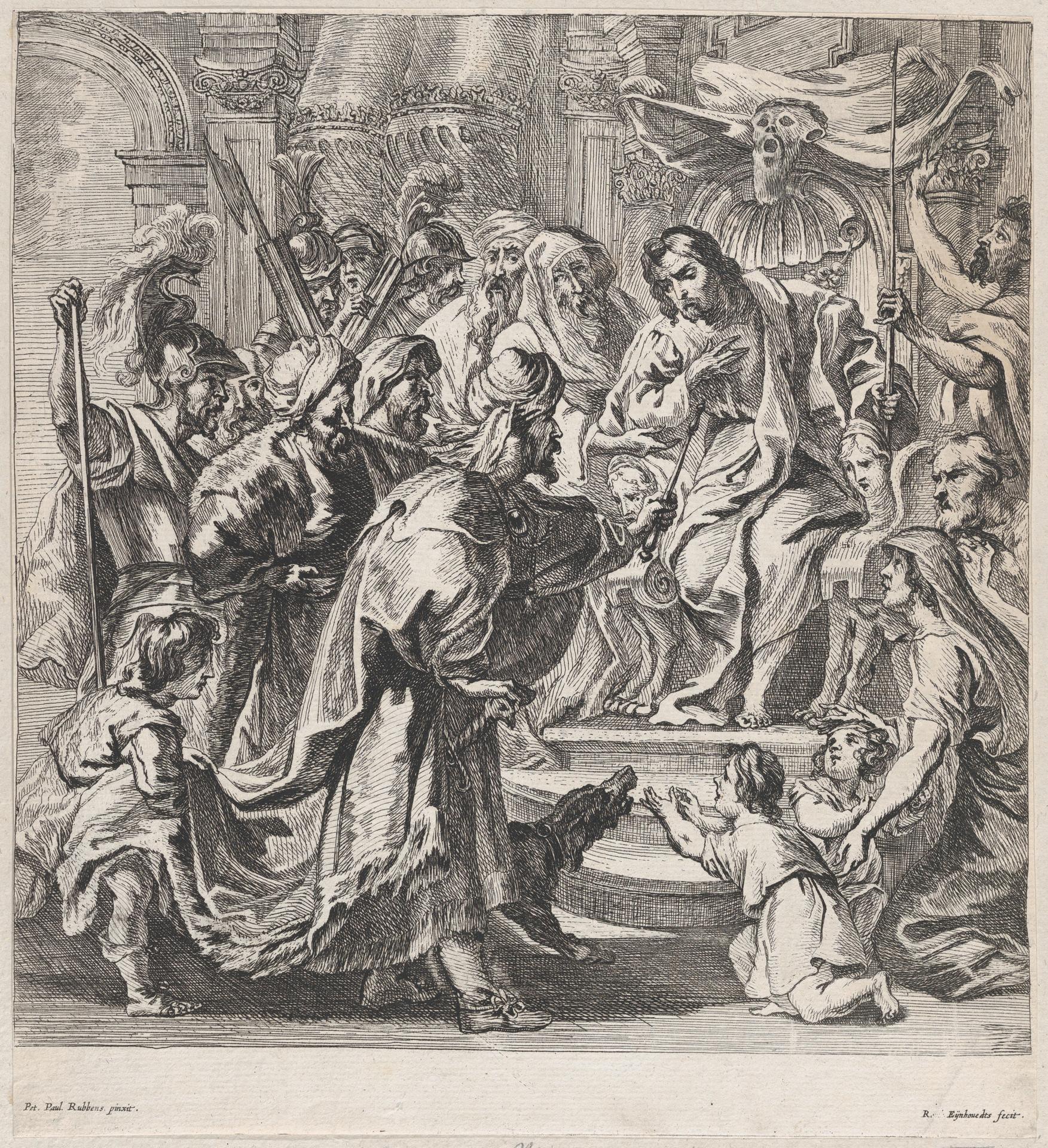
Cambyses punishing the unjust judge Sisamnes
Original title: Cambyses punishing the unjust judge Sisamnes
kurzbeschreibung
Between 1630 and 1680, Rombout Eynhoudts produced this etching, which depicts the Persian king Cambyses calling the judge Sisamnes to account for an unjust verdict. The upright sheet ranks among the meticulously detailed printed graphics of the seventeenth century.
Description
Cambyses sits enthroned on a raised platform, holding a sword against the kneeling Sisamnes. Priests, soldiers, and onlookers crowd around the two, while a dog looks up at the king. Columns and arches hint at an architectural interior behind them. The figures' bodies are captured in expressive gestures and exaggerated movements typical of Mannerism. This black-and-white etching employs strong contrasts of light and dark, along with fine, precise lines.
Context
This etching dates from the seventeenth century and was made in the Netherlands, where printmaking was then widespread. Rombout Eynhoudts took up biblical and historical subjects that conveyed moral lessons. The story of Sisamnes, which comes from the Greek historian Herodotus, often served to illustrate justice and the power of rulers. The trimmed sheet points to later handling or collection practices.
Impact
The diagonal alignment of the figures and the threatening posture at the center generate gripping tension. Thanks to the delicate linework and dramatic shadows, the scene gains a theatrical force that draws the viewer straight into the action.
Technique
This work is an etching: the drawing was bitten into a metal plate and then printed on paper. That process makes it possible to create fine hatching and soft transitions, which are essential to the figures' sculptural appearance. The sheet is monochrome and has been trimmed to approximately 29.5 × 26.8 cm.
AI-generated description text
Source: Metropolitan Museum of Art · Public Domain (CC0 1.0)