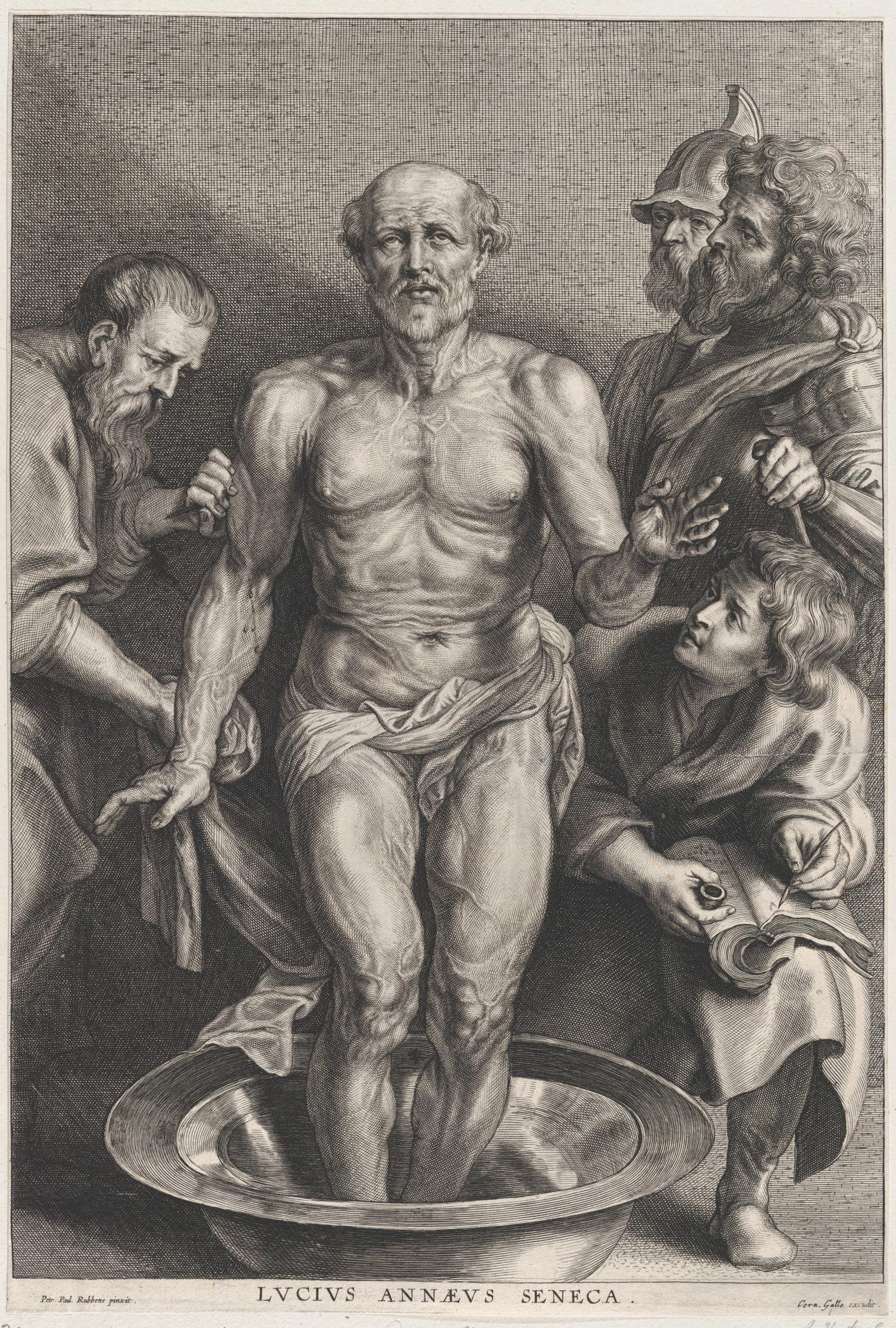
The Death of Seneca
Original title: The Death of Seneca, standing at center with his feet in a basin of water, supported by a disciple at left while another takes down his last words at right
kurzbeschreibung
Unlike the usual Seneca depictions, which often present the philosopher's death as a dramatic bloodbath, this engraving by Alexander Voet II focuses on the moment in a water basin. The Roman stands at the center, surrounded by figures who point at him or take notes. It is dated to about 1655–78. Voet's work is present here in the second state of two.
Description
A bare-chested man with a simple cloth around his hips stands barefoot in a large metal tub. His gaze is serious and withdrawn. On the left, a bearded old man points at him with his finger; on the right, a man wearing a helmet-like head covering also extends his index finger. Another participant leans to the right and seems to be making notes in a book, while another, inclined to the left, holds a book and scrutinizes the main figure.
Context
Tacitus describes Seneca's suicide, and this literary source forms the basis for the motif. Alexander Voet II worked as a Flemish engraver in Antwerp. As was customary at the time, the print was likely made as a reproductive engraving after a painting or drawing.
Impact
The symmetrical arrangement focuses attention on the dying philosopher and gives the event a dignified solemnity. The dense linework and nuanced shading create a quiet, melancholy mood that underscores the seriousness of the moment.
Technique
For this engraving, lines were incised into a copper plate and then printed on paper. The differentiated gray tones and precise line placement reveal the engraver's experience. The second state may contain revisions compared to the first.
AI-generated description text
Source: Metropolitan Museum of Art · Public Domain (CC0 1.0)