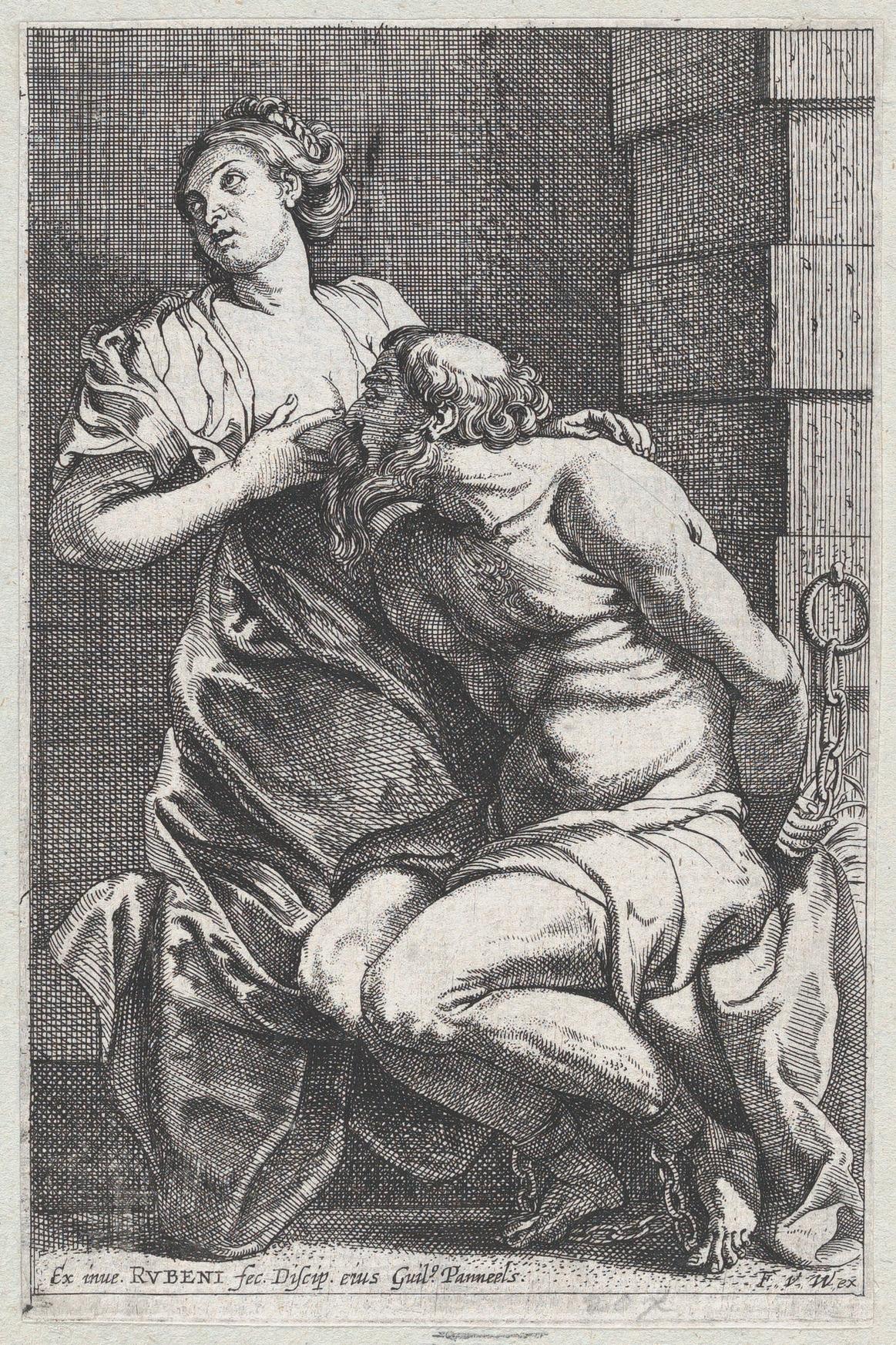
Cimon and Pero (ca. 1631)
Original title: Cimon and Pero
kurzbeschreibung
An etching by Willem Panneels from around 1631 presents the ancient scene of Caritas Romana: Pero suckling her imprisoned father Kimon. This is the second state of two (Hollstein) and derives from an invention by Peter Paul Rubens.
Description
Two figures occupy an interior. On the left, a woman stands, her right hand holding a chain that loops around the neck of a seated man. He sits on the ground, head bowed, his torso bare and muscular, legs crossed, clad only in simple trousers. A wall with a window opening indicated by vertical lines forms the backdrop. The postures—the upright woman, the bent man—give the image an emotional charge.
Context
The motif of Caritas Romana was popular in the Baroque era, symbolizing virtue and family devotion. Panneels, a pupil of Peter Paul Rubens, made this etching after an invention by his teacher, as the inscription 'Ex inue. RUBENI fec. Discip. eius Guil' Pannels' confirms. The print dates to about 1631, when Panneels was active in Antwerp as a graphic artist, translating Rubens's compositions into print.
Impact
Strength and vulnerability stand in stark contrast: the woman acts with care, while the man remains passive and dependent. The spare yet precise linework brings the gestures and the emotional tension between the figures to the fore.
Technique
The etching was made by incising lines into a metal plate that was then bitten with acid. It was printed on paper in portrait format; the sheet has been trimmed, so the margins are missing. This technique allows for fine hatching and a gradation of light that recalls Rubens's painterly models.
AI-generated description text
Source: Metropolitan Museum of Art · Public Domain (CC0 1.0)