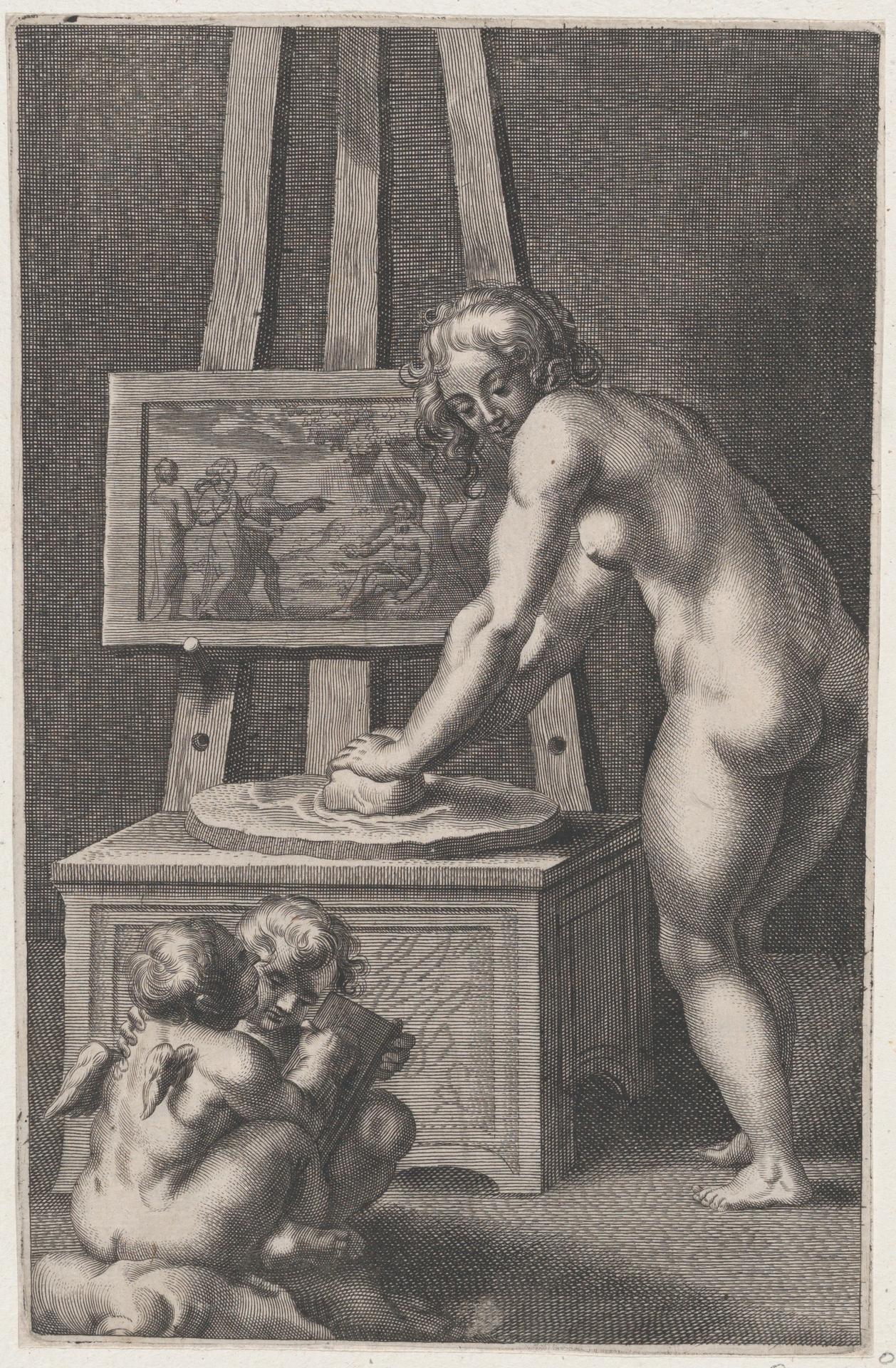
Pictura: Allegory of Painting (ca. 1610–50, Met-Objekt 1208)
Original title: Pictura: allegory of painting, with a nude woman at center grinding pigments, two putti drawing at lower left
kurzbeschreibung
An engraving from around 1610 to 1650 presents an allegory of painting. A nude woman sits at the center, grinding pigments, while two putti study a book at the lower left. This print is a reverse copy of an unidentified artist's work.
Description
A nude woman occupies the middle of the image, crushing colored pigments on a plate. Behind her hangs a painting that depicts three figures in a dramatic scene. Beneath the table, two putti crouch, looking at an open book. The arrangement is symmetrical: the woman and the painting fill the background, the putti the foreground. The rendering remains monochrome in shades of gray, with even lighting and no discernible shadows.
Context
In the seventeenth century, the allegory of painting was a popular motif, representing the personification of art. This sheet is a reverse copy, suggesting it reproduces an older model. Such prints served to spread pictorial ideas and were used in artists' workshops or collections. Nothing is known about the origin of the anonymous engraver.
Impact
The calm, symmetrical layout and even lighting give the print a clear, almost statuary presence. The nude woman and putti appear idealized, conveying a timeless, allegorical mood. Fine lines and hatching create a detailed yet tranquil effect.
Technique
The print was executed as an engraving in the intaglio process. The monochrome gray tones arise from lines and hatching of varying density. Because it is a reverse copy, the plate was engraved in mirror image to the model, as was common for reproductive prints.
AI-generated description text
Source: Metropolitan Museum of Art · Public Domain (CC0 1.0)