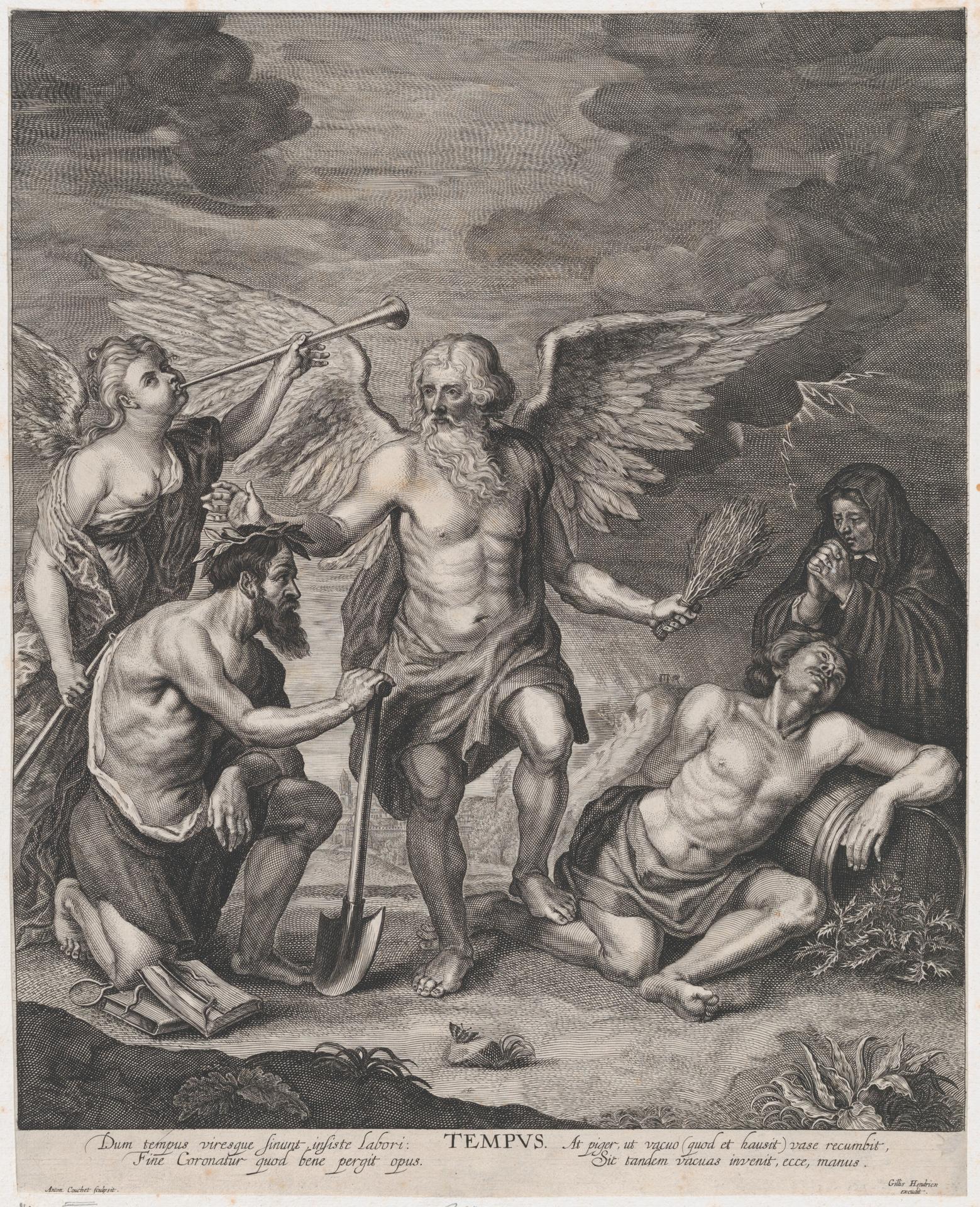
Time crowning Employment and punishing Idleness
Original title: Time crowning Employment and punishing Idleness
kurzbeschreibung
In the engraving "Time Crowning Diligence and Punishing Idleness" by Antoine Couchet, made between about 1650 and 1677, an allegorical scene unfolds. Winged Time (Tempus) appears at the center, holding a crown and a noose, intervening between a working man and an idle one. The print is black and white and bears Latin inscriptions in the lower section.
Description
Symmetrically arranged, the layout draws the eye to the central figure of Tempus, a winged old man carrying a crown in one hand and a noose in the other. To his left stands a man in a working posture; to his right, one in a still, almost begging pose. A winged female figure with a pipe player hovers behind, surrounded by clouds and a turbulent sky. Gray tones and fine hatching bring out the contours and textures of the figures and the setting.
Context
Antoine Couchet was a seventeenth-century French engraver active in Paris. The print dates from the Baroque era, when allegories for moral instruction were widespread. The motif of Time as judge was common in early modern art and literature. The Latin inscriptions confirm the work's didactic purpose.
Impact
Clear symmetry and the central placement of Tempus make an immediate impression. The contrast between the dramatic sky and the calm figures evokes a solemn, moralizing mood. The fine engraving gives the sheet a noble, artful appearance.
Technique
The print was produced as an engraving, in which the image is incised into a copper plate and then printed on paper. The lines appear sharp and detailed, with visible hatching that creates shadow and volume. According to Hollstein, this is the second or third state of three.
AI-generated description text
Source: Metropolitan Museum of Art · Public Domain (CC0 1.0)