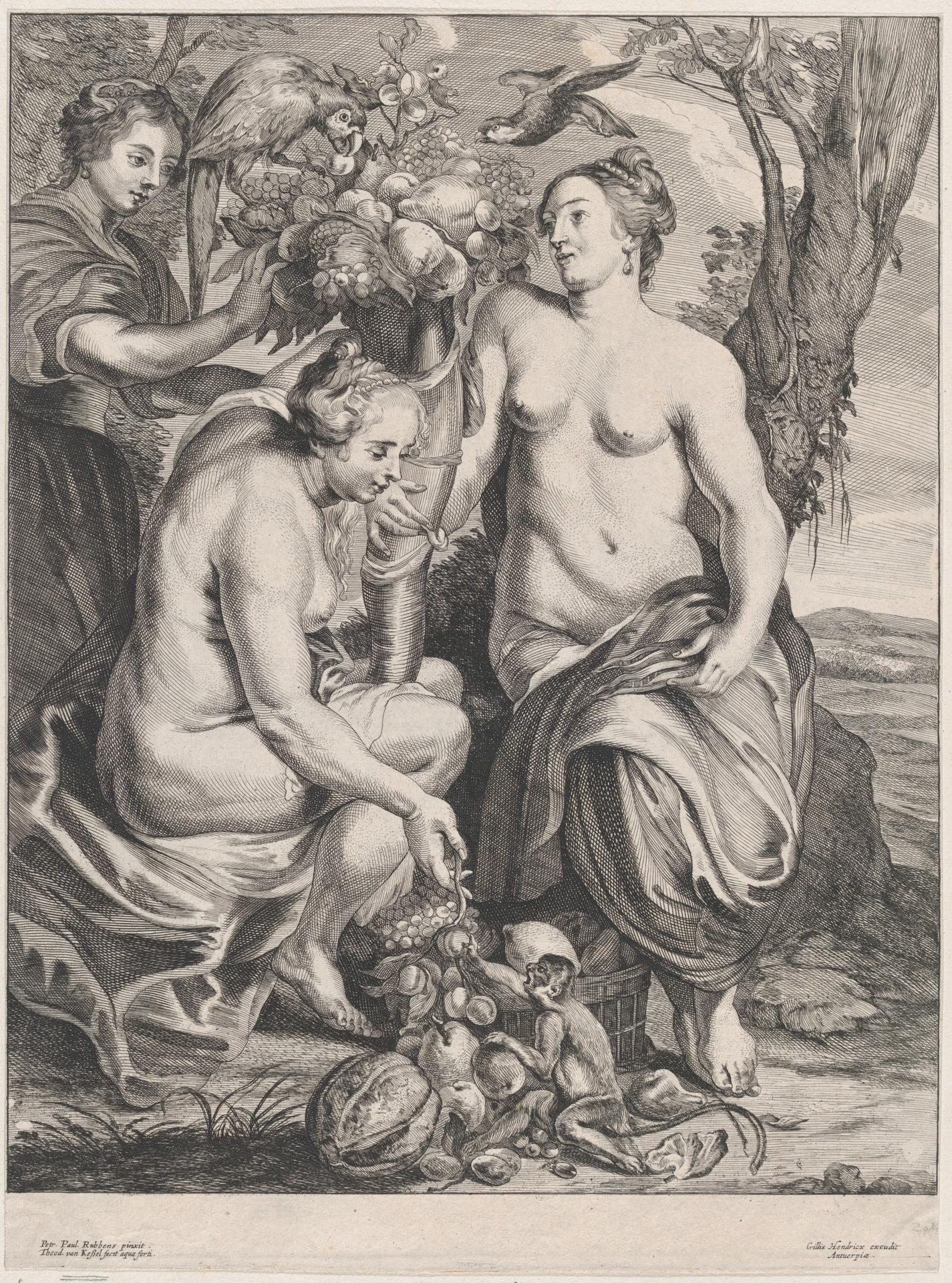
Allegory of Abundance: Ceres Holding a Cornucopia at Right and Pomona at Left Feeding Fruit to a Monkey
Original title: Allegory of abundance: Ceres holding a cornucopia at right and Pomona at left feeding fruit to a monkey
kurzbeschreibung
This etching and engraving by Theodor van Kessel, made around 1652–60, presents an allegory of abundance. Two nude women with fruit form the core of the image: on the right, a figure with a cornucopia, and on the left, Pomona kneeling to feed a monkey.
Description
At the center, two unclad women sit exchanging fruit; both wear traditional garments. A third figure stands to the right, holding a horn brimming with produce. On the left, Pomona kneels and offers fruit to a monkey seated on the ground. Trees, a bird in the sky, and a broad landscape suggest the setting. The arrangement feels symmetrical, rendered in black and white with sharp, precise lines.
Context
Theodor van Kessel, a seventeenth-century Flemish artist, was known for allegorical and mythological scenes. The theme of abundance draws on the classical fertility goddesses Ceres and Pomona, common in Baroque art. Such prints celebrated prosperity and nature's bounty and circulated widely as printed images.
Impact
The symmetrical layout and richly elaborated natural details create a calm, balanced impression. The exact linework gives the print a clear, almost scientific quality that underscores the allegorical message of plenty and fertility.
Technique
Etching and engraving combine here to produce extremely fine, detailed lines. The process allows textures and shading to be rendered precisely, as seen in the garments and fruit. The sheet is trimmed and measures 43 × 31.9 cm.
AI-generated description text
Source: Metropolitan Museum of Art · Public Domain (CC0 1.0)