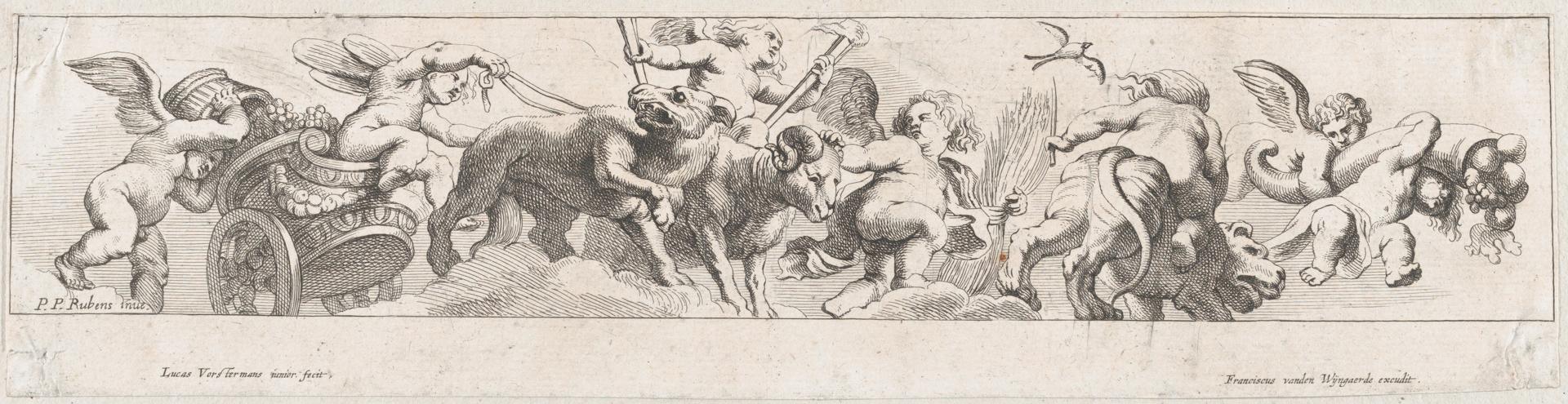
Frieze with putti, some riding a chariot pulled by animals, others riding animals and holding garlands
Original title: Frieze with putti, some riding a chariot pulled by animals, others riding animals and holding garlands
kurzbeschreibung
Lucas Vorsterman II made this frieze of putti between about 1640 and 1666. The print is an etching and survives in its second state of two.
Description
Across the frieze, putti appear in varied poses. Some ride in a vehicle drawn by animals, while others sit astride beasts and carry garlands. The layout feels animated and lively, thanks to the moving animals and the putti's postures. As an etching, the image is monochrome, and the lighting is even, as is typical for this printmaking technique.
Context
Lucas Vorsterman II, a Flemish engraver and etcher of the Baroque, worked in Antwerp. His output includes many reproductive prints after other artists as well as original works. Friezes with putti were common motifs in Baroque art, often serving decorative purposes. The dating ca. 1640–66 falls within the period when Vorsterman II was active.
Impact
The arrangement of putti and animals creates a vivid, dynamic impression. The Baroque style, with its rich detail and emphasis on movement, gives the frieze an ornamental yet narrative quality.
Technique
For this etching, lines were bitten into an etched plate. Sharp contours and detailed lines stand out in the figures and objects. That it is the second state of two points to reworking of the plate.
AI-generated description text
Source: Metropolitan Museum of Art · Public Domain (CC0 1.0)