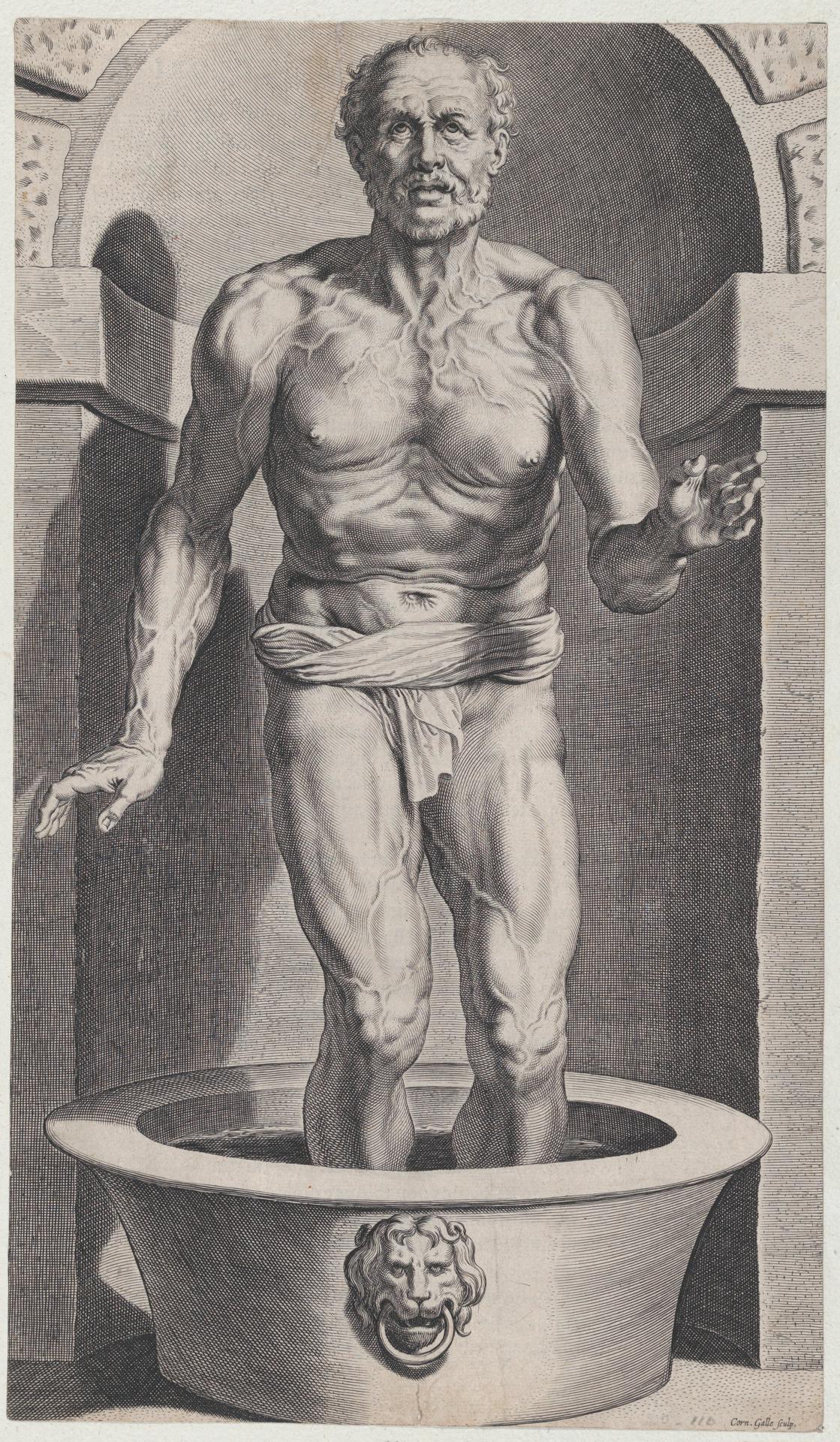
Seneca at the bath, standing in a niche with his feet in a basin
Original title: Seneca at the bath, standing in a niche with his feet in a basin
kurzbeschreibung
This engraving by Cornelis Galle I was made around 1615 and belongs to a series that presents the life of the Roman philosopher Seneca in several scenes. Seneca appears here in a niche with his feet in a basin. The impression is the third of three known states.
Description
A muscular male body with a narrow waist stands upright in a niche. A simple cloth wraps around his hips. His arms are slightly raised, palms facing outward. Both feet are submerged in a basin whose sides are decorated with lion heads. The layout is framed by a stylized niche with columns and architectural elements reminiscent of ancient Roman baths. Light falls on the figure from the front, bringing out its musculature.
Context
Cornelis Galle I worked as a Flemish engraver in Antwerp around 1615. This print is part of a series that recounts the life of the Roman philosopher Seneca. Such cycles were very popular in the seventeenth century for making moral and philosophical content accessible to a wider audience. Showing Seneca at his bath may allude to ancient literary sources that describe his lifestyle.
Impact
The calm, symmetrical arrangement and clear linework give the print a dignified, almost monumental presence. The emphasized anatomy and architectural framing create a classicizing effect that invites the viewer to contemplate.
Technique
This print is an engraving, a process in which lines are incised into a metal plate. Fine strokes and hatching shape the body and shadows with great precision. The impression comes from the third of three known states, suggesting that the plate was reworked.
AI-generated description text
Source: Metropolitan Museum of Art · Public Domain (CC0 1.0)