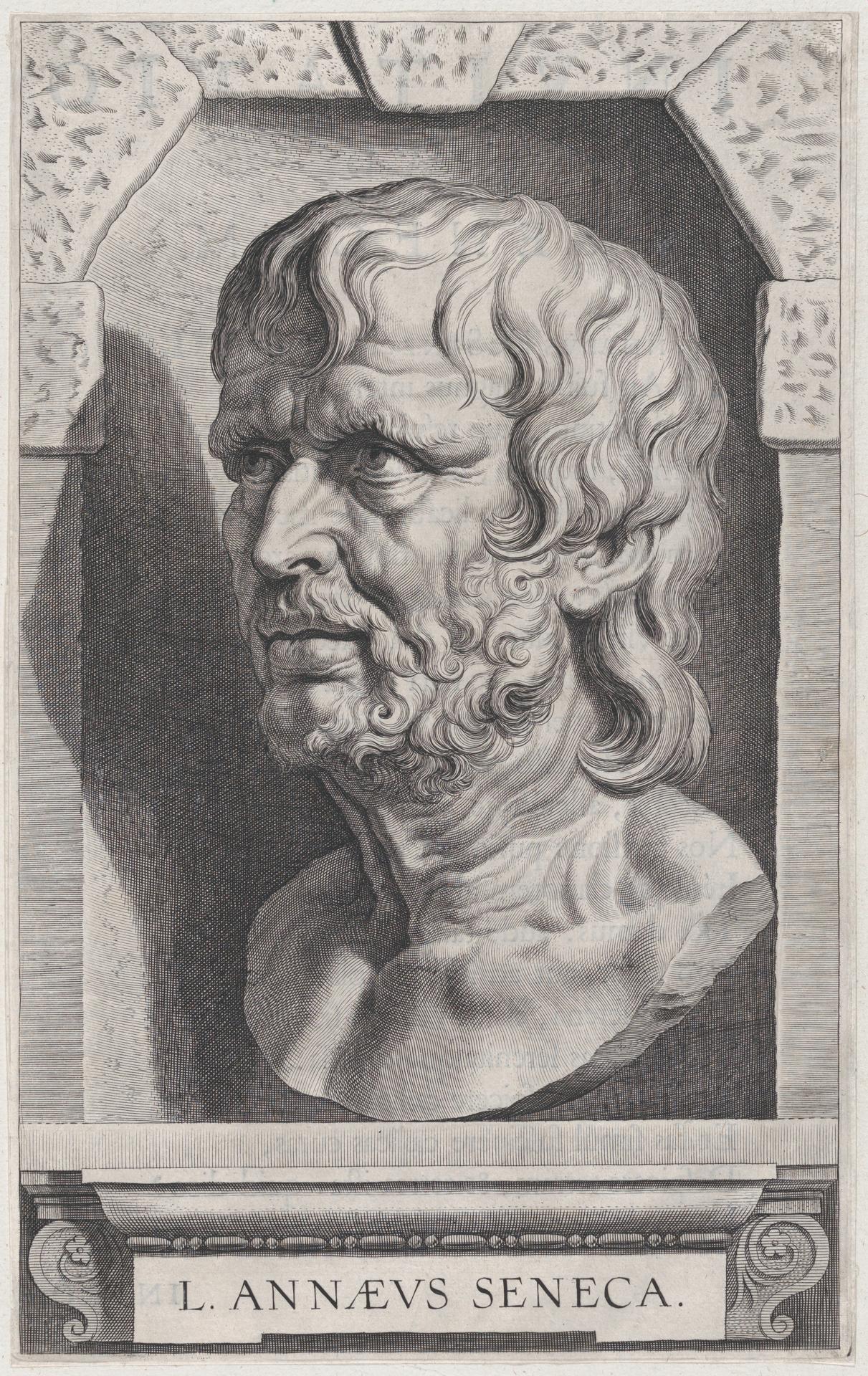
The bust of Seneca, in a stonework niche
Original title: The bust of Seneca, in a stonework niche
kurzbeschreibung
Around 1615, Cornelis Galle I engraved a portrait relief of the Roman philosopher L. Annæus Seneca. The print is a copper engraving on paper. An idealized likeness of the scholar appears within an ornamental niche.
Description
Seneca's bust fills the frame, his hair a mass of tight curls, his expression severe. Flushed cheeks and deep-set, pensive eyes draw attention; a dark ground sets the face off sharply. The relief sits inside a niche with decorative moulding, and below it the name 'L. ANNÆVS SENECAS' is lettered in Latin capitals.
Context
The Fleming Cornelis Galle I was working in Antwerp as a copper engraver around 1615. This sheet belongs to a series of philosopher portraits that were prized in the early modern period as collectibles and teaching aids. The Seneca likeness follows an ancient type handed down through Roman copies and accepted as authentic during the Renaissance.
Impact
Careful rendering of the facial features and the dark ground create a grave, contemplative mood. The ornamental frame gives the portrait a formal, almost monumental quality that reinforces the sitter's dignity.
Technique
For a copper engraving, lines are cut into a metal plate and then printed onto paper. Fine hatching gives the shadows a sculptural solidity, while the ruddy cheeks are built up from dense dots and lines. The trimmed sheet measures 31.2 × 19.5 cm.
AI-generated description text
Source: Metropolitan Museum of Art · Public Domain (CC0 1.0)