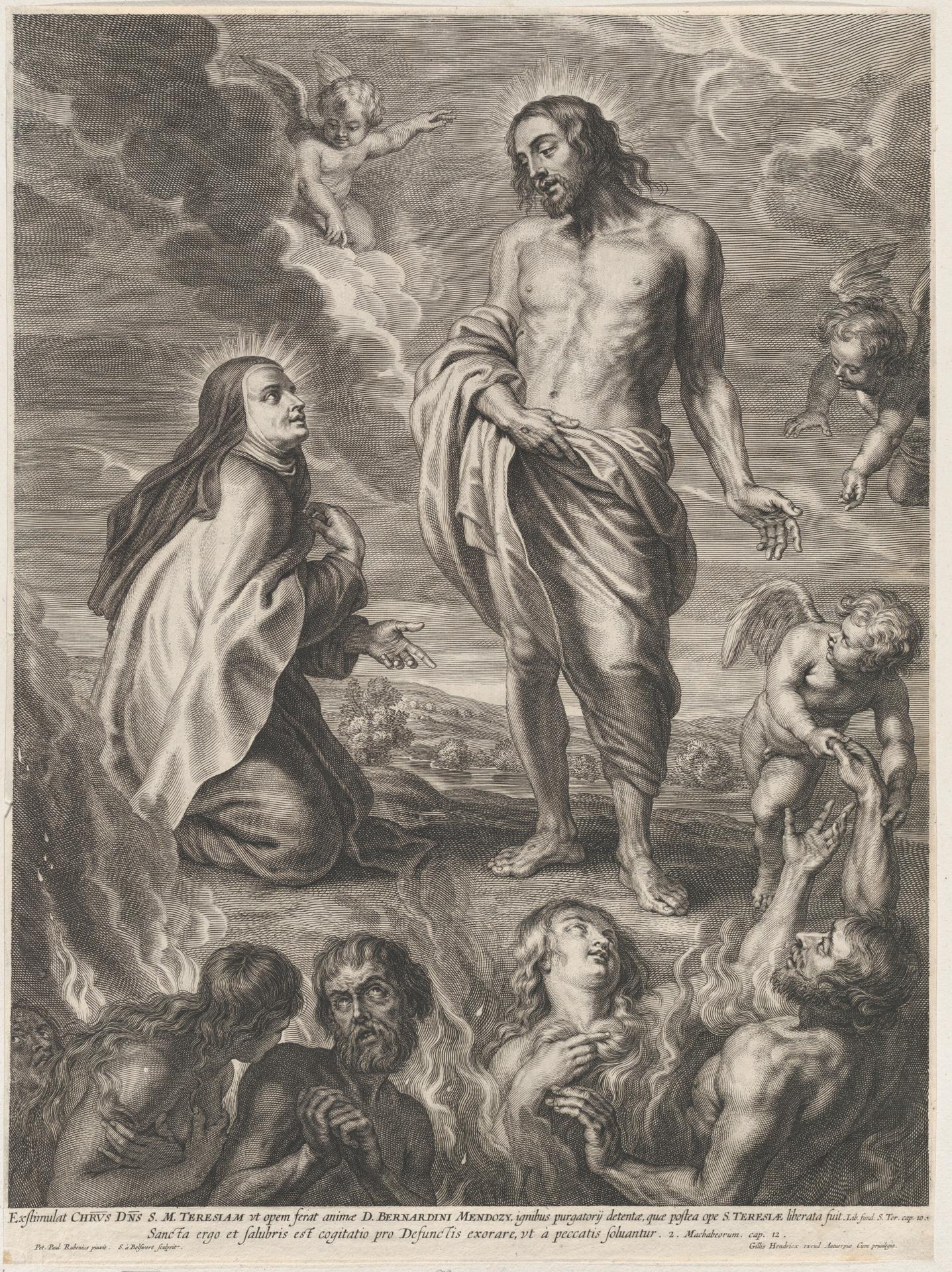
Saint Teresa of Avila interceding for Bernardino de Mendoza (ca. 1640–59)
Original title: Saint Teresa of Avila interceding for Bernardino de Mendoza
kurzbeschreibung
Schelte Adams à Bolswert produced this engraving between about 1640 and 1659. It shows Saint Teresa of Ávila interceding with Christ on behalf of Bernardino de Mendoza. The print is the second of three states and measures 46.2 × 34.3 cm.
Description
Jesus Christ stands at the center, barefoot, in a white robe, his head glowing to signify his divine nature. To the left kneels Teresa of Ávila in a long dress and head covering; her gaze is fixed on Christ, who touches her with one hand. In the lower right appear several angels and figures being touched by Christ, while at the upper left an angel carries a lance. Clouds and rays form the heavenly backdrop; the design orders everything symmetrically toward Christ. The gray tones and strong light-dark contrast are typical of Baroque engraving.
Context
Schelte Adams à Bolswert (1586–1659) was a Dutch engraver, known above all for his reproductive prints after Peter Paul Rubens. This sheet was made in the Baroque period, when religious prints were widely circulated and served both devotion and the dissemination of saints' images. Bernardino de Mendoza was a Spanish diplomat and military man; Teresa of Ávila appears here as his advocate. Who commissioned the engraving or for what occasion is not documented.
Impact
The print gives off a solemn yet intimate atmosphere in which divine grace comes near through the central figure of Christ and the intercession of the saint. The symmetrical arrangement and the contrast of light and darkness direct the eye straight to the divine event and evoke a devout mood.
Technique
Engraving brings the motif onto the plate through fine lines and graduated hatching, from which it is pulled onto paper. This yields detailed tonal values with strong light-dark contrasts. The present sheet is the second of three printing states, which attests to reworking of the plate.
AI-generated description text
Source: Metropolitan Museum of Art · Public Domain (CC0 1.0)