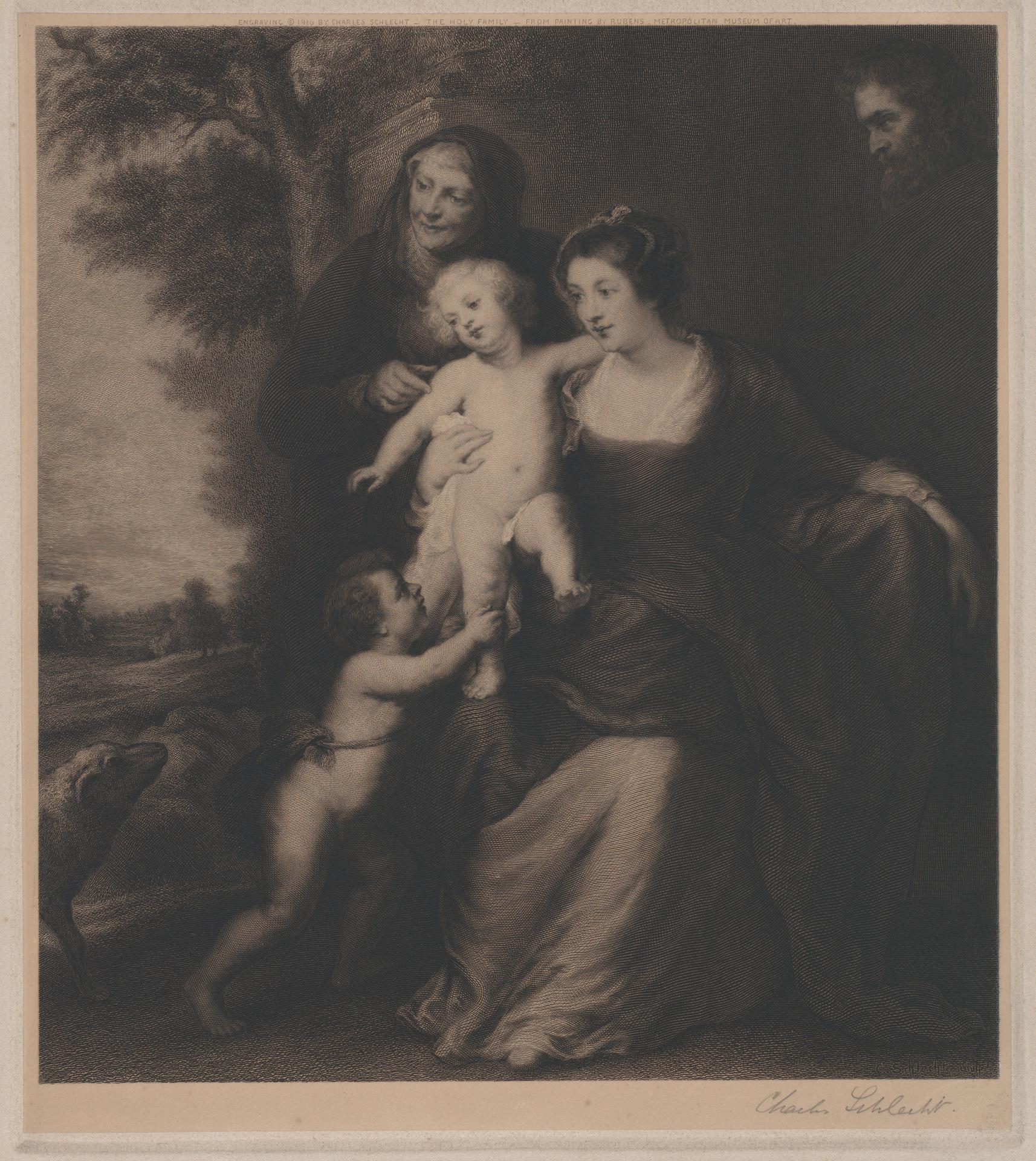
The Holy Family with Saint Anne and the infant Saint John the Baptist
Original title: The Holy Family with Saint Anne and the infant Saint John the Baptist
kurzbeschreibung
This engraving from 1916 by Charles Schlecht takes up a theme from Christian tradition: the Holy Family with Saint Anne and the young John the Baptist. Set in a rural landscape, the multi-figure scene draws on the long tradition of religious family portraits. The print is executed as an engraving, an intaglio technique.
Description
A seated woman holds a child on her lap, while a second woman stands beside her carrying another child. A small boy approaches the child on the lap; a dog appears in the left foreground. A man observes the group from the background, framed by trees and a bright sky. The figures wear traditional garments, and the layout is symmetrically arranged around the central group. Muted grays dominate the image, with soft light falling from the front to highlight faces and fabrics.
Context
Created in 1916 during World War I, when religious subjects were increasingly in demand in art. Schlecht thus takes up a popular motif of Old Master painting and translates it into engraving. His work belongs to the tradition of reproductive printmaking, which made religious images accessible to a wider public. Little is known about the artist's life, but his output is situated in the milieu of the early 20th-century Munich art scene.
Impact
The symmetrical arrangement and calm expressions evoke a solemn, devotional mood. Through the precise linework of the engraving, the scene gains a clear, almost ceremonial presence that emphasizes the religious message of the motif.
Technique
For this engraving, the lines were cut into the printing plate with a burin. The technique allows exact, fine hatching, with which garments and landscape are modeled in detail. The restrained gray scale results solely from the application of lines, without additional tone plates.
AI-generated description text
Source: Metropolitan Museum of Art · Public Domain (CC0 1.0)