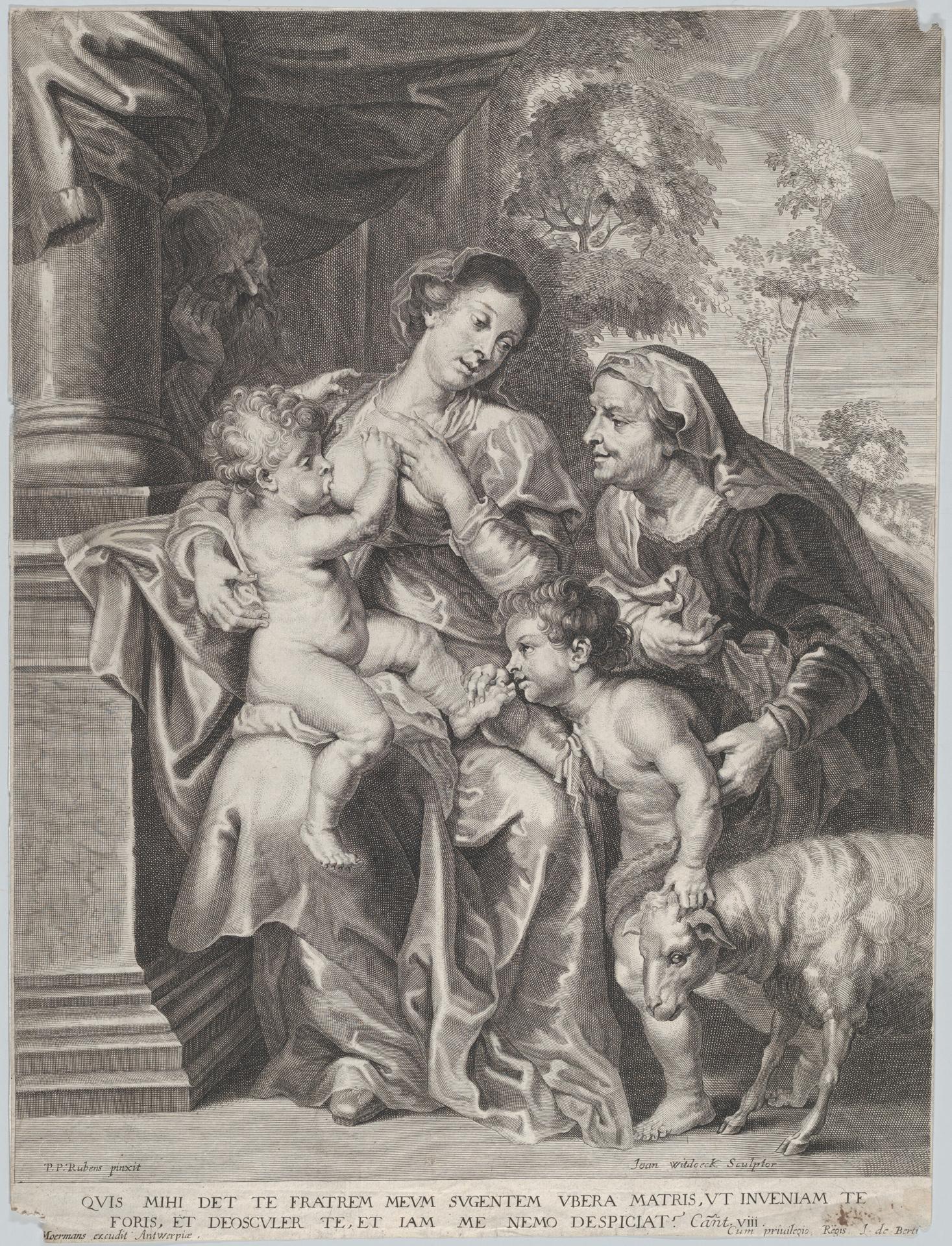
The Holy Family with Elizabeth and the infant Saint John the Baptist, the Virgin nursing the infant Christ
Original title: The Holy Family with Elizabeth and the infant Saint John the Baptist, the Virgin nursing the infant Christ
kurzbeschreibung
Unlike related prints from Rubens's circle, Jan (Hans) Witdoeck's engraving gives the nursing of the Christ Child the central role. Made around 1635–42, the work measures 42.4 × 31.9 cm and survives as the second of three states. Its Baroque character comes through in precise linework and a balanced arrangement.
Description
Mary has settled on a low base and offers her breast to the Christ Child, while Elizabeth turns toward her and wraps the infant in a cloth. Barefoot and plainly dressed, the young John the Baptist stands nearby; a lamb points to Christ. A tree and part of a building frame the group at the back. The figures cluster at the middle, brought forward by diffuse light from the front. The monochrome range of greys follows from the engraving technique.
Context
Witdoeck, a Flemish engraver, worked closely with Peter Paul Rubens and translated his paintings into prints. A Rubens painting of about 1630 served as the model for this Holy Family. The print was published in Antwerp and stresses the Holy Family, as was typical of the Counter-Reformation.
Impact
The calm, symmetrical arrangement creates a solemn mood, carried by soft light and flowing lines. The exact rendering of the garments and the lamb gives the sheet a lively texture that draws the viewer into the event.
Technique
For this engraving the lines were cut into the copper plate with a burin. Fine, parallel hatching produces the greys and models the figures. The second of three states points to later reworking of the plate.
AI-generated description text
Source: Metropolitan Museum of Art · Public Domain (CC0 1.0)