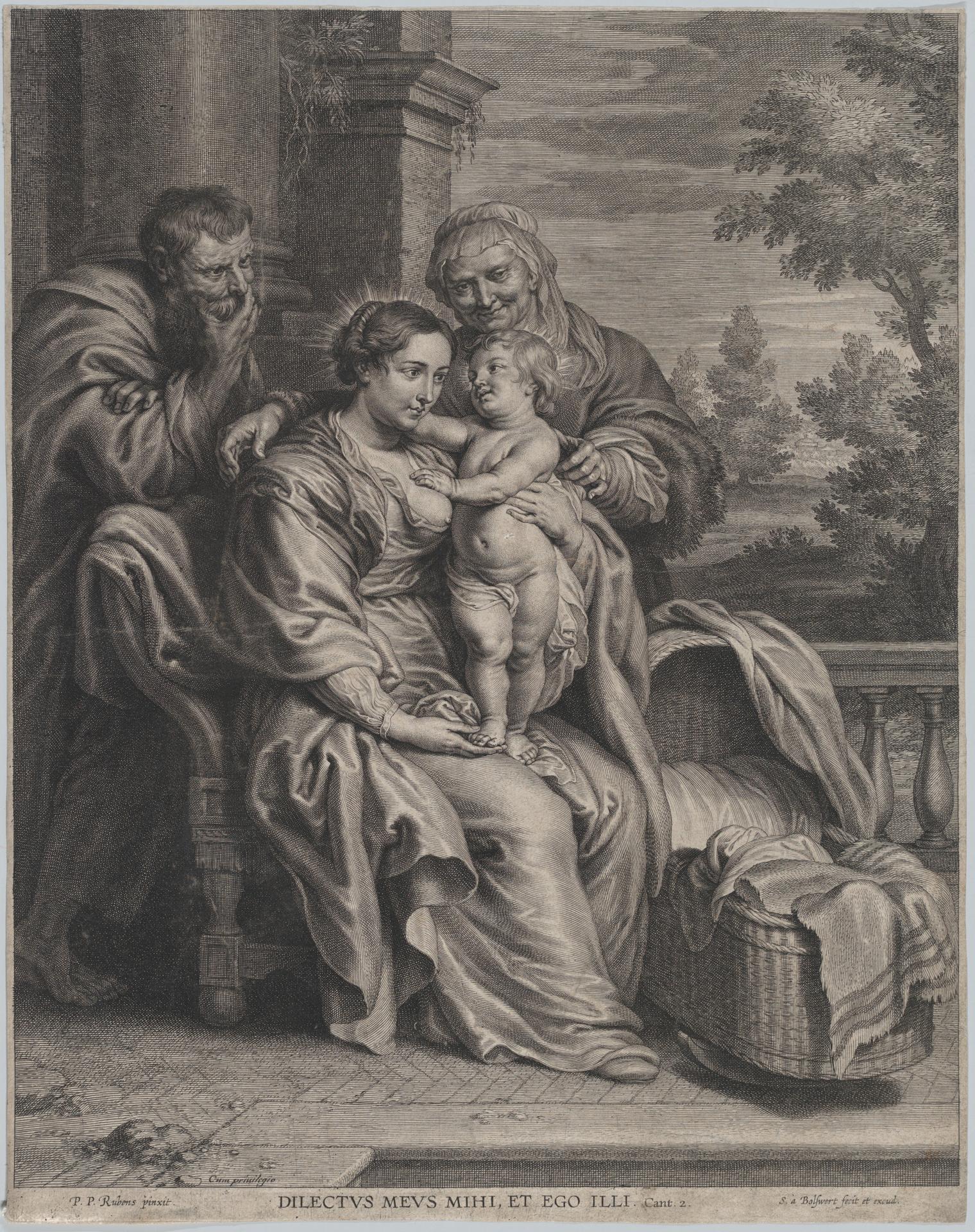
The Holy Family with Saint Anne (ca. 1625–35, Met-Objekt 1165)
Original title: The Holy Family with Saint Anne
kurzbeschreibung
Schelte Adams à Bolswert made this engraving around 1625–35. It presents the Holy Family with Saint Anne: Mary with the Christ Child, flanked by Joseph and Anne. The layout is symmetrical, with Mary and the child at the center and the two other figures to either side.
Description
Mary sits in the foreground, holding the Christ Child on her lap; Joseph appears on the left, the older Saint Anne on the right. The biblical garments are rendered with fine, flowing lines that differentiate textures, especially the folds of drapery. Trees and part of a building suggest an outdoor setting. The monochrome printing, with restrained tonal values, is characteristic of engraving. Baroque style is evident in the precise linework, which emphasizes both fabric textures and facial features.
Context
Schelte Adams à Bolswert (1586–1659) was a Dutch engraver known for reproductive prints after paintings by Flemish masters such as Peter Paul Rubens. This sheet was made in the first half of the 17th century, when religious printmaking was widespread. The motif of the Holy Family with Anne was popular in Catholic art of the Counter-Reformation because it emphasized the intercession of the saints. The print exists in a second state, indicating that the plate was reworked.
Impact
The symmetrical arrangement and calm treatment create a solemn, devotional mood. Fine hatching and soft shadow transitions produce an almost painterly effect that invites quiet contemplation.
Technique
The lines were engraved into a copper plate and then transferred to paper with printing ink. This method allows high detail, seen in precise contours and subtle hatching. The impression has been trimmed to 42.3 × 33.4 cm, suggesting later treatment of the sheet.
AI-generated description text
Source: Metropolitan Museum of Art · Public Domain (CC0 1.0)