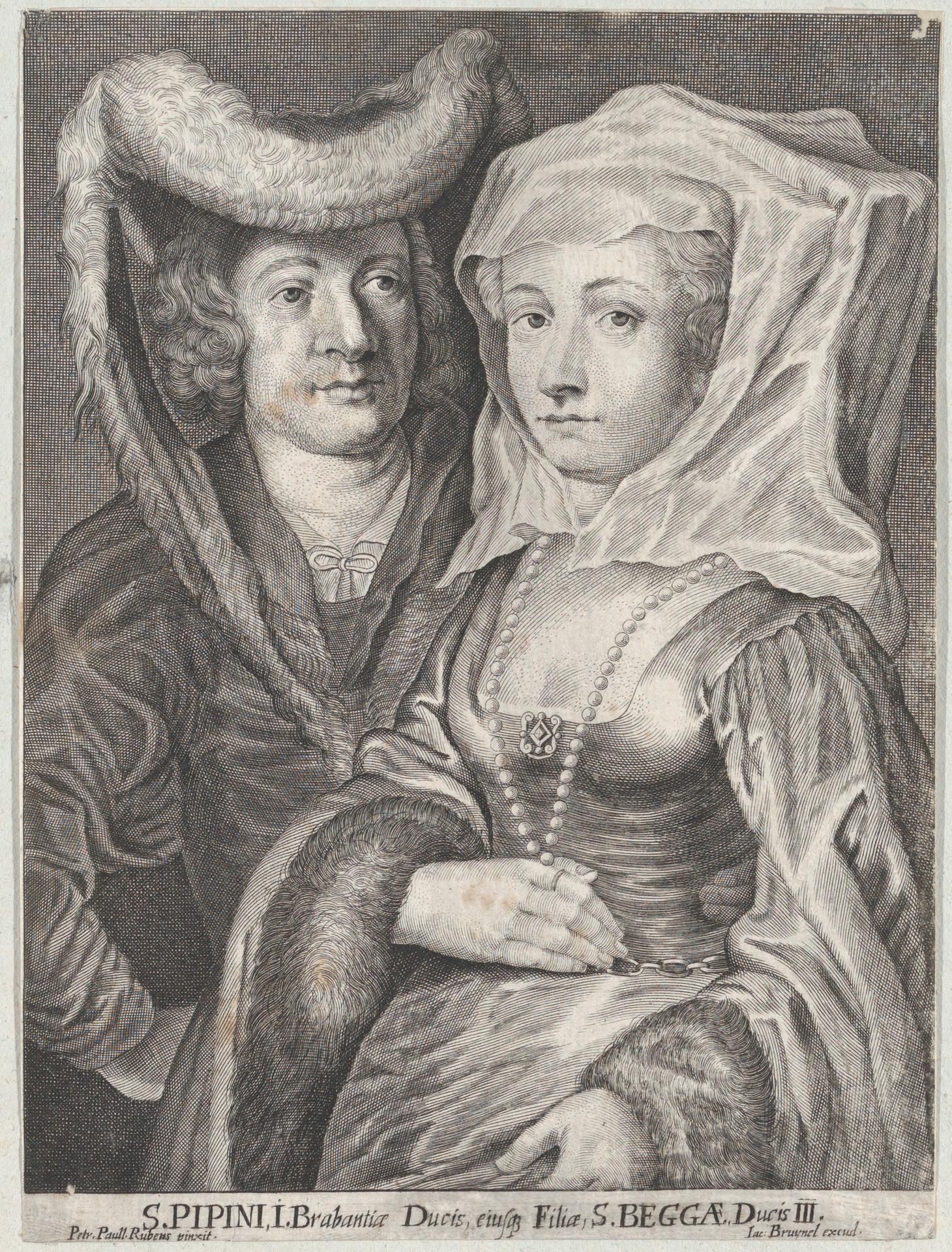
Saint Pepin I and his daughter, Saint Begga (ca. 1650–1700)
Original title: Saint Pepin I and his daughter, Saint Begga
kurzbeschreibung
An anonymous etching from around 1650–1700 presents Saint Pepin I, Duke of Brabant, together with his daughter, Saint Begga. This impression is a reverse copy of an earlier engraving. The etching has been trimmed to a sheet measuring 19 × 14 cm.
Description
Two saints appear in half-length. At the left stands Pepin I in a fur cap and a dark gown whose sleeves are trimmed with fur. Begga is shown at the right, wearing a veil, a pearl necklace and a brooch at her neckline. Both figures look in the same direction, their hands clasped. A plain ground sets the pair apart from their surroundings. An inscription along the lower edge supplies the names and titles of those depicted.
Context
The print dates from the seventeenth century, a period when devotion to the Frankish saints Pepin and Begga was widespread, especially in the southern Netherlands. Its design follows a familiar type of saint portrait used for private devotion or to illustrate hagiographic texts. That it is a reverse copy points to reproduction after an older model. The absence of an attribution makes it difficult to place the sheet within a specific oeuvre.
Impact
The symmetrical placing and frontal stance of the figures give the print a solemn, formal character. Delicately graded lines and hatching create a calm, contemplative mood that invites devotion. With no colour present, attention settles entirely on the faces and gestures of the saints.
Technique
The etching depends on evenly drawn lines and characteristic stroke work. The biting process allowed for very detailed and precise rendering. The present impression is a reverse version, produced by copying the original engraving.
AI-generated description text
Source: Metropolitan Museum of Art · Public Domain (CC0 1.0)