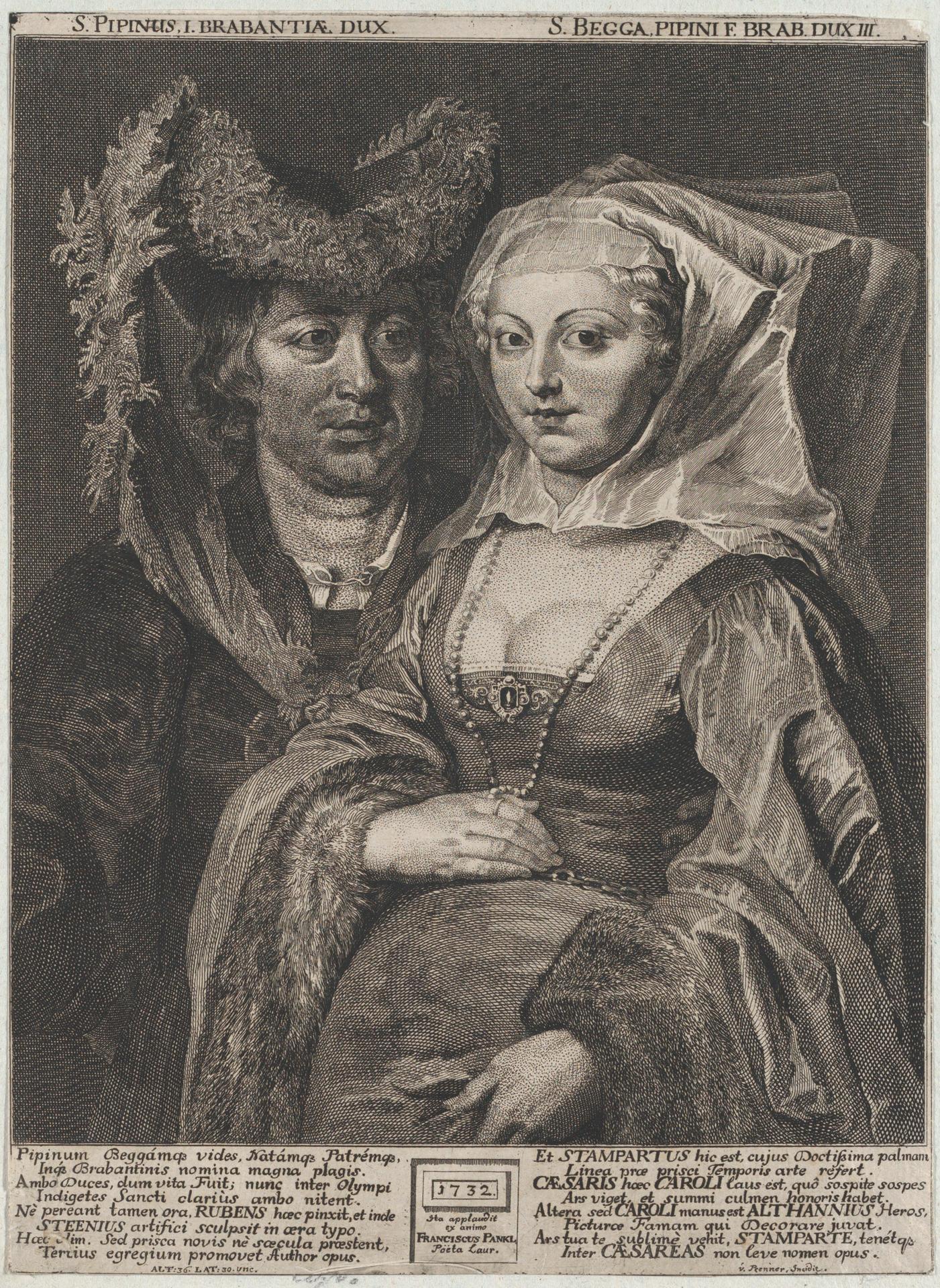
Saint Pepin I and his daughter, Saint Begga (1732)
Original title: Saint Pepin I and his daughter, Saint Begga
kurzbeschreibung
Anton Joseph von Prenner produced this etching in 1732 as a reverse copy. It presents Saint Pepin I and his daughter, Saint Begga, as a pair of saintly portraits. The sheet survives as a single print and belongs to the field of reproductive printmaking.
Description
The arrangement reads as a mirror image: Pepin stands on the left, Begga on the right. Pepin wears a feathered headpiece and a fur-trimmed cloak, while Begga appears in a gown with a striking belt and a pearl necklace. Both direct their gaze the same way, underscoring their bond. A dark ground sets off the figures. At the top, the saints' names are inscribed in Latin; below, a block of text provides further details and the year 1732.
Context
Prenner, an Austrian draughtsman and engraver of the Baroque, is known for his reproductive prints. This 1732 etching reverses an older model, a common means of circulating saints' images in Catholic lands. Pepin I and Begga were venerated as ancestors of the Carolingians and as saints in Brabant. Prints like this served private devotion and the cultivation of local saintly cults.
Impact
The mirrored layout and dark ground give the sheet a solemn, formal presence. Through costume and Latin inscriptions, the figures feel distant and venerable. The etching's monochrome draws attention to line and facial features, creating a quiet, contemplative mood.
Technique
This work is an etching: the drawing was incised into a metal plate, which was then bitten with acid. The present version is a reverse copy, made in reverse after another print. Trimmed to 23.1 × 17 cm, the sheet suggests later use as a single leaf.
AI-generated description text
Source: Metropolitan Museum of Art · Public Domain (CC0 1.0)