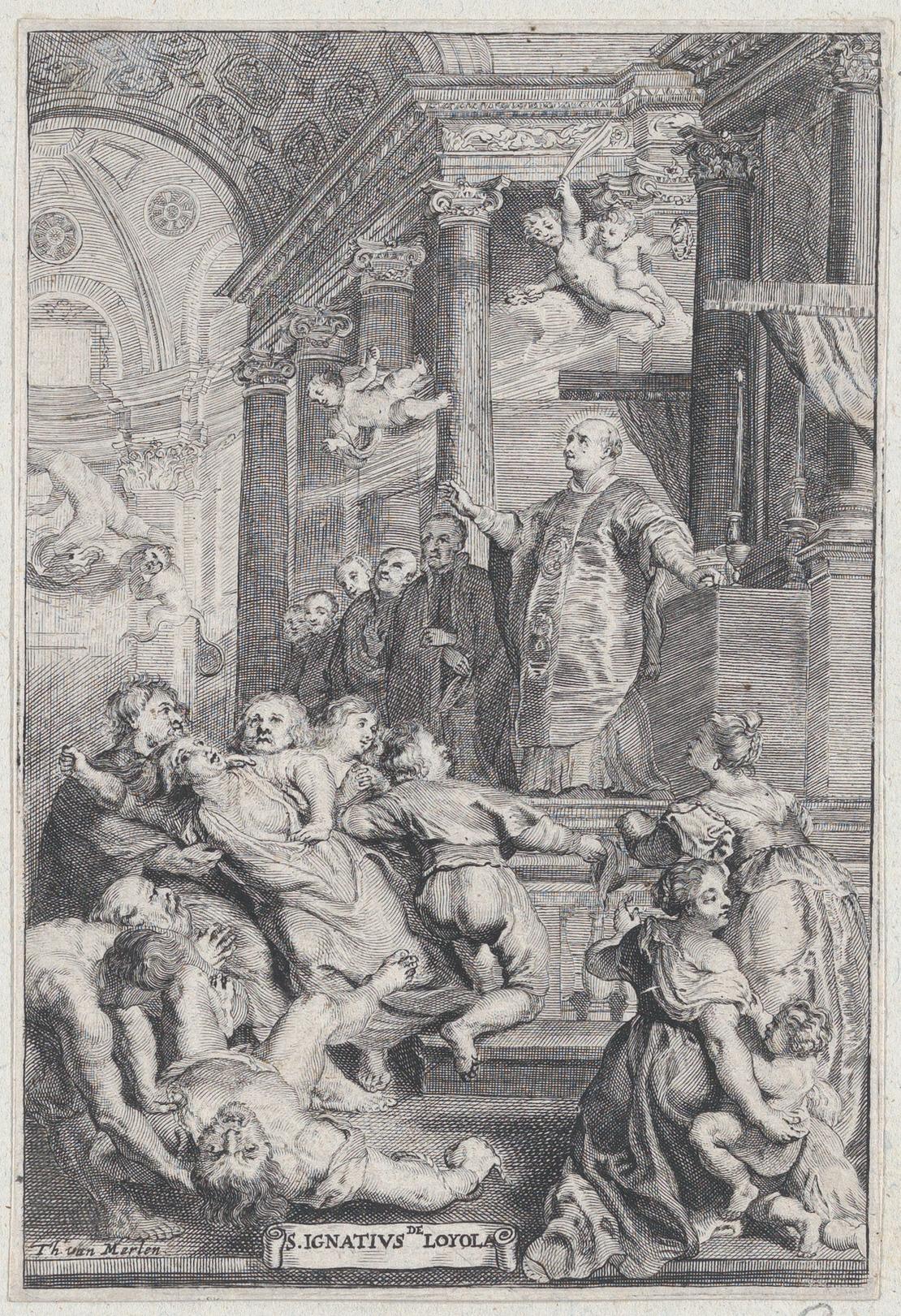
The Miracles of Saint Ignatius of Loyola
Original title: The Miracles of Saint Ignatius of Loyola
kurzbeschreibung
Unlike typical devotional images of Saint Ignatius of Loyola, this etching by Theodor van Merlen II, made between 1633 and 72, is a reduced copy of a larger original. Measuring just 13.4 × 9.1 cm, the sheet presents the founder of the Jesuits amid a Baroque miracle scene, surrounded by angels and kneeling faithful.
Description
Standing on a raised platform, the saint preaches while several figures lie on the ground at his feet—a reference to a healing. Columns and a vaulted ceiling suggest a sacred setting. Angels hover from above, emphasizing the divine presence. The figures' garments are Baroque, the layout dynamic and focused entirely on the saint. Gray and black tones dominate the etching, with carefully balanced light and shadow.
Context
Theodor van Merlen II worked in the 17th century as a Flemish engraver and publisher in Antwerp. This print is a reduced copy after a larger work on the miracles of Saint Ignatius of Loyola. Ignatius, founder of the Jesuit order, was canonized in 1622; images of his miracles helped spread his cult. Such devotional prints were common in the Baroque period, serving private piety or as book illustrations.
Impact
The dynamic arrangement and central placement of the saint make the miracle feel immediate. Delicate lines and the handling of light create a solemn yet intimate mood that draws the viewer into the event. Angels and the sick lying on the ground underscore divine power and the saint's intercession.
Technique
For this etching, the drawing was scratched into a metal plate, etched with acid, and then printed. The lines are fine and precise, as is typical of Baroque printmaking. As a reduced copy, the plate was likely made after a larger model, allowing a faithful reproduction on a smaller scale.
AI-generated description text
Source: Metropolitan Museum of Art · Public Domain (CC0 1.0)