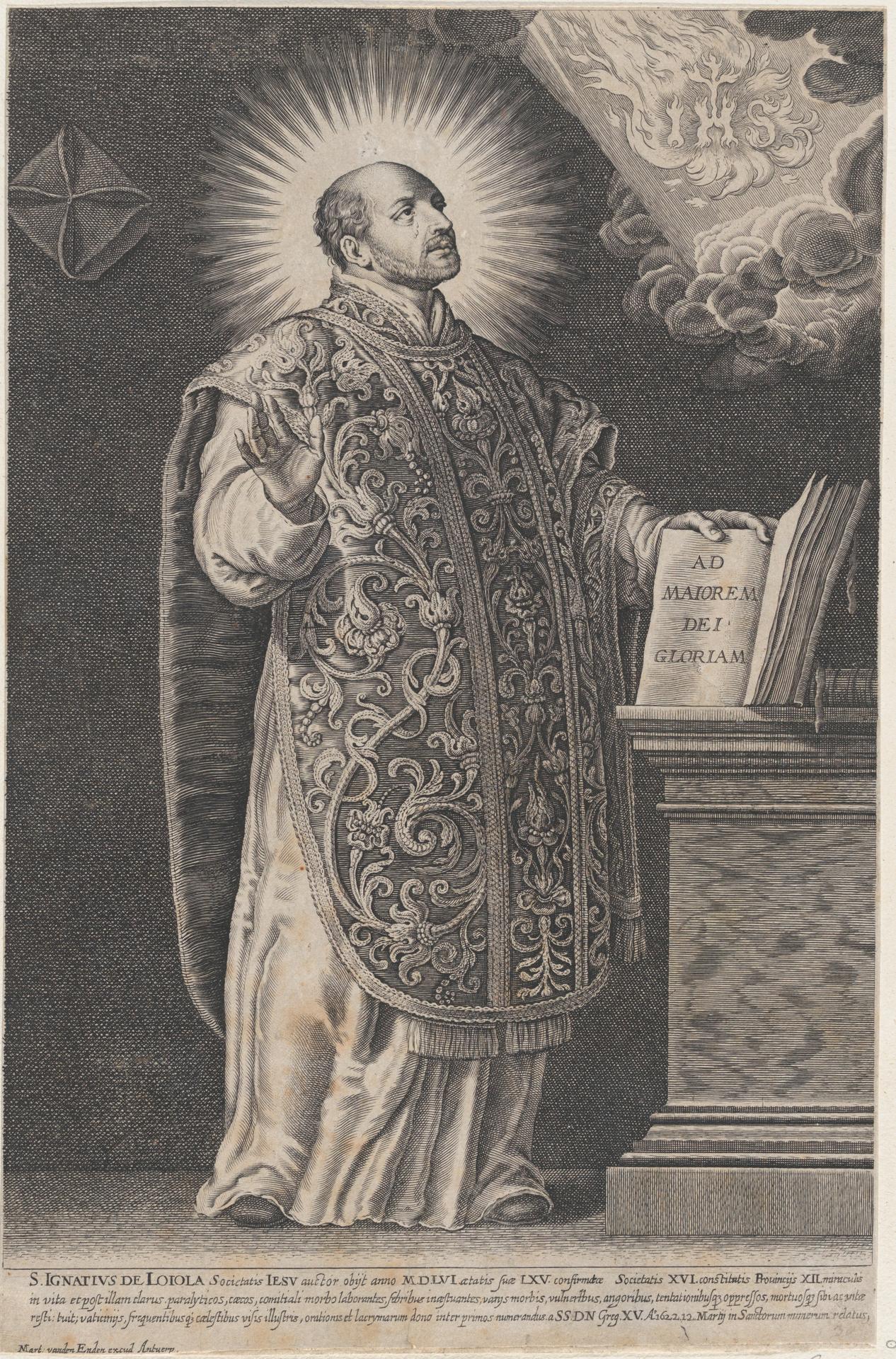
Saint Ignatius Loyola, standing and holding an open book (ca. 1630–54)
Original title: Saint Ignatius Loyola, standing and holding an open book
kurzbeschreibung
Ignatius of Loyola stands upright, an open book held before him, in this anonymous engraving made between 1630 and 1654. The saint appears full-length within a halo of rays, while clouds and a coat of arms frame the symmetrical arrangement. The sheet reproduces a seventeenth-century religious subject as a copy.
Description
At the middle stands Ignatius, before him an opened book bearing the Latin inscription "AD MAJOREM DEI GLORIAM." A luminous halo surrounds his head, marking his sanctity. His garment is sumptuous, richly adorned with embroidery that underscores his dignity. Clouds with an emblem or coat of arms fill the upper area. Below the figure runs a block of Latin text; the layout feels clear and balanced.
Context
Made between 1630 and 1654, the print belongs to an era when Ignatius of Loyola, canonized in 1622, received great veneration in Catholic art. As a copy of another engraving, the sheet attests to the motif's wide circulation. The inscription "Ad maiorem Dei gloriam" quotes the motto of the Jesuit order, which Ignatius co-founded in 1540. Such devotional images were meant to encourage veneration of the saints and were often printed in larger editions.
Impact
The bright halo and symmetrical ordering draw the eye at once to the saint's face and the book. Hard contrasts of light and shadow in the garment give the view a solemn, dignified note. The clear pictorial structure and the Latin inscriptions invite the viewer to contemplative absorption.
Technique
The artist worked in engraving: lines were cut into a metal plate and then printed. The monochrome rendering uses finely graduated lines to bring out the embroidery of the garment and the structure of the clouds. The sheet has been trimmed, so the original margins and any possible inscriptions are missing.
AI-generated description text
Source: Metropolitan Museum of Art · Public Domain (CC0 1.0)