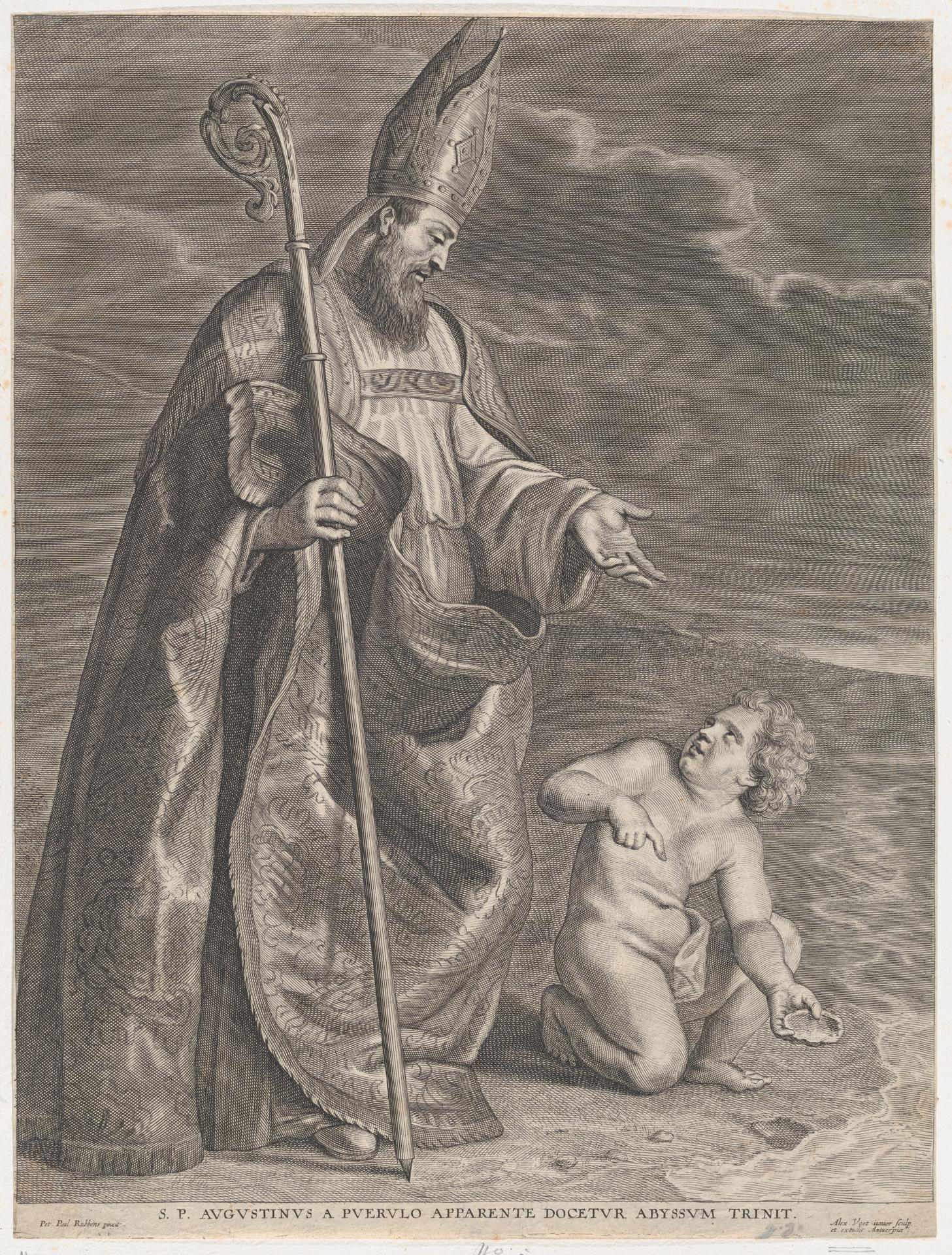
Saint Augustine, appearing to a child on a beach (ca. 1662–95)
Original title: Saint Augustine, appearing to a child on a beach
kurzbeschreibung
Created around 1662–95, this engraving by Alexander Voet II depicts Saint Augustine's encounter with a child on the beach. The child kneels before him, and the print is in black and white; it is the first of two states.
Description
Clad in a splendid, patterned bishop's robe and holding a staff, Augustine stands and extends a hand to the child. The child rests on his knees, looks up at him, and holds something in his hand. Sea and a lightly clouded sky close off the background. The layout is clear, the figures stand out distinctly from one another. Light falls evenly, without noticeable shadows.
Context
This sheet was made in the second half of the 17th century in Flanders, where Voet worked as an engraver. It likely follows a religious pictorial tradition that recounts Augustine's visionary meeting with a child who vainly tries to empty the sea. The print belongs to a series of saint depictions made for private devotion. The first state shows the fine linework characteristic of Flemish printmaking of that era.
Impact
Cleanly drawn lines and the calm arrangement give the scene a solemn, contemplative feel. The juxtaposition of a magnificent bishop and a humble child creates an emotional tension that moves the viewer to reflect on faith and humility.
Technique
The sheet is an engraving printed in black and white, so it contains only shades of gray. The process allows fine lines and hatching, with which the garments and the landscape are captured in detail. The present impression corresponds to the first state as recorded in Hollstein.
AI-generated description text
Source: Metropolitan Museum of Art · Public Domain (CC0 1.0)