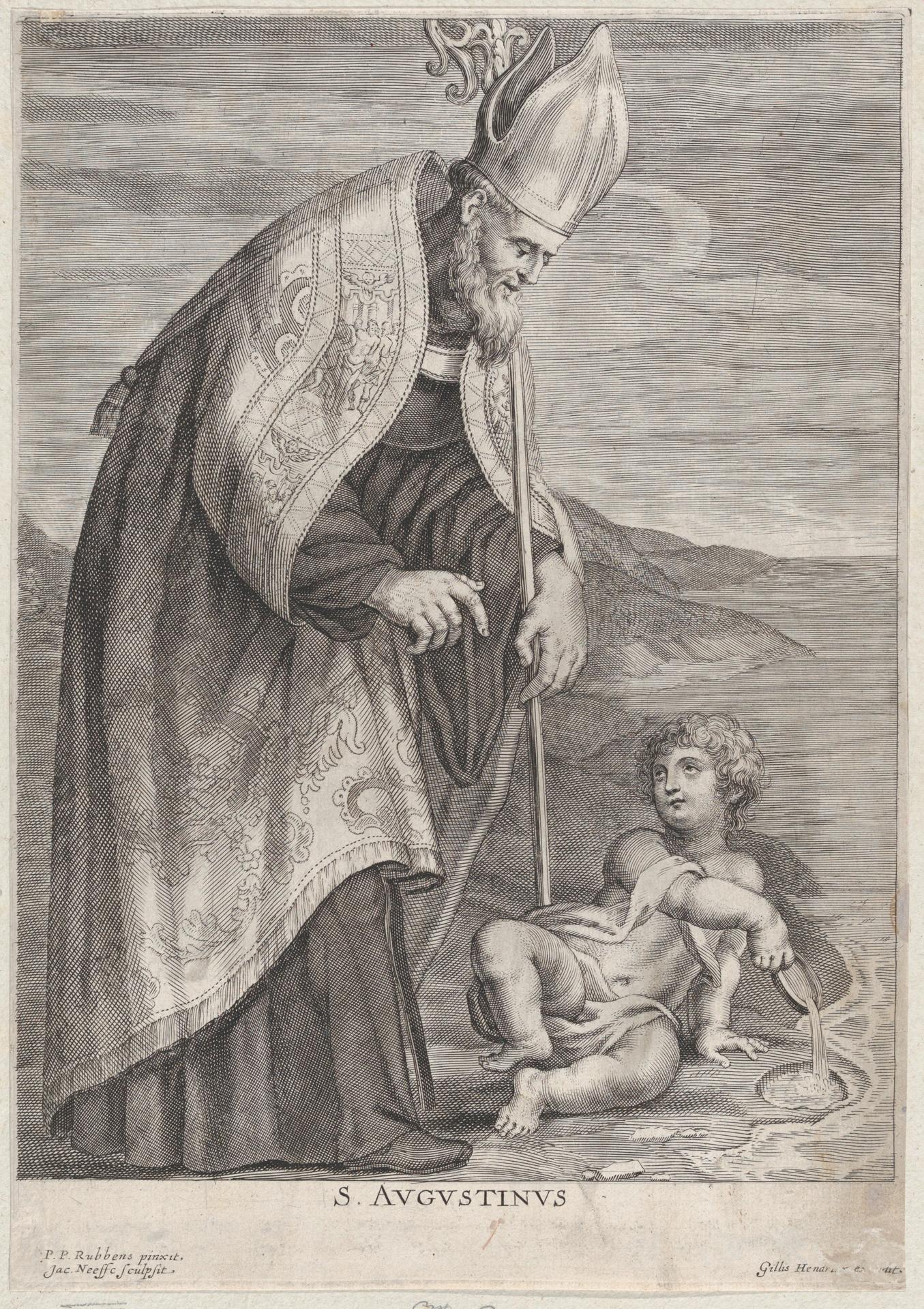
Saint Augustine, appearing to a child on a beach (ca. 1640–60)
Original title: Saint Augustine, appearing to a child on a beach
kurzbeschreibung
Around 1640–60, Jacobus Neefs produced this copper engraving. It presents Saint Augustine in bishop's robes with a staff, encountering a child on the beach. The scene follows the legend in which Augustine cannot grasp the mystery of the Trinity and the child teaches him a lesson. The black-and-white print reveals carefully worked internal drawing.
Description
On the shore, Saint Augustine meets a child. The saint wears an intricately patterned garment, his face serious and thoughtful, and he holds his bishop's staff. The child sits opposite him with a toy nearby. Mountains and sea suggest the coastal setting. The engraving is in black and white, with precise, detailed linework. At the bottom appear the inscription 'S. AUGUSTINVS' and further lines of text.
Context
Jacobus Neefs, a seventeenth-century Flemish engraver, worked in Antwerp and often engraved after designs by other artists. The tale of Saint Augustine and the child on the beach is widely known and concerns the mystery of the Trinity. Devotional images of this kind were popular in Catholic Counter-Reformation art and served religious instruction. The engraving was made at a time when printmaking was used to spread pictorial motifs widely.
Impact
A calm, contemplative mood emanates from the sheet, carried by the expansive landscape and the restriction to black and white. The encounter between the dignified saint and the small child creates a tension between spiritual authority and childlike innocence. The precise linework encourages close attention to details.
Technique
For this engraving, lines were incised into a copper plate and then printed. The precise, fine lines allow high detail and subtle gradations of shading. The sheet is trimmed and measures 28.7 × 20 cm.
AI-generated description text
Source: Metropolitan Museum of Art · Public Domain (CC0 1.0)