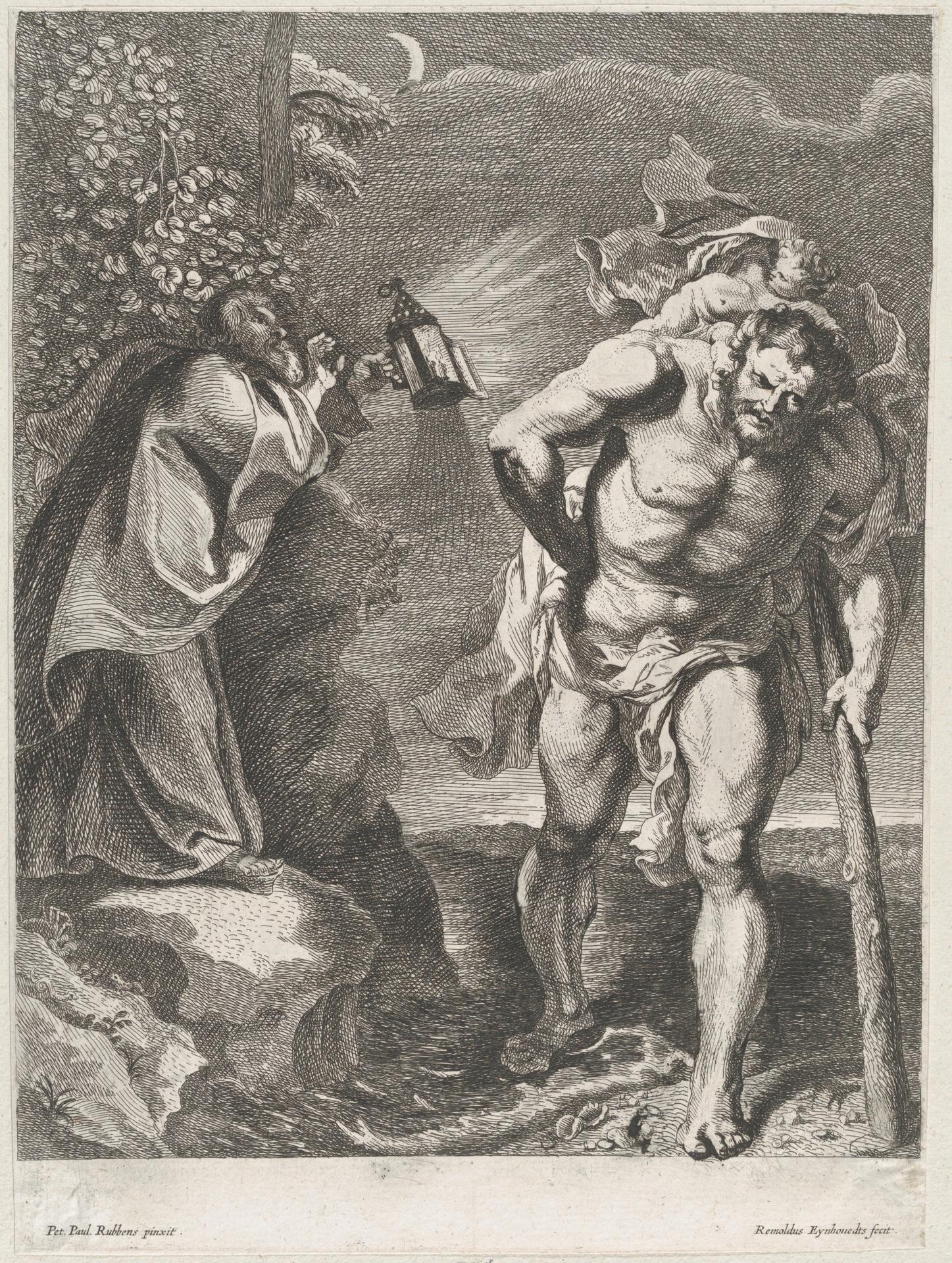
Saint Christopher carrying the Christ child across a stream, another man holding a lantern at left on the riverbank
Original title: Saint Christopher carrying the Christ child across a stream, another man holding a lantern at left on the riverbank
kurzbeschreibung
Rombout Eynhoudts made this etching sometime between about 1636 and 1680. It presents Saint Christopher carrying the Christ child on his back across a river. On the left bank, a man with a lantern stands watching. The print is in the third of three states.
Description
The robust, barefoot Christopher, wearing only an apron and holding a staff, anchors the design. The child sits calmly on his shoulders, gazing to the right. At the left edge, a man with a lantern observes the crossing. Trees and the river's course form the landscape backdrop. The etching remains monochrome, relying on strong contrasts of light and dark to convey the lighting.
Context
Rombout Eynhoudts ranks among the Dutch artists of the early seventeenth century. The legend of Saint Christopher carrying the Christ child over a river was popular in Baroque art because it underscored the saint's protective role. The print appeared in an era when printmaking flourished in the Netherlands, covering both religious and secular subjects. Nothing is recorded about the exact circumstances of its creation, but technique and style point to the realm of Dutch etching.
Impact
The vigorous lines and sharp contrasts give the sheet a dramatic, Baroque character. The muscular saint and the handling of light draw attention to the main figure, lending the scene a quiet but insistent presence. The monochrome execution emphasizes its drawn quality and delicate shading.
Technique
Executed as an etching, the work exists in the third of three states, suggesting careful reworking of the plate. The etching process allows fine lines and shading that support the chiaroscuro effect. The trimmed sheet measures 38 × 22.8 cm, a format common for single-sheet prints of the time.
AI-generated description text
Source: Metropolitan Museum of Art · Public Domain (CC0 1.0)