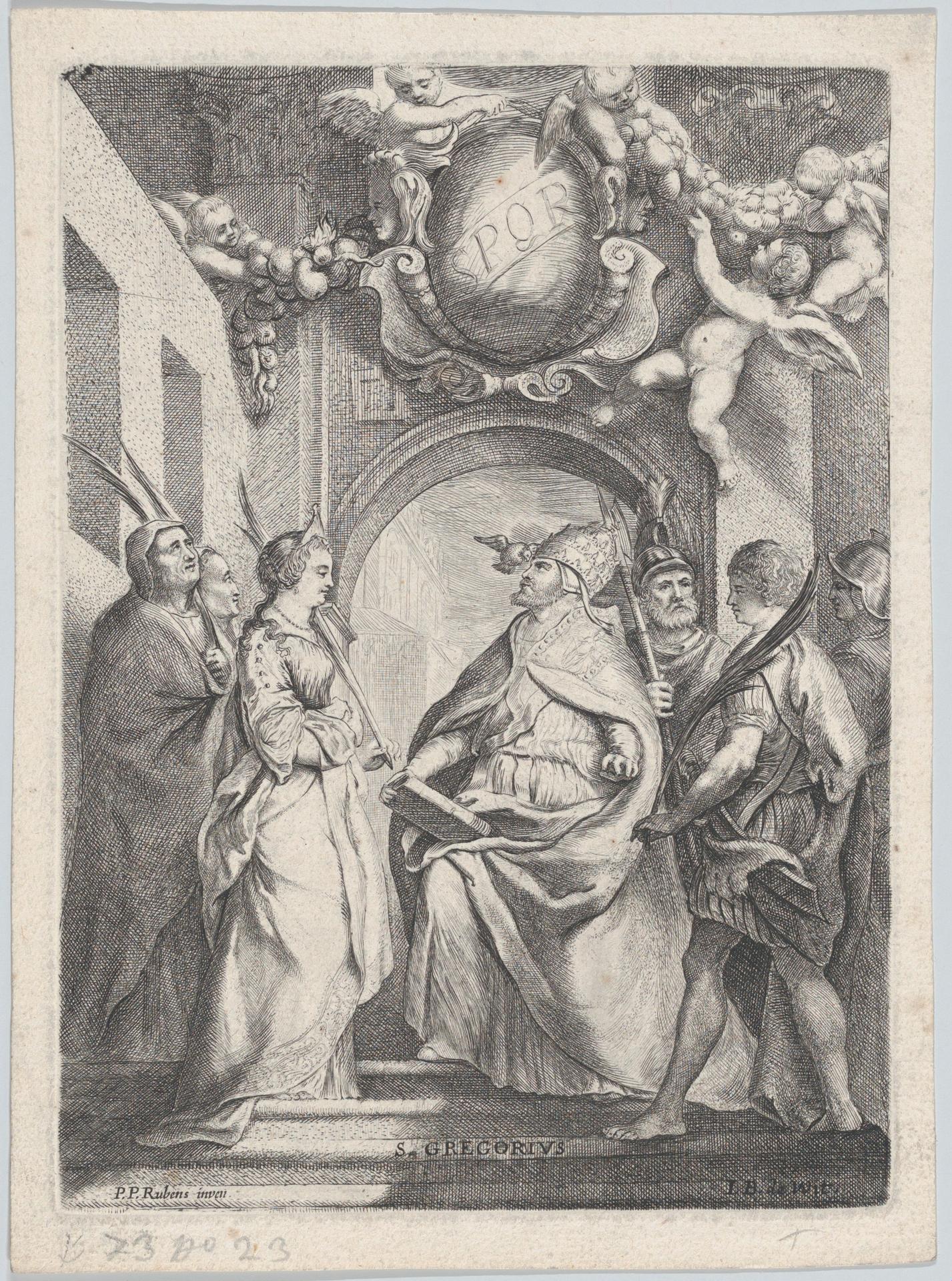
Saint Gregory surrounded by other saints, in front of an archway with putti holding garlands overhead (ca. 1711–54)
Original title: Saint Gregory surrounded by other saints, in front of an archway with putti holding garlands overhead
kurzbeschreibung
Jacob de Wit's etching, made between 1711 and 1754, gathers Saint Gregory with other saints before an architectural backdrop. The print is the second of two states and measures 20.3 × 14.9 cm (plate).
Description
Raised on a pedestal, Saint Gregory occupies the middle, in a long robe and head covering, holding a book. Around him stand figures in varied dress, some with caps, others in armor. A coat of arms with the letters 'SPQR' hovers above the group, surrounded by putti with fruit. Everything fits within an arch that putti decorate with garlands. Light falling from above brings out the contours and surfaces of the figures.
Context
The Dutchman Jacob de Wit worked in the 18th century as a painter and printmaker, valued for his ceiling paintings and drawings in the Baroque style. In his time religious subjects remained alive in art, even in largely Protestant Amsterdam. Saint Gregory, one of the four Latin Church Fathers, carried weight in Catholic pictorial tradition. The letters 'SPQR' allude to the saint's Roman origin and his papacy.
Impact
The print first affects the viewer through its calm, dignified mood, which arises from the clear lighting and the ordered group of figures. The gaze is led from top to bottom, lingers on the faces, then follows the garlands and the coat of arms. The restriction to gray tones and precise linework create a graphic clarity that makes every detail of the scene stand out.
Technique
For this etching, the drawing was incised into a wax-coated metal plate and then etched. The second state suggests that the artist revised or added to the plate compared with the first. Shading comes from fine lines and cross-hatching, as was usual for 18th-century printmaking.
AI-generated description text
Source: Metropolitan Museum of Art · Public Domain (CC0 1.0)