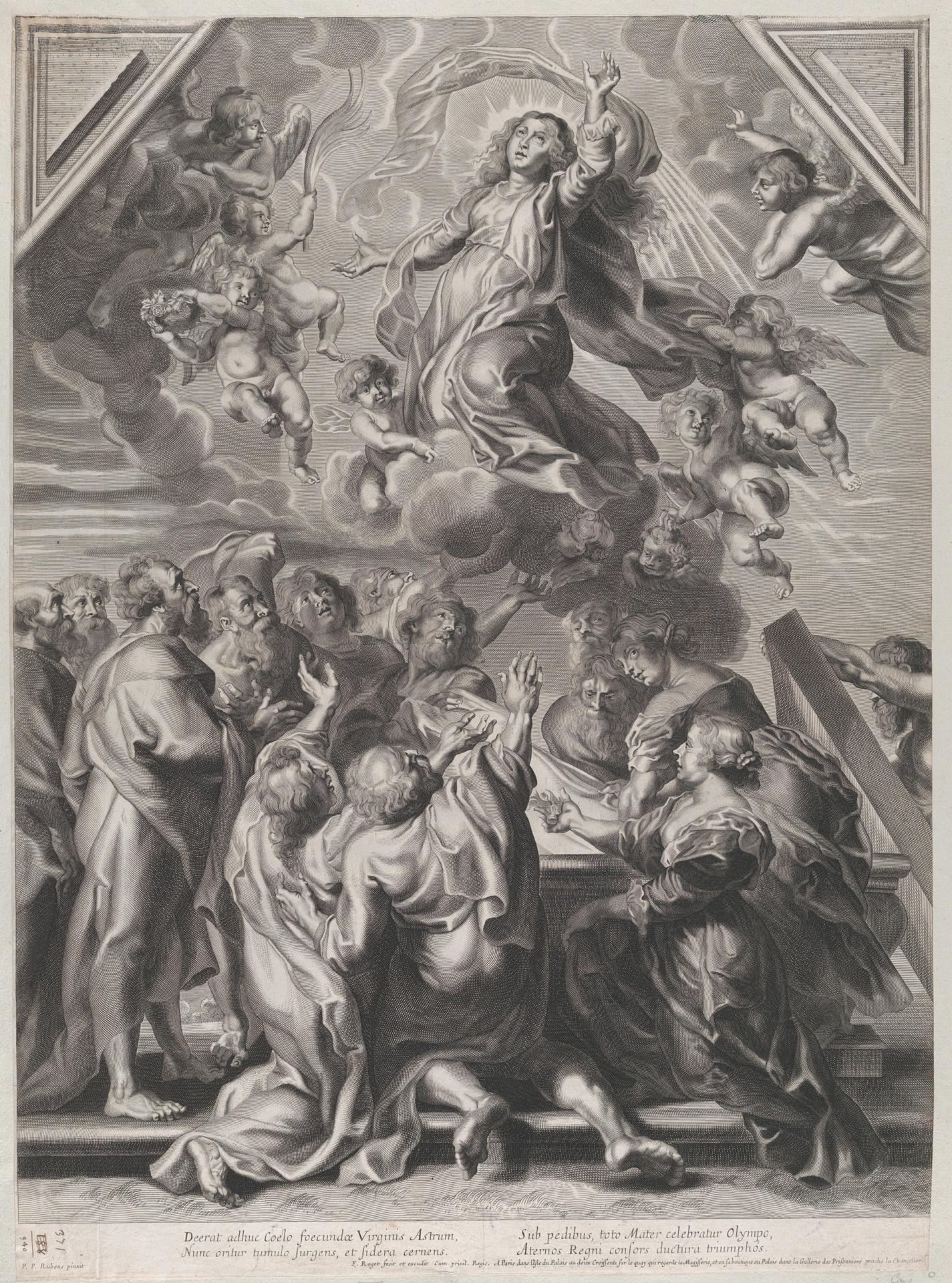
The Assumption of the Virgin
Original title: The Assumption of the Virgin
kurzbeschreibung
François Ragot's engraving 'The Assumption of the Virgin Mary' dates from the mid to late 17th century. It portrays Mary's assumption into heaven, surrounded by angels, while below her the apostles remain in prayer. The print was made using the engraving technique, an intaglio process.
Description
Mary sits enthroned at the center, crowned and bathed in bright light, one hand raised. Angels surround her, some carrying flowers and symbols. In the lower section, several apostles and other figures kneel in prayer. The layout is symmetrically focused on Mary. The black-and-white effect comes from fine hatching that models light and shadow.
Context
François Ragot worked as an engraver in 17th-century France. His career fell in an era when religious subjects dominated art; the Assumption had been a central image in the Catholic Church since the Middle Ages. Who commissioned the work or for what occasion is not recorded.
Impact
The central arrangement and lighting give the print a solemn, elevated mood. The baroque liveliness of the figures and the precise execution create an emotional depth that draws the viewer into the religious event.
Technique
For this engraving, lines were incised into a copper plate and then printed on paper. Fine hatching and cross-hatching create the gray values and light effects. At roughly 65 × 48 cm, the print is a considerable size for a print of that time, which required particularly precise work.
AI-generated description text
Source: Metropolitan Museum of Art · Public Domain (CC0 1.0)