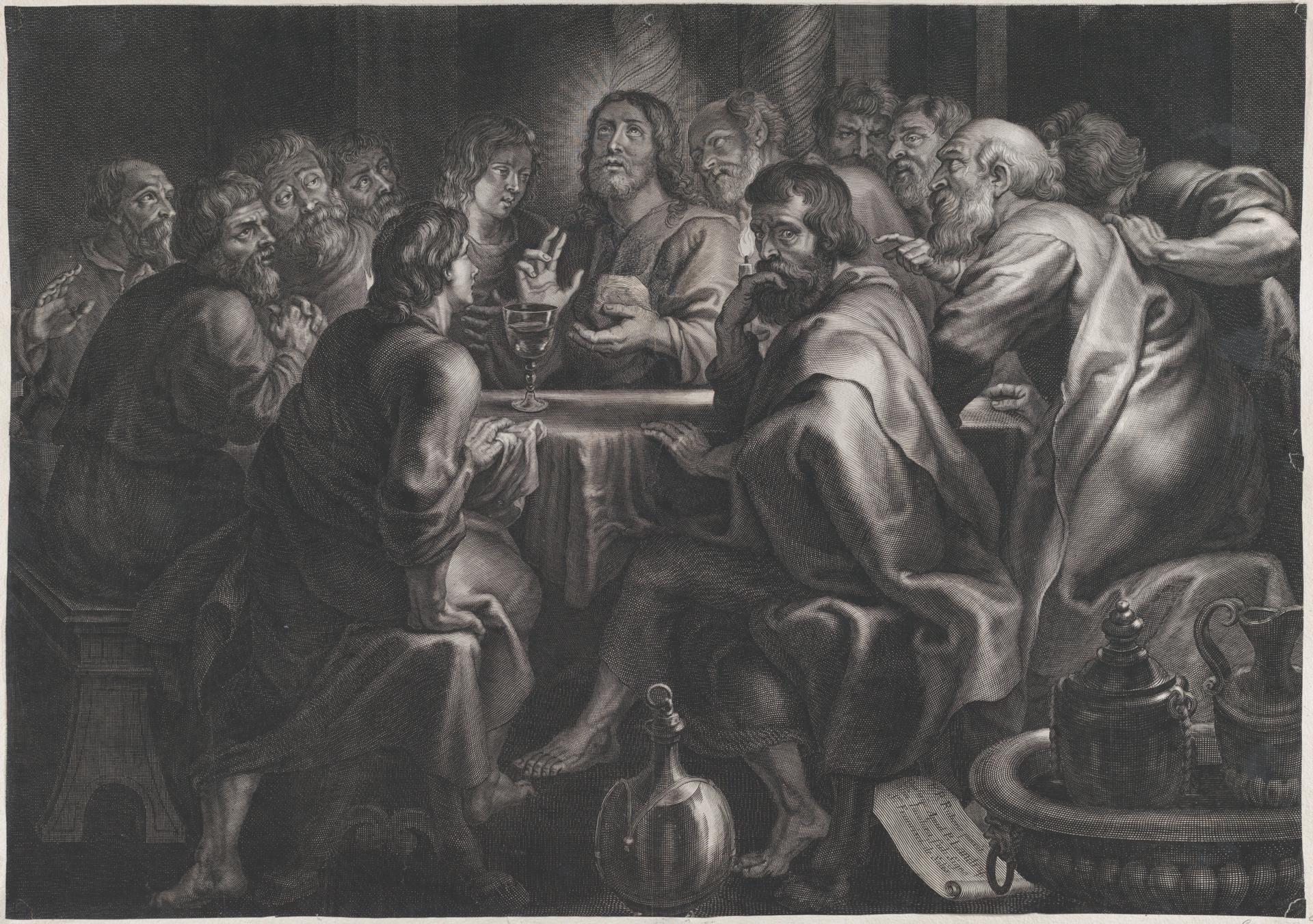
The Last Supper (early 17th–17th century)
Original title: The Last Supper
kurzbeschreibung
Dating to the early 17th century, Pierre Landry's engraving "The Last Supper" shows Jesus Christ among his apostles at their final meal. The print follows the traditional iconography of this subject and survives as a richly detailed impression.
Description
Several men have gathered around a long table, with Jesus Christ occupying the middle position. The apostles wear customary robes, and their lively postures and gestures bring out the tension of the moment. A chalice and a flask on the table stand for wine and water. A balanced arrangement places Jesus at the center, the apostles spread to either side. Soft light defines outlines as well as the shadows of figures and objects.
Context
The Frenchman Pierre Landry worked as a copperplate engraver in the 17th century, producing mainly reproductive engravings after paintings. His print appeared in an era when biblical subjects were widely popular and found buyers both in the church and in private homes. The engraving employs the standard Last Supper iconography, which goes back to Jesus's final meal with his disciples before the crucifixion. Prints of this kind often served religious instruction and carried biblical narratives to broad sections of the population.
Impact
The balanced layout and Jesus's calm central position give the image a solemn, dignified mood. The detailed print and the apostles' animated gestures create a narrative density that draws the viewer into the biblical event. The print's gray tones support the serious, contemplative atmosphere of the subject.
Technique
For this sheet the design was engraved into a copperplate and then printed on paper. Finely graded lines and precise shading reveal considerable manual skill. Gray tones are characteristic of this printing method and bring out the contours and textures of figures and objects.
AI-generated description text
Source: Metropolitan Museum of Art · Public Domain (CC0 1.0)