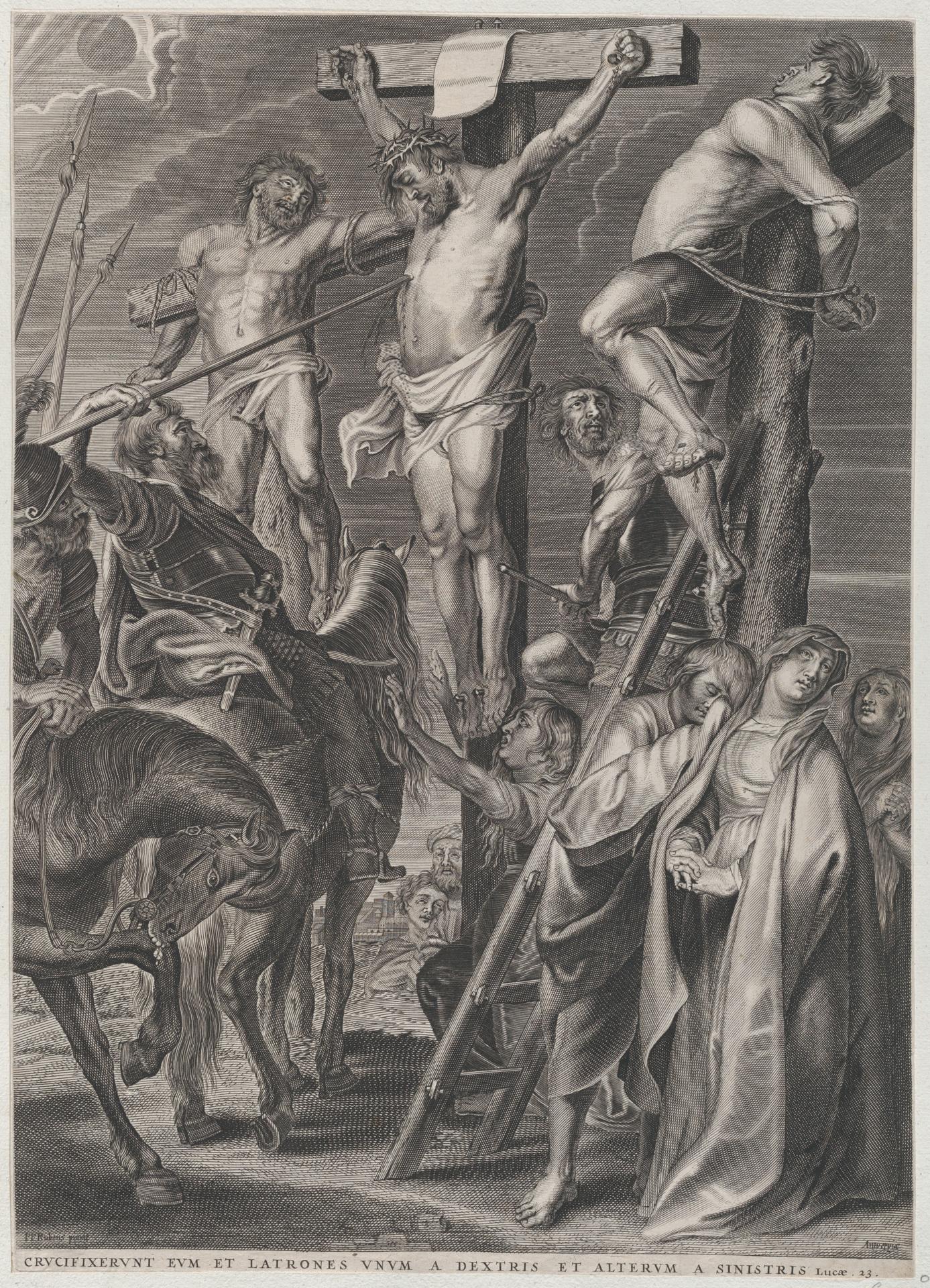
Christ on the cross between the two thieves
Original title: Christ on the cross between the two thieves
kurzbeschreibung
An anonymous engraving from around 1631 presents the crucifixion of Christ as it unfolds between the two thieves. The print survives in a fourth state of four, and the trimmed sheet measures 35.5 × 49.6 cm.
Description
Three crosses anchor the design, with Christ at the center in a long robe and crown of thorns, while the two thieves, more scantily clad, flank him. On the left appears a horseman with a spear; on the right, a crowd of mourning women and men in contemporary dress. Clouds and a suggestion of architecture define the setting. The crosses are arranged symmetrically about the central axis, yet the varied postures and expressions of the figures heighten the drama. As a monochrome sheet, the engraving uses hatching and line to model light and shadow.
Context
This print was made around 1631, an era when religious printmaking circulated widely across Europe. Because the artist remains unknown, neither workshop nor regional origin can be securely identified. The subject follows the biblical account of the crucifixion from the Gospels, a theme frequently rendered in the Baroque period. The existence of a fourth state points to repeated reworking of the plate, suggesting sustained demand or an ongoing development of the work.
Impact
The symmetrical layout and careful drawing of the figures give the image a solemn yet dramatic mood. Clear contrasts between the crosses and the surrounding people draw the eye to the central event and produce a calm but insistent effect.
Technique
This is an engraving: lines were incised into a metal plate and then printed. Shading is achieved through dense parallel lines and cross-hatching, allowing subtle transitions between light and dark. After printing, the paper was trimmed to the dimensions given, so the original plate size can no longer be determined.
AI-generated description text
Source: Metropolitan Museum of Art · Public Domain (CC0 1.0)