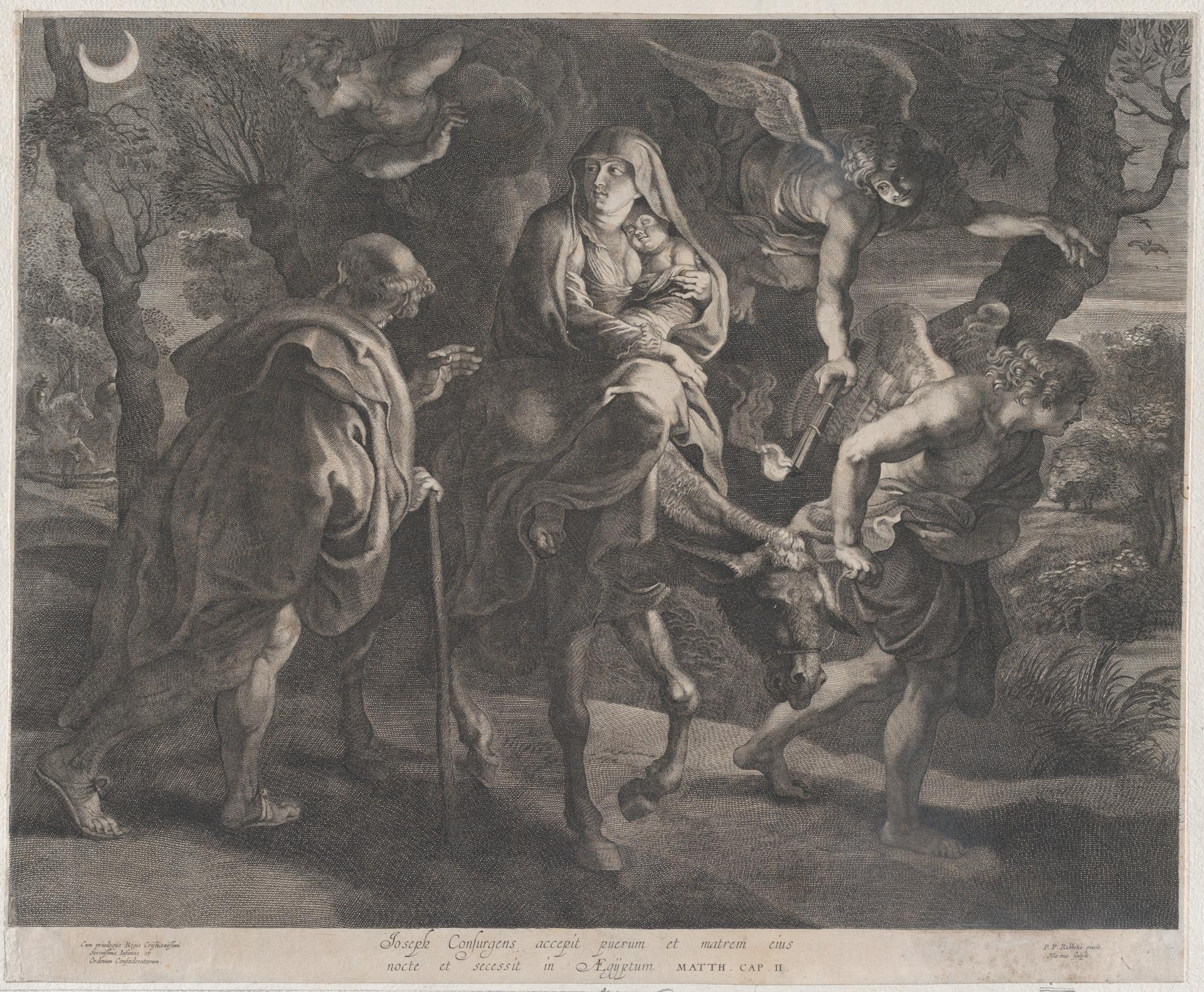
The Flight into Egypt
Original title: The Flight into Egypt
kurzbeschreibung
Ignatius Cornelis Marinus made this print between 1620 and 1640. It shows the Holy Family on their flight: Mary sits on a donkey with the Christ child, Joseph walks beside her, and angels hover over a nighttime landscape. The surviving impression is in the second or third state of three; stylistically, the sheet belongs to the Baroque.
Description
Mary rides a donkey, holding the infant Jesus in her arms, while Joseph strides alongside with a staff. From the upper right an angel glides toward them; another leans down from above. Trees and a moon fill the background, giving the scene a nocturnal feel. The garments follow biblical tradition as was common in pictures of this period. Strong lines and shading bring movement into the image and, together with the subdued light, create a dramatic mood.
Context
The Flight into Egypt is one of the most widespread subjects in Christian art: it tells how the Holy Family traveled to Egypt to escape Herod's massacre of the innocents. Marinus was a Flemish engraver active in the first half of the seventeenth century. His print was made during the Baroque, an era when religious themes were treated with emotional force and dramatic staging. The print likely served as a devotional image or for collectors who valued biblical scenes in graphic form.
Impact
The restless composition and nighttime atmosphere give the sheet an urgent, almost mysterious effect. The way the figures move and the light falls directs the eye to the central group and makes the Holy Family's need for protection palpable. Baroque drama draws the viewer emotionally into the biblical event.
Technique
This is an etching, an intaglio process in which the drawing is scratched into a metal plate and the plate is bitten with acid. It was printed on paper; the sheet measures about 38 × 46.1 cm. Monochrome printing and fine lines are characteristic of seventeenth-century printmaking.
AI-generated description text
Source: Metropolitan Museum of Art · Public Domain (CC0 1.0)