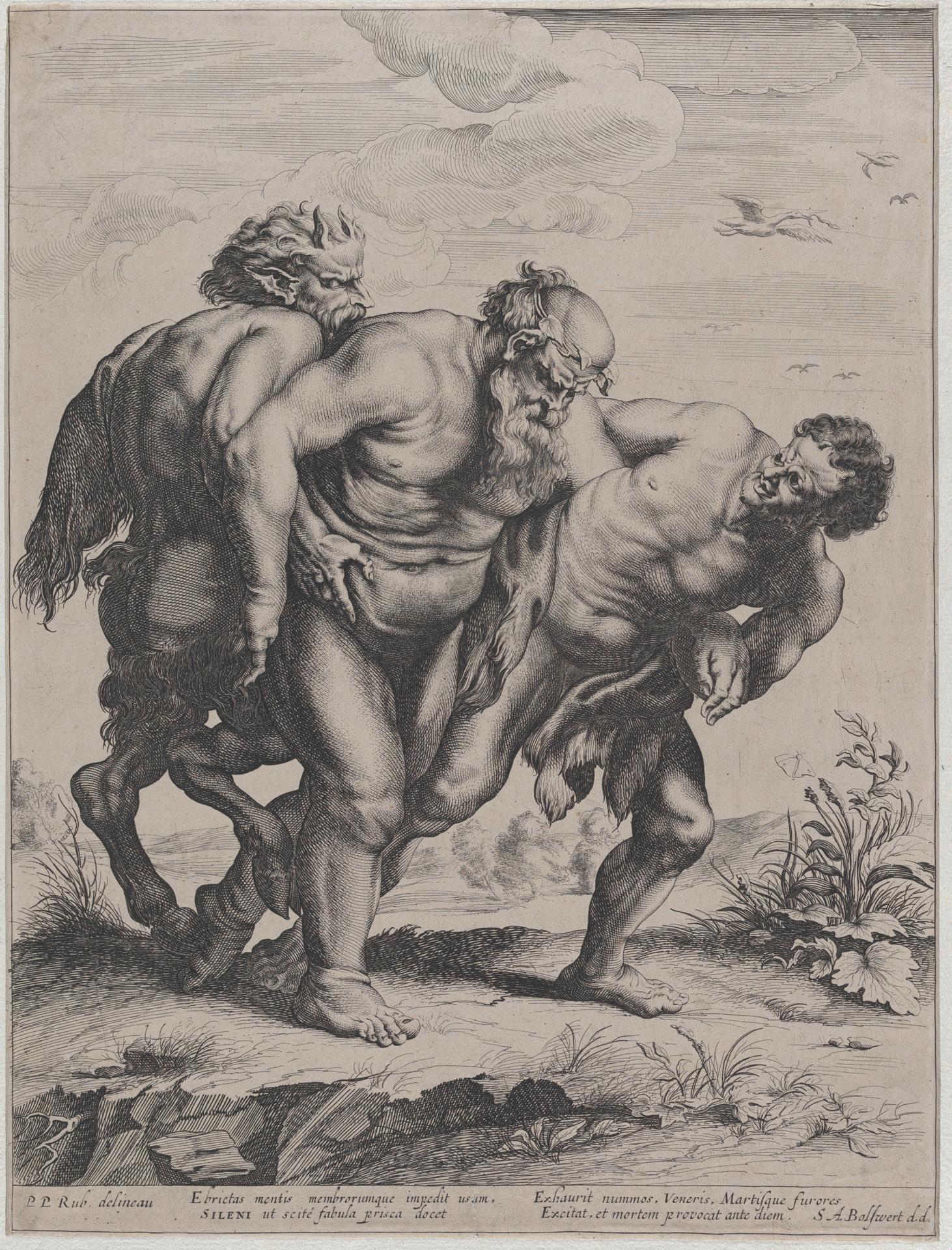
The drunken Silenus, supported by a satyr and a faun
Original title: The drunken Silenus, supported by a satyr and a faun
kurzbeschreibung
Schelte Adams à Bolswert engraved this print at some point between 1625 and 1659. It shows the drunken Silenus propped up by a satyr and a faun. The impression is in black and white and belongs to the second of three states.
Description
Three half-naked men with heavy muscles, short hair and beards crowd together in a restless formation. Silenus, drunk and staggering, occupies the middle, held upright by his companions on either side. The setting is open air: clouds gather, birds wheel overhead, and shrubs and flowers grow in the foreground. The uneven distribution of the bodies and their opposing directions create tension and suggest violent movement.
Context
Bolswert, a seventeenth-century Dutch engraver, won fame for his reproductions after Peter Paul Rubens. This sheet probably derives from a painting or drawing from the master's circle, who treated the drunken Silenus more than once. The span 1625–59 corresponds to the artist's working years; he died in 1659. Prints like this helped bring Flemish Baroque compositions to a wide audience.
Impact
From these muscular bodies comes a forceful, even impetuous movement. Delicate lines and hatching give the figures volume and bring out their plasticity. Because colour is absent, the eye settles entirely on the pictorial structure and the details of the landscape.
Technique
An engraving: lines are cut into a metal plate and then printed. Fine hatching shapes the muscles and the surroundings, with the density of strokes increasing in the shadows. The paper, trimmed to 43.5 × 33 cm, points to a later treatment.
AI-generated description text
Source: Metropolitan Museum of Art · Public Domain (CC0 1.0)