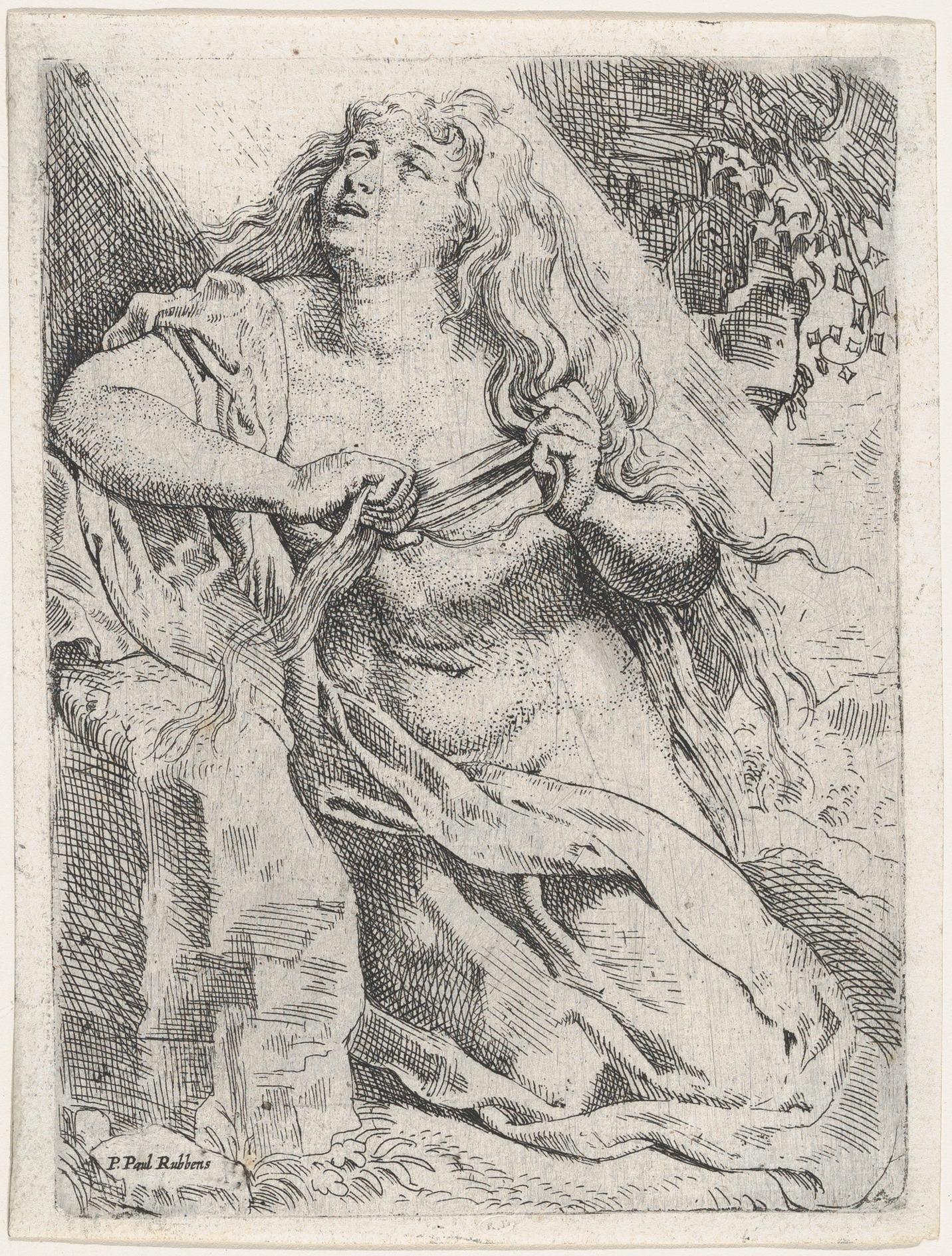
Mary Magdalen in the wilderness
Original title: Mary Magdalen in the wilderness
kurzbeschreibung
Willem Pietersz Buytewech etched Mary Magdalene in the Wilderness around 1613–14. The penitent saint appears in a barren landscape. This impression is the second of three states and measures 13.1 × 10.3 cm (plate). It belongs to the fine printmaking of the Dutch Mannerist tradition.
Description
A woman with long, loose hair gazes upward and to the left. Her simple garment falls loosely around her body. In one hand she holds a piece of cloth, which she examines intently. Wavy lines in the background suggest a natural setting. The figure occupies the foreground, while the landscape behind remains minimal. The layout is asymmetrical.
Context
Buytewech made this etching in the early 1610s in the Netherlands, during a period of active experimentation in printmaking. The motif of the penitent Mary Magdalene was common in both Catholic and Protestant art and served as an example of remorse and contemplation. The artist was known for his inventive arrangements and for linking landscape and figure. The work follows in the wake of Hendrick Goltzius and others who advanced etching technique.
Impact
A quiet, thoughtful mood pervades the print, helped by the figure's upward posture. Delicate lines and the monochrome palette create an intimate, almost meditative atmosphere. The asymmetrical arrangement draws the eye to the figure and her gesture, giving the view depth.
Technique
As an etching, the image is produced through an intaglio process: the drawing is scratched into an acid-resistant ground and then bitten with acid. Buytewech used fine, precise lines to model textures and shading, as was typical of early 17th-century Dutch printmaking. The second state shows reworkings from the first, indicating careful artistic control.
AI-generated description text
Source: Metropolitan Museum of Art · Public Domain (CC0 1.0)