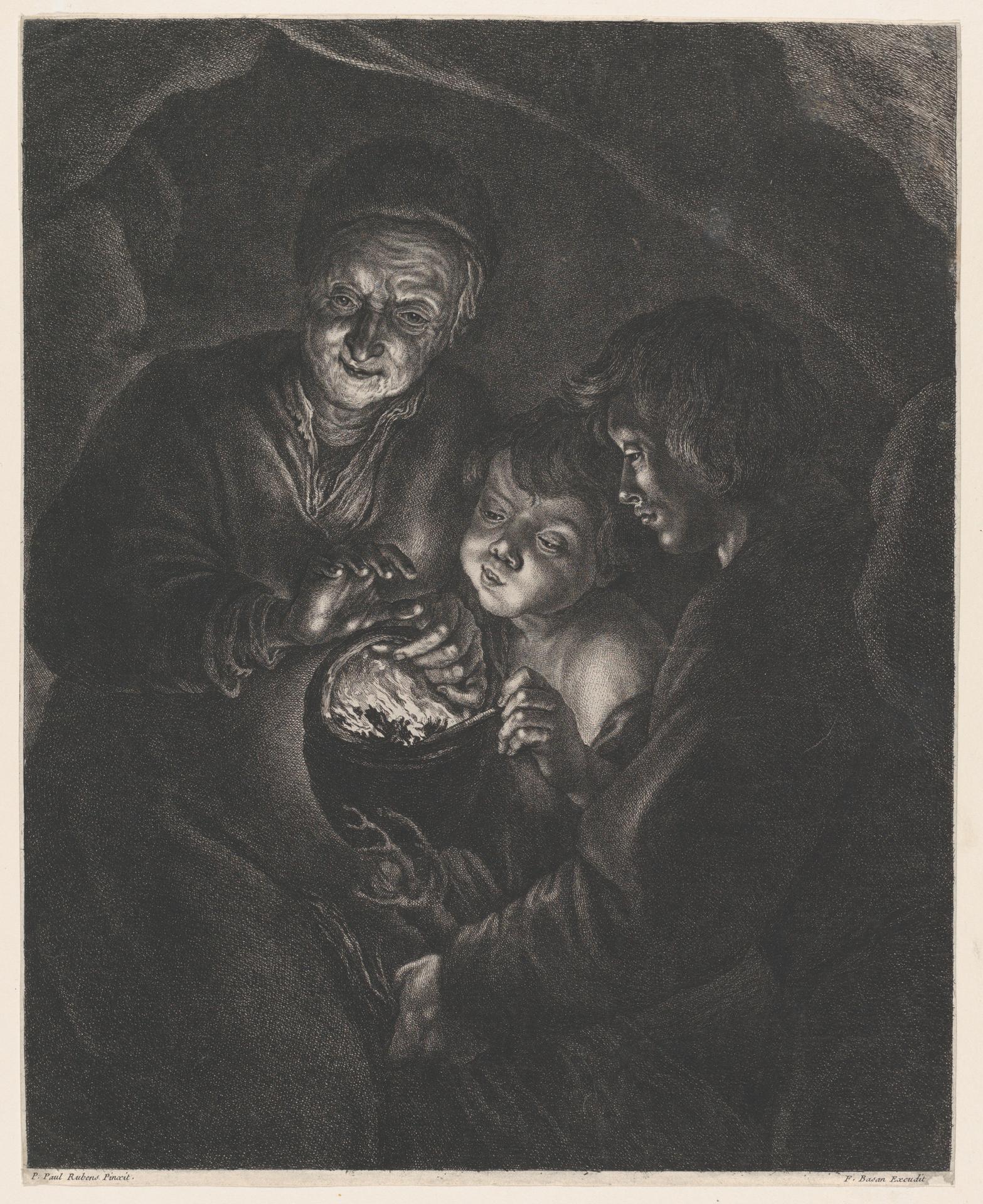
Old Woman with a Brazier, after Rubens
Original title: Old Woman with a Brazier, after Rubens
kurzbeschreibung
Unlike many reproductive engravings of its time, which aimed for decorative effect, this 18th-century print by Pierre François Basan focuses on the quiet presence of an old woman in a hood holding a coal pan, with two children beside her. The engraving is based on a painting by Peter Paul Rubens and exemplifies the period practice of circulating important images through print.
Description
Three figures fill a darkened room: an older woman in a hood carries a bowl, one child next to her supports the vessel, and another looks up at her. The tight grouping creates a sense of closeness. Light falls sparingly, drawing the eye to faces and the bowl. Mostly dark, monochrome tones define the image, as is typical of intaglio printing. The arrangement centers on the old woman, who serves as the focal point.
Context
As the 18th century progressed, reproductions of famous paintings in print became increasingly sought after. Basan, a French engraver and publisher, made a name for himself with such works. Rubens's original shows an everyday encounter with an old woman and children—a subject frequently taken up in 17th-century Dutch and Flemish painting.
Impact
The intimate grouping and sparse lighting make the print immediately engaging and moving. Its dark, monochrome appearance evokes a serious, contemplative mood. Shading and contours are placed to draw attention to the expressions and interactions of the figures.
Technique
For this engraving, the motif was incised into a copper plate and then printed in black ink on paper. The linework uses varying densities of strokes to create shading. The use of only one color is consistent with the usual appearance of intaglio printing.
AI-generated description text
Source: Metropolitan Museum of Art · Public Domain (CC0 1.0)